Motorcycle Chrome Pitting in Smyrna — Why It Happens
Those little rust freckles on your pipes aren't a mystery. Here's what's really going on, and when it's safe to keep riding.
At the same time We’ll admit something most shops keep quiet. When you roll in with tiny rust freckles creeping across your pipes, we usually can’t name the exact day it started or the one thing that caused it. Chrome is sneaky that way. It looks bulletproof, and then one morning it just isn’t. If you’ve spotted rough little spots on your exhaust or handlebars, you’re probably looking at the motorcycle chrome pitting Smyrna riders run into every humid summer. As a result the good news is that it all makes sense once you know what’s happening underneath the shine.
What you're really asking
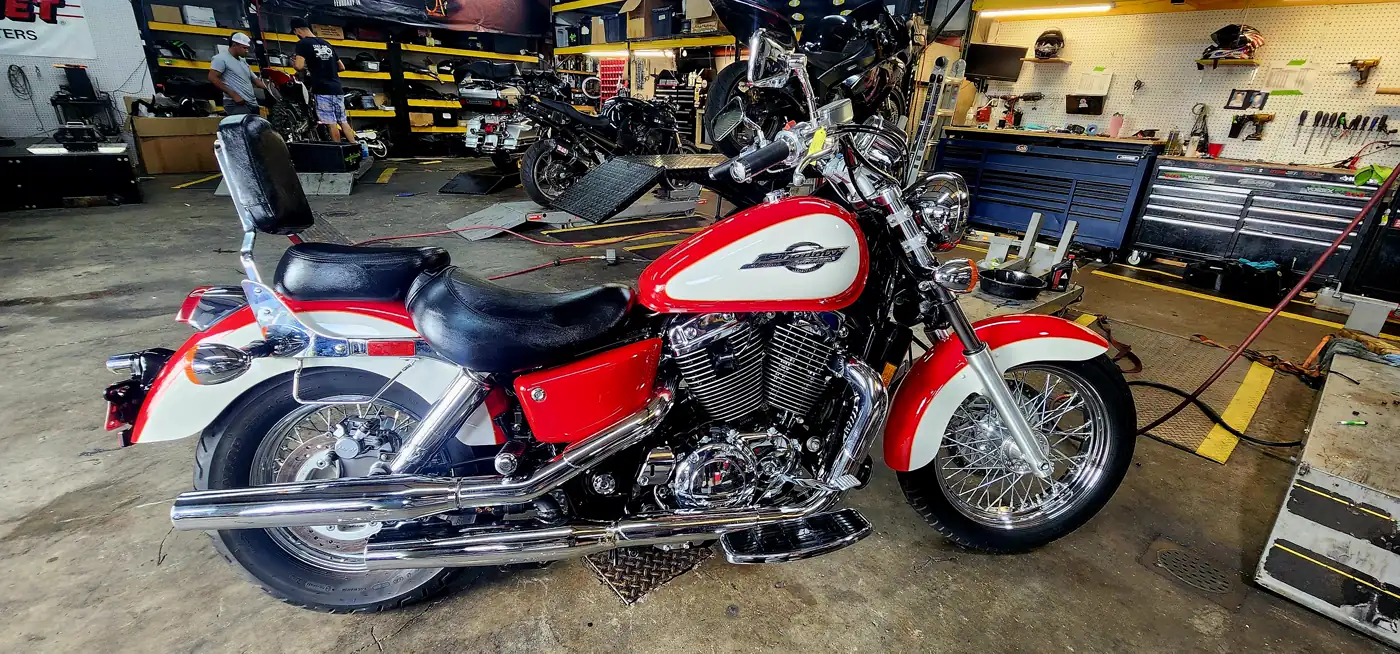
On the other hand most folks don’t walk in saying “I have chrome pitting.” They say the bike looks tired. So Up close, the mirror finish on the exhaust has gone a little cloudy. You run a fingertip over it, and instead of glass, you feel grit, almost like fine sandpaper. Then you spot them: little brown or orange dots, some no bigger than a pinhead, scattered right where the shine used to be perfect.
That’s the symptom, and it tends to show up first on the parts that take the most weather. Exhaust headers get it. So does the lower run of pipe near the road, along with handlebars, mirror stems, and the spokes if you’re running a wire wheel. What you’re really asking isn’t what to call it. You’re asking whether your bike is quietly rusting out on you, and whether you did something wrong. Both are fair questions, so let’s answer them straight.
The honest answer, in plain words
Chrome isn’t a solid metal on your bike. It’s a very thin layer of shiny plating over steel underneath. That layer is what gives you the deep, wet-looking reflection you can practically comb your hair in. As long as the plating stays sealed, the steel below never meets air or water. The trouble starts when that sealed layer gets a tiny break, and those breaks are usually too small to see.
Once moisture finds a pinhole, it reaches the bare steel and the steel starts to rust from the inside. That rust takes up more room than the metal it came from, so it swells and pushes upward against the plating. Eventually it breaks through as a little raised speck, and later as a tiny crater. That crater is a pit. String a bunch of them together and you’ve got pitting. So the honest answer is simple: pitting is rust escaping from beneath the shine, not dirt sitting on top of it.
Here’s why that matters. Early pitting is shallow. The dots are surface-level and a real detail can often polish most of it away. Deeper pitting is a different story, because the plating has actually lifted and the metal is compromised. You can smooth it and protect it, but you can’t magically grow the chrome back. Knowing which stage you’re at is the whole game, and it’s the first thing our team looks at.
What actually changes it
Pitting almost never comes from one villain. It’s a slow pile-up of small things, and here in Cobb County, those small things stack fast. From most common to least, this is usually the order we see.
- Moisture that sits. Water left on chrome after a ride or a rain, especially overnight, is the number-one cause. Georgia humidity means the air itself is damp, so even a covered bike in a carport breathes moist air all night.
- Hard-water spots. Our tap water carries a lot of minerals. When droplets dry on hot chrome, they leave crusty white rings that trap moisture against the surface and slowly eat in.
- Spring pollen. That yellow dust isn’t just messy. It’s mildly acidic, and left on the finish through a warm, wet week, it helps break down the seal.
- Road grime and brake dust. Fine grit sticks to warm pipes, holds water, and works like a tiny abrasive every time you wipe it off dry.
- Time and neglect. Chrome that never gets sealed simply loses the fight faster. Bikes stored under a tarp with no airflow are prime candidates.
- Harsh cleaning. Steel wool, gritty polishes, and scouring pads scratch through the protective layer and open the door for rust in the first place.
This is the point where a lot of riders make the wrong call. They see the first few spots, panic a little, and reach for the most aggressive thing in the garage. Steel wool. A drill wheel. A polish that promises to “cut” the rust off. It feels productive, and it does make the dots vanish for a weekend. But every one of those tools scratches the plating, which is exactly the wound that let rust in to begin with. You end up trading a few pits today for a rougher, faster-rusting surface next season.
Is it safe to ride like this?
Most of the time, yes. Cosmetic pitting on your exhaust, handlebars, or mirror stems is an appearance problem, not a safety one. Your bike runs the same, stops the same, and won’t leave you stranded because a pipe has a few rust freckles. If that’s all you’re seeing, keep riding and just get it looked at before it spreads.
There are a couple of spots where pitting stops being cosmetic, though, and this is the part worth taking seriously. Pitting on your fork tubes is one. Those shiny sliders have to glide through a rubber seal, and a rough, pitted tube tears that seal and starts a fork leak. Pitting or heavy rust on a wheel rim, a fastener that holds something structural, or anywhere near the brakes is the other. When rust is on parts that carry load or touch the braking system, that’s a stop-and-check situation, not a keep-riding one. A quick whole-bike once-over sorts it out fast, and it’s smart to eyeball your tires while you’re down there, since they’re the one part actually touching the road. If you want a plain-English rundown, Michelin’s motorcycle tire resources are a solid, no-hype place to start.
How we approach it
A real detail is a world apart from a wash, and that gap is exactly where chrome gets saved. A wash removes the dirt you can see. A detail removes what’s bonded to the surface, then corrects and protects it so the problem slows way down. When a bike comes in with pitting, we work in a set order rather than just attacking the shiny parts.
- Clean first, gently. We lift off pollen, hard-water crust, bug guts, tar, and brake dust with the softest thing that works, never the harshest. You can’t judge chrome you can’t see clearly.
- Read the pits. We check whether each spot is shallow surface rust or a deeper lifted-plating pit. That decides everything that follows.
- Polish, don’t grind. Shallow pitting gets a careful machine polish that removes the rust and brings the reflection back without cutting through good plating.
- Seal it. This is the step most people skip. A sealant or coating fills the microscopic gaps and keeps moisture off the steel, which is the whole reason pitting started.
- Protect the paint too. While we’re in there, paint correction knocks out swirls and light scratches, and a coating leaves the tank feeling slick and glassy under your palm.
That last piece is worth a word, because riders ask about it constantly. A ceramic coating is a clear, durable layer that bonds to chrome or paint and makes the surface easier to clean and far more water-hating. Rain beads up and rolls off instead of sitting and drying into spots. What a coating is not is a force field. It won’t stop a rock chip, and it isn’t scratch-proof, no matter what the internet promises. It buys you protection and easy cleanup for years, depending on how you care for it, and that’s plenty. If you’re curious about the full menu, here’s what our team handles, and if you’re weighing your options, this breaks down what changes the total before you ever bring the bike in.
The Smyrna piece of this
Geography matters more than riders think. Smyrna sits just outside I-285, minutes from Cumberland and the Battery, so a huge share of local bikes are daily commuters that live outdoors. New builds around Belmont Hills often have tidy two-car garages, and that helps a lot. But plenty of the classic ranch homes and the fast-growing townhome share near Market Village have carports, driveways, or open lot parking with no garage at all. A bike parked in the open breathes damp Georgia air all night, every night, and that’s the single biggest reason motorcycle chrome pitting Smyrna owners notice tends to show up here. It doesn’t matter whether you’re grabbing lunch at Muss & Turner’s or dropping the kids near Campbell High School; the bike sitting in the lot is soaking up the same humid air the whole time.
The seasons pile on, too. Tree pollen runs heavy from late February into May, with counts that regularly climb past 1,500 grains per cubic meter, coating every bike in acidic yellow dust. Then summer brings near-daily afternoon thunderstorms that soak the finish and dry it into hard-water spots by evening. Roads add their own grit, since Smyrna is a city of 1950s-era street grids under constant construction, meaning utility cuts, steel plates, and gravel tracked across the pavement that the state and county track through resources like Georgia DOT. A rider commuting from Oakdale toward Vinings Landing picks all of that up on the lower pipes without ever noticing. The same goes for a Sunday spin out to the Silver Comet trailhead on Mavell Road, or a longer run west toward Paulding and Polk counties by way of Dallas Highway; the miles are a blast, but the grit and damp come home with you.
Here’s the thing we wish every rider knew a season earlier. Pitting is almost always a storage-and-timing problem, not a bad-luck problem, so the season before it shows is the cheapest, easiest time to stop it. A rider in Bellhaven Chase who seals the chrome in early spring, before pollen season, spends a fraction of the effort of someone chasing rust in August. The Powder Springs crowd sees the very same pattern, and if you ride that way you’ll recognize exactly what Powder Springs riders run into out on their end of the county. We’d rather protect your chrome in March than restore it in September, every single time.
What you actually walk away with
When the pitting is caught early and the finish is sealed, the payoff is genuinely fun to see. The chrome goes back to that deep, liquid reflection, the tank feels slick and glassy under your hand, and the whole bike reads a step cleaner than the day it left the showroom floor. That’s not a sales line. A brand-new bike is clean, but it’s usually never been corrected or coated, so a properly detailed machine honestly outshines it.
There’s a practical side, too. A protected finish holds its value, which matters whether you’re keeping the bike for a decade or trading up next year. It also pairs naturally with custom paint, since the same correction-and-coating work that saves your chrome is what makes a fresh paint job stay showroom-slick for the long haul. And if the once-over turns up something mechanical along the way, that’s an easy hand-off, because you can see what the work covers on the repair side under the same roof.
So take a breath. Chrome pitting looks alarming, but it’s one of the most understandable problems on a bike, and it’s very fixable when you catch it before it goes deep. Look at your pipes this weekend. If you feel grit instead of glass, you now know what it is, what caused it, and that you can almost certainly still ride while you get it handled. Clear-headed beats worried every time.
Pitting is rust escaping from under the shine, not dirt sitting on top of it. Once you know that, the fix stops being scary.
CATCH IT EARLY
Run a finger across your exhaust and bars. Smooth as glass is healthy. Gritty and speckled means it’s time to clean, correct, and seal before pollen season stacks on more damage.
Questions Smyrna riders ask us
Could this be something other than chrome pitting?
Sometimes, yes. Baked-on hard-water spots, brake dust staining, or a thin film of oxidation can all look like pitting at a glance and wipe right off. True pitting feels gritty and stays put because it’s rust coming up from under the plating. A quick hands-on check tells the two apart in seconds, so don’t assume the worst until someone looks.
Is it safe to ride with chrome pitting?
Usually it is. Pitting on exhaust, handlebars, or mirror stems is cosmetic and won’t affect how the bike runs or stops. The exceptions are fork tubes, wheel rims, and anything structural or near the brakes, where rust can cause leaks or worse. If the pitting is only on shiny trim, keep riding and get it looked at soon.
What actually causes chrome to pit?
Moisture is the main driver. Water left sitting after rides or rain, dried hard-water spots, spring pollen, and road grit all break down the thin protective plating and let the steel underneath rust. Georgia’s humidity and daily summer storms speed the whole process up, which is why we see it so often around Smyrna.
Can I fix chrome pitting myself?
You can slow it down with gentle cleaning and a good sealant, and that’s genuinely worth doing. What we’d steer you away from is steel wool, drill wheels, or gritty “rust-cutting” polishes, since those scratch the plating and make the problem come back faster. Deeper pits need machine polishing and proper sealing to stop them for real.
Will chrome pitting get worse if I ignore it?
It will, and that’s the honest part. Rust doesn’t pause. Shallow surface pitting that could be polished away this spring can lift the plating and become permanent by the end of summer. Catching it early is dramatically easier than restoring it later, so the moment you feel grit is the moment to act.
Does ceramic coating stop pitting for good?
It’s a huge help, not a guarantee. A coating seals the microscopic gaps that let moisture reach the steel, and it makes the surface shed water and clean up easily for years, depending on care. What it can’t do is make chrome scratch-proof or undo rust that’s already deep. Think of it as strong, long-lasting protection rather than a permanent force field.
We take care of riders all across the west side of metro Atlanta, so Smyrna is right in our wheelhouse. From here we regularly help friends in Marietta, Vinings, Mableton, and Austell, along with folks rolling in from Powder Springs, Kennesaw, and Fair Oaks. We also see plenty of bikes from Atlanta proper, Buckhead, Sandy Springs, East Cobb, and Douglasville, because good detailing and honest chrome work are worth a short ride from just about anywhere in the county.
SAVE THAT SHINE BEFORE IT SPREADS
If your Smyrna bike is showing those first little rust freckles, don’t wait for pollen season to make it worse. Text us a photo of the spots and we’ll tell you straight whether it’s a quick polish-and-seal or something deeper. We’ll get your chrome back to a reflection you can comb your hair in, and keep it that way through the whole Georgia summer.
470-460-9883Diaz Motorcycles and Service, LLC · 847 Barnes Mill Road, Marietta, GA 30062