Motorcycle Diagnostics Peachtree City — Why It Happens
Your bike is telling you something. Here's how to read it, what it usually means, and when it can wait.
Late March hits and the yellow dust shows up on everything. Cars, mailboxes, the seat of a bike that sat all winter under a cover. That’s the week our phone starts ringing, because that’s the week riders across PTC pull the cover off and find out the bike doesn’t feel the way they left it. It cranks slow. It idles funny. Something ticks that didn’t tick in November. Spring is the season that turns quiet little problems into loud ones, and it’s why motorcycle diagnostics Peachtree City riders ask about almost always start with the same sentence: it was fine when I parked it.
Here’s the good news up front. A bike that sat still didn’t break. It changed. Fuel aged, a battery drained, a filter loaded up with pollen, moisture found a low spot. Those are all knowable things with known fixes. You’re not staring down a mystery. You’re staring down a short list, and we’re going to walk it with you.
What you're really asking
When someone calls us in April, the question they say out loud is usually “what’s that noise?” But the question under it is different. The real question is: am I about to ride something that’s going to leave me on the shoulder, and how bad is this going to be? That’s fair. Nobody wants to find out on a Saturday morning halfway to breakfast.
So let’s answer the real one. Most spring symptoms fall into a handful of buckets, and the ones that show up first are usually the mildest. The scary-sounding stuff is rarer than you’d think. Your ears are not lying to you, but they’re also not a diagnosis. A tick can be a valve. A tick can also be a loose heat shield rattling against a header, which costs you about ninety seconds with a wrench and gives you a great story.
The honest answer: the usual causes, most common first
Let’s describe these the way you’d actually experience them, not the way a service manual would. If one of these sounds like your bike, you’re probably in the right neighborhood.
It cranks slow, or clicks, then nothing
This is the number one spring call and it’s almost always the battery. A motorcycle battery that sat four months without a tender doesn’t die dramatically. It fades. You’ll get one strong start, then a lazy one, then a click. Charging system parts can cause the same thing, so we test both rather than guessing. If you want the version of this that goes deep on symptoms, it’s worth reading what Kennesaw riders run into, because the pattern travels.
It starts, then idles rough or stalls at a light
Old fuel is the usual culprit. Gas that’s been sitting since fall loses its lighter fractions and leaves behind varnish in tiny passages. On a fuel-injected bike, you’ll feel it as a stumble off idle. On anything with carbs, it can be a full-on refusal. Pollen plays here too, because a loaded air filter changes how the engine breathes, and a bike that breathes wrong runs wrong.
The brakes feel wooden, or the lever comes back too far
Brake fluid pulls in moisture over time. Sitting doesn’t help it. You’ll notice a spongy lever or a first-pull that feels far away. Meanwhile, a bike parked on the same spot for months can develop a light surface rust film on the rotors, which feels like a scrape for the first block and then clears.
Tires feel weird in a corner
Cold-set flat spots, low pressure, or rubber that’s simply aged out. Rubber has a shelf life whether you ride it or not. Date codes matter more than tread depth on a low-mileage bike, and if you want a straightforward primer, Michelin’s motorcycle tire resources lay out how to read them.
Chain noise, or a clunk when you roll off
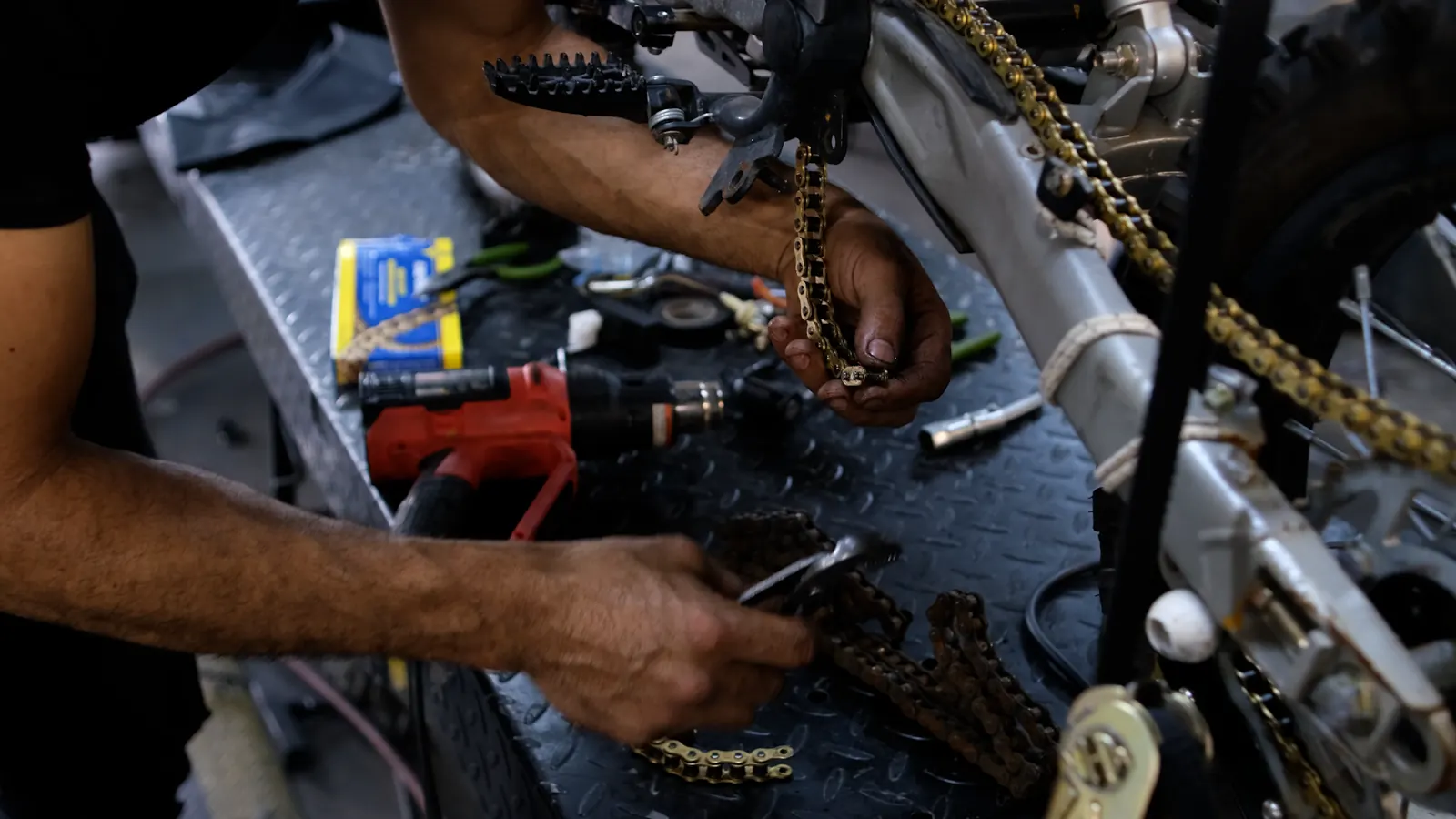
A dry chain after storage will sing at you. Tight spots, uneven slack and a worn sprocket all announce themselves the same way, so we measure instead of eyeballing it.
- Slow crank or click — battery first, charging system second
- Rough idle or stall — stale fuel, clogged filter, dirty injectors or jets
- Spongy lever — old brake fluid, glazed pads, surface rust on rotors
- Odd feel in a turn — tire pressure, tire age, flat-spotting
- Noise from the drive side — dry or worn chain, worn sprockets
RIDE OR DON'T
Ride it if it’s cosmetic, mildly noisy, or a slow-crank you’ve already recharged. Don’t ride it if the brake lever goes soft, if you smell fuel, if a tire is losing pressure overnight, or if a noise changes with engine speed and keeps getting louder. Those four are trailer-it days, and that’s the whole list.
There's a second failure that hides behind the first one
Here’s the part most people miss, and it’s the reason a bike sometimes comes back a month later. The first symptom you notice is often a passenger, not the driver. A dead battery gets replaced, the bike fires up, everybody’s happy. Then it dies again in June, because the real problem was a stator that stopped charging properly and the new battery was just running down its savings account.
Same story elsewhere. A dry chain that ate itself usually took a sprocket with it. Stale fuel that gummed an injector often left a fuel filter that’s half-plugged. Rough idle from a pollen-packed filter can mask a vacuum leak that’s been there since last season. So when we find the obvious thing, we don’t stop. We ask what caused the obvious thing, and then we check whether that cause left anything else behind.
Fix the symptom and you get a good week. Fix the cause and you get a good season.
That second look is the entire difference between a repair and a real diagnosis. If you like the mechanics of how that thinking works, our writeup on what the work covers walks through the order pros use to isolate a fault instead of chasing it.
What changes the picture
Two bikes with the same noise can need completely different work, and the variables are pretty predictable. How long it sat. Whether it was on a tender. Whether the tank was full or half-empty, since a half-empty tank sweats inside. Mileage, age, and whether anything aftermarket is in the mix. A bike wearing a slip-on exhaust, for example, has more clamps and shields to rattle than a stock one, and those rattles fool a lot of good ears.
Parts availability matters too, especially on older or European machines. A Guzzi or a mid-2000s Ducati may need a part that takes a few days to land, while a Goldwing or a Harley bagger usually doesn’t. None of that is a surprise once we’ve had eyes on the bike, and we’ll always tell you the shape of it before we start. If you want the full breakdown of what changes the total, we wrote that out separately so there are no mystery lines.
How we actually run a diagnosis
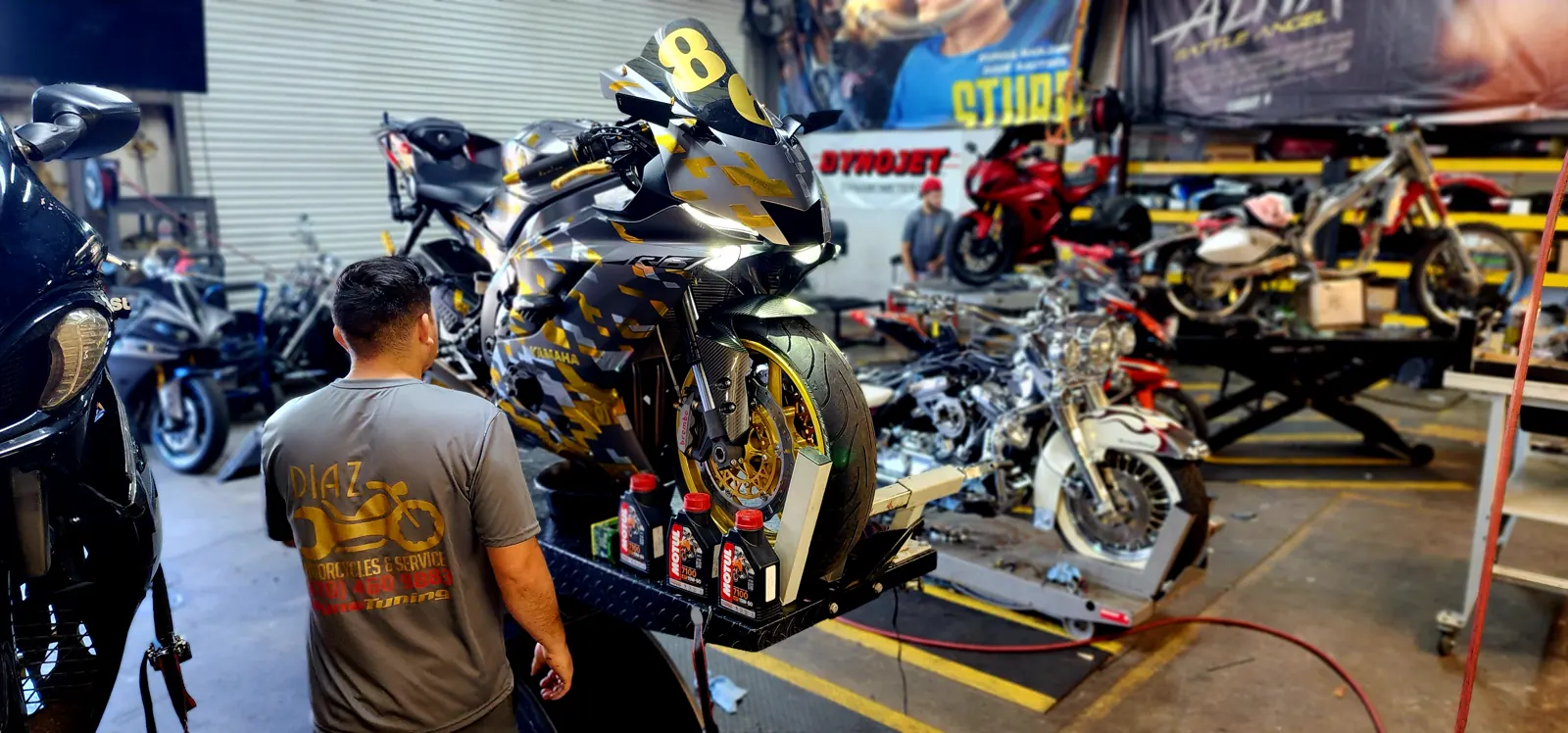
Good motorcycle diagnostics Peachtree City riders can rely on is boring on purpose, because boring is repeatable. Guessing is exciting and expensive; a checklist is neither.
- We listen to you first. What you felt and when you felt it narrows the field faster than any tool.
- We reproduce the symptom. If we can’t make it happen, we don’t call it fixed.
- We test the cheap and common stuff before the deep stuff — battery, charging, fuel, filters, plugs.
- So we put a scan tool on it where the bike supports one, and read the codes plus the live data behind them.
- We check what the failure touched, so the second failure doesn’t become next month’s phone call.
- We call you with what we found in plain words, and you decide what happens next.
That’s it. No drama. You can see how our crew approaches it in more detail on the repair page, but the short version is that we’d rather spend an extra hour finding the cause than have you spend a Saturday finding it for us.
Peachtree City has its own way of doing this to a bike
This town is not like the rest of metro Atlanta, and the bikes show it. There’s no motorcycle shop inside the city limits, so every rider here already drives out of town for service — that objection about who’s closer doesn’t really exist. What does exist is a garage culture. Bikes here live indoors, covered, often on tenders, in two- and three-car garages from Aberdeen to Braelinn to the lakefront homes out on The Peninsula. They’re not commuters. With more than a hundred miles of golf cart paths handling the short trips, the bike in the garage is a hobby, and hobby bikes get ridden in bursts.
Bursts are exactly what expose storage problems. A bike that runs twenty minutes to Braelinn Village and back never gets hot enough to burn moisture out of the oil. Then one perfect Saturday it gets a real ride, and everything that was hiding shows up at once.
The roads add their own flavor. PTC was designed without a grid on purpose, so those long curvilinear streets sweep instead of turning square. They’re beautiful. They also have limited sight lines and heavy tree canopy, and dappled light and shadow will hide a pavement defect until your front wheel finds it. Add shade-held moisture, wet leaves, acorns and sap near the greenbelt around Flat Creek Nature Area, and you get a place that’s genuinely hard on tires, brakes and suspension bushings even at modest speed. Georgia DOT keeps the surfaces in good shape here; the canopy is the part nobody can pave away.
Picture the version of this where you caught it early
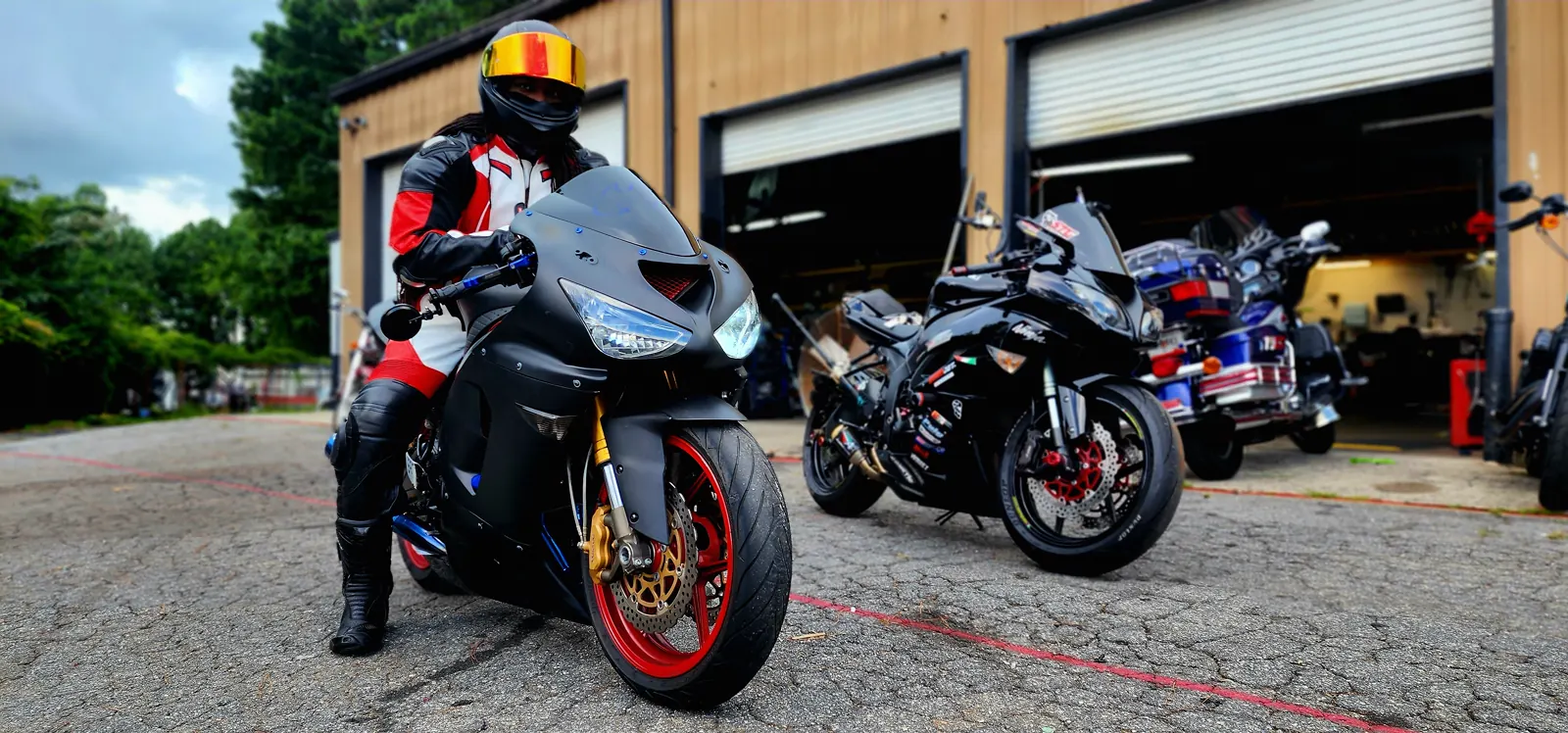
It’s the first warm Saturday. You roll out of the garage, take the twenty-minute run southwest to Senoia, park on the square, get a coffee and talk to two strangers about your bike before you finish it. Nothing ticks. The brakes bite exactly where you expect. You ride home the long way through the shade, and the only thing on your mind is where to go next weekend.
That version costs you one phone call in March. The other version costs you a Saturday. That’s the whole trade, and it’s why we push pre-season checks so hard around here rather than waiting for something to break.
Plenty of riders in Fayette County also use Cycle Specialty over in Fayetteville, about fifteen minutes away, for Yamaha sales, parts and service — good people to know. Our lane is different. We’re the shop you come to for deep diagnostic work, restoration, custom paint and the kind of finish work that nobody in the county specializes in. The ride to us in East Cobb is roughly 48 to 56 miles and usually somewhere around an hour to an hour and a half, estimated from the road geography, and honestly most of our PTC friends never make that drive. We pick the bike up.
What you walk away with
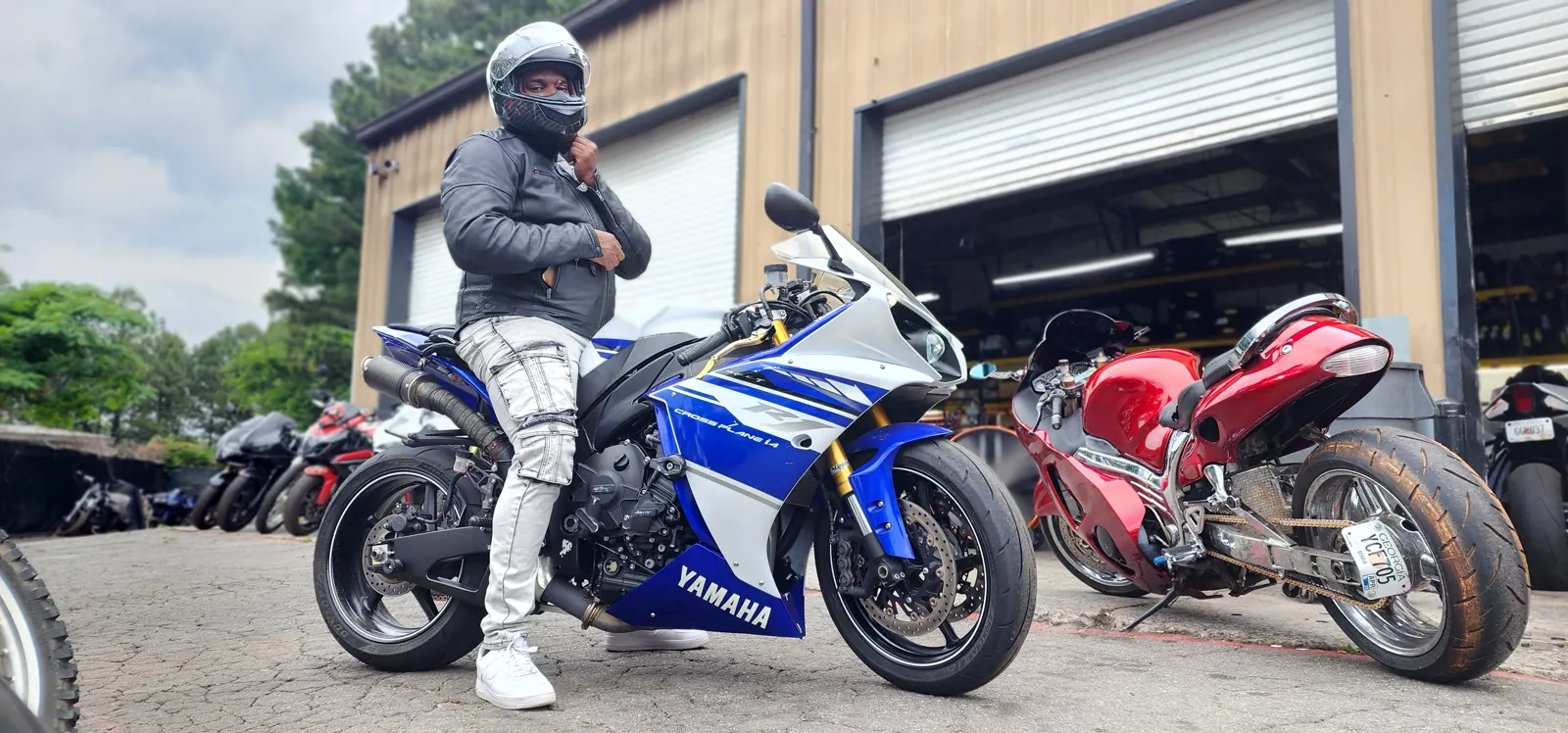
Here’s the outcome we’re actually after. Not just a fixed bike — a rider who knows their machine. When you can hear a noise and say “that’s a heat shield, not a valve,” you’ve earned something. When your battery is on a tender in November because you decided that’s how you do it, your bike in April is going to reward you for it. That’s not luck. That’s you taking care of a nice thing well.
Bikes in this town look good because their owners are the type to keep them that way. Getting the mechanical side to match the cosmetic side is a short walk from where most PTC riders already stand. So bring us the symptom, even the vague one. Especially the vague one. We’ll tell you what it is, whether it can wait, and what it’ll take — and then you get to go enjoy the thing you’ve been taking care of all along.
Questions Peachtree City riders ask us
Will it get worse if I keep riding?
Usually yes, and usually slowly. Most spring symptoms are wear or storage effects that keep moving in one direction. The exceptions are brakes, tires and fuel smells, which can go from annoying to serious fast. If it’s one of those three, park it and call.
How urgent is this, really?
Think in three tiers. Cosmetic and cold-start quirks can wait a few weeks. Rough running, chain noise and weak charging should get looked at within a ride or two. Brakes, tires, leaks and any noise that grows with engine speed are same-week items, no debate.
What happens if I just ignore it?
The common outcome isn’t a breakdown, it’s a bigger repair. A worn chain takes the sprockets. A weak charging system cooks a new battery. A dragging brake eats a pad and then a rotor. Ignoring it rarely makes it dangerous overnight; it just makes the eventual fix bigger than it had to be.
How do you find the cause instead of guessing?
We reproduce the symptom first, then work from most common to least. Battery and charging get tested, not assumed. Fuel and air get checked. Where the bike supports a scan tool we read codes plus the live data behind them, because a code tells you where to look, not what’s wrong.
Could it be something totally different than what I think?
Often, and that’s a good thing. Ticks turn out to be heat shields. Rough idle turns out to be a pollen-packed filter. Riders regularly brace for the worst and leave with something simple. We’d rather find the easy answer than sell you the hard one.
Do I have to ride it up to Marietta?
No. Most Peachtree City riders have us pick the bike up, especially anything that’s questionable to ride. Transport is a normal part of how we work with Fayette County customers, not a special favor.
We take care of riders all over the south side and beyond. Along with Peachtree City, we work with folks in Fayetteville, Tyrone, Brooks and Woolsey, plus Newnan, Senoia and Sharpsburg over in Coweta County. North of there we help riders in Fairburn, Union City and Palmetto, and east toward Jonesboro and Riverdale. If your bike lives anywhere in that stretch, getting it to us is a phone call, not a project.
TELL US WHAT IT'S DOING
Got a noise, a stumble, or a bike that just doesn’t feel right after sitting all winter? Describe it to us in your own words — you don’t need the technical term. We’ll tell you what it likely is, whether it’s safe to ride, and how we’d sort it out. Peachtree City riders get pickup and delivery, so the bike comes to us and goes home clean. Call or text Diaz Motorcycles and let’s get you back out there.
470-460-9883Diaz Motorcycles and Service, LLC · 847 Barnes Mill Road, Marietta, GA 30062