Motorcycle Not Starting Kennesaw — Causes & Fixes
The sounds your bike makes, what each one means, and when it's still safe to ride.
A friend of ours rolled in here after a rough morning. He’d pushed his bike into another shop first, and the guy at the counter barely looked up. So he got a sigh, a shrug, and a line about how these things just happen. Then he left with the same dead bike he walked in with. Here’s the thing, though: a motorcycle not starting Kennesaw riders can’t explain isn’t a mystery. It’s a clue, and clues are easy to follow once somebody actually bothers to look.
We see this all the time, so we can tell you plainly that it’s almost never the scary thing you’re picturing. Bikes don’t quit at random, because something stopped doing its job and left fingerprints everywhere. By the end of this, you’ll know what your bike is telling you, which causes to check first, and when it’s fine to ride.
First, describe it the way you actually feel it
Nobody walks in and says “my starter solenoid is chattering.” You say “it went click,” and honestly, that’s perfect. In fact, that plain description is the most useful thing you can hand us, because every one of those sounds points at a different part of the bike.
- Dead quiet — no click, no dash lights, no fuel pump hum.
- One loud click, then silence, and a dash that dims as you press.
- Fast machine-gun clicking, like a card stuck in the spokes.
- A slow, tired crank that gives up after a few turns.
- Strong cranking that never actually catches.
- A half-second of firing, then a stumble back to nothing.
- Fine last weekend, but after sitting all week it won’t.
Every one of those points somewhere different. Dead quiet usually means power isn’t getting through, while a single click means the starter got the message but has no muscle behind it. Strong cranking with no catch? Then the electrical side is likely fine, so we go look at fuel and spark instead. See how fast that narrows things down?
WRITE IT DOWN
Before you call anybody, note three things: the exact sound, the weather that morning, and how long the bike had been sitting. Because those details cut diagnosis time way down.
Why bikes quit — the common causes, most common first
1. The battery, and it's not close
The battery sits at the top of this list, and nothing else is even nearby. Motorcycle batteries are small, plus they live a hard life. Heat cooks them in July, short hops never fully recharge them, and a bike that sits quietly drains itself. So a battery that felt strong in April can be done by August. Good news? This one is usually a same-visit fix.
2. The charging system
Sometimes the battery is only the victim. Stator and regulator problems show up often on bikes that run hot in stop-and-go traffic, and they’ll kill a brand-new battery in a couple of weeks. That’s why we test charging output before we hand anybody a new battery. Otherwise you’d just be right back here.
3. Old fuel and a gummed-up fuel system
Gas goes stale much faster than people expect. On a bike that’s sat since the holidays, fuel turns to varnish and clogs the tiny passages in a carb, or it plugs an injector’s filter. Then the engine cranks beautifully and never catches. Since January and February are quiet months here, we get a wave of this every warm Saturday in spring.
4. Spark
Plugs foul, coils get weak, and plug caps corrode. Weak spark usually shows up first as hard starting on cold mornings, and only later as a full no-start. Also, a bike stored outdoors under a cover collects moisture, and moisture loves sneaking into caps and connectors.
5. Safety switches and the little stuff
Here’s the fun one. Kickstand switch, clutch switch, neutral switch, kill switch, or a blown main fuse — any of them can stop a healthy engine cold. And we’ve all bumped a kill switch while wrestling a cover off, so there’s no shame in it. Honestly, it’s a great day when that’s the whole problem.
Now flip it around and look at it from the bike's side
Your bike isn’t being difficult on purpose, because it’s just following rules. An engine needs three things to start: enough electricity to spin, fuel in the right amount, and spark at the right moment. Take any one of those away and it stops. So that’s the entire mystery, start to finish.
Once you see it that way, though, the panic drains right out of the situation. There’s no curse and no lemon, just a short chain of simple parts with one loose link.
A bike that won't start isn't broken in some deep way. It's just missing one of three simple things.
How we actually find the cause
We work the same order every time, with the quickest checks first. That order matters a lot, because it means nobody pays for hours of hunting around in the dark.
- Listen to it with you there, since your words plus the sound tell us plenty.
- Test the battery under load, because one can read fine at rest and still collapse when the starter pulls.
- Check charging output at idle and at rpm, so we know if the battery is the cause or the casualty.
- Check grounds, the main fuse, and connectors that corrode on bikes stored outdoors.
- Pull a plug and test for spark, because its color tells a story.
- Check fuel delivery, and whether the gas smells like gas or like varnish.
- Only then go deeper, into sensors, stator testing, or compression.
That’s the boring, reliable version, and boring is exactly what you want here. Then we call you before anything gets replaced, and we explain what we found in plain words. If you’d like the longer look at how we handle a job start to finish, here’s what that service actually involves.
What the fix usually involves
Most no-starts end simply. A battery and terminal service, a stator or regulator swap, a fuel system clean, a set of plugs and caps, or one stubborn switch — that covers the big majority of what rolls through the door. None of it takes forever, and most of it is same-week work.
Fuel system work takes more patience, because varnish doesn’t rinse off. Still, once the bike is running again, we can check how it’s actually breathing under load. For bikes that need real tuning after a rebuild, tools like Dynojet’s dyno center exist for a reason, though plenty of bikes never go that far.
We’ll also tell you honestly when a job isn’t worth doing on a particular bike. Kennesaw skews younger than much of Cobb because of KSU, so we see plenty of first bikes and half-finished garage projects. You can see everything we cover if you want the wider list.
When it's safe to ride, and when it really isn't
Let’s be clear about this part, because it matters more than anything else on this page. A bike that’s hard to start is sometimes fine, and sometimes it’s a strand waiting to happen. So here’s how we sort it.
- Probably fine: it fired first try and charging tests good, so ride it, but get the battery load-tested soon.
- Ride it straight to a shop: it needed a jump but runs steady and the lights stay bright.
- Don’t ride it: your headlight dims as you rev, or the bike died while moving, or it’s needed two jumps this week.
- Don’t ride it, part two: you smell raw fuel, or it backfires hard while you’re trying to start it.
- Never push-start into traffic on Barrett Parkway, because that corridor is signal-dense with heavy turning traffic and one of the highest-risk surface streets for riders here.
If your bike quits and you’re stuck somewhere, get off the road, put something solid between you and traffic, and call. We’d much rather talk you through it than hear about a close call afterward. And if you’re newer to riding, the MSF rider courses are worth giving up a weekend for.
Kennesaw is hard on bikes in a very specific way
Kennesaw really has two kinds of bikes, and they fail in two different ways. Out in Legacy Park — 117 acres with a 7-acre Town Green, four pools, eleven tennis courts, disc golf and an amphitheater — bikes live in dry garages. Same story at Pinetree Country Club, where about a thousand homes built from the 1970s onward sit on big lots around an 18-hole championship course next to KSU. So those bikes are stored beautifully, but they also sit, and sitting is its own kind of wear.
Then there’s the apartment corridor near campus, where bikes live outdoors under covers all year. Those get ridden more, so weather goes to work on connectors, plug caps and battery terminals instead. Meanwhile, in the subdivisions off Due West Road, most folks land somewhere between those two worlds.
Traffic plays a part too. Georgia doesn’t allow lane splitting, so a Kennesaw commuter sits in the I-75 grind with everybody else. Clutches, brakes, cooling systems and chains all wear faster, plus an air-cooled engine heat-soaks in July until the battery bakes.
Road surface matters more than people think. Cobb DOT is building a six-year resurfacing plan funded largely by 2022 SPLOST revenue, which is good news. Still, older rural-origin roads like Stilesboro, Due West, Big Shanty and Old 41 were widened and patched over decades, so they carry uneven seams, sunken utility cuts and shoulder drop-offs. Construction along Barrett Parkway adds steel plates and loose gravel, and the railroad tracks downtown get slick when wet and crossed at an angle. All that shaking loosens connectors, which is a sneakier no-start cause than riders expect.
Downtown is worth a slow roll anyway. Main Street’s restored historic core has dining and retail, plus the Kennesaw Farmers Market runs April through September. The Southern Museum of Civil War and Locomotive History sits right there too, home of The General, the locomotive from the 1862 Great Locomotive Chase.
And of course, the whole reason you own the thing is the good stuff. I-575 puts Kennesaw riders far closer to north Georgia twisties than anybody in south Cobb, so there’s a real weekend riding culture here. Closer to home, Burnt Hickory Road is part of that rolling northwest Cobb loop.
There's a detail in all this that changes how you'll ride out of here
Here’s the detail: almost every no-start we see gave a warning first. A lazy crank on a cold morning. Headlights that dip at a red light on Barrett Parkway. Those signs are small, so they’re easy to wave off, but they’re the entire warning you get.
So the real fix isn’t only swapping a part. It’s rolling out with the weak link gone, and knowing which sound to listen for next time. That’s why we walk you through what we found instead of just sliding your keys across the counter.
If you’d rather stay ahead of it, February is the smart month. Kennesaw riders start early, so a pre-season check before the first warm Saturday means you’re out riding while everybody else waits their turn. Here’s the full rundown on it.
Getting here from Kennesaw
We’re in Marietta, roughly 11 to 14 miles out, so figure 22 to 30 minutes. You can run I-575 to I-75 south and come over on Roswell Road, or take Barrett Parkway east to Sandy Plains and then Roswell Road. And yes, we know your bike might not be making that trip under its own power right now, which is completely normal.
If you want something closer for a quick look, Acworth Cycle & ATV and Small Engines at 4648 S Main St in Acworth handles motorcycle, ATV and small-engine work about 12 minutes away. And we’d rather point you somewhere useful than pretend we’re the only shop on the map. Still, serious work already leaves Kennesaw for somebody, so what you’re shopping for is capability, not distance.
This isn’t a Kennesaw-only headache, either. The riders over in Dallas hit the same wall every spring, for the same handful of reasons. Bikes are bikes, and heat, sitting and stop-and-go traffic don’t care about the city limit sign.
What it feels like once it's sorted
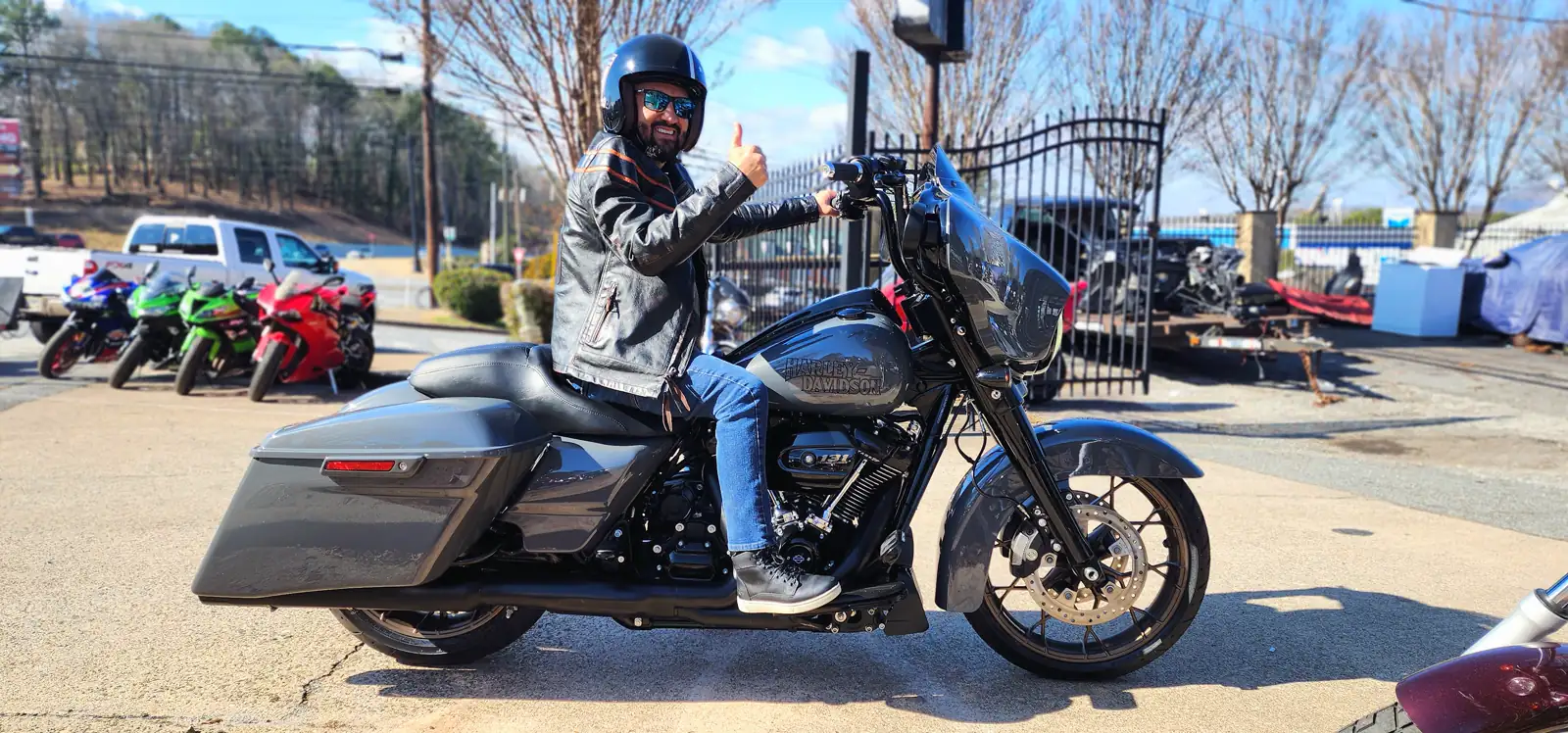
The best part of this whole job is the walk-out. You hit the button, it lights right up, and then you feel a little silly for worrying about it all week. That’s the goal every time, so we do the boring testing up front.
You’ll get the same story we’d give a buddy: what failed, why, and what to watch for. No sighing, no shrugging, and no talking down. So you came in with a motorcycle not starting Kennesaw heat and traffic had been beating on for months, and you leave with a bike you’d trust on Burnt Hickory Road at eight in the morning.
Big Shanty riders have been tinkering and getting back out there for a very long time, and your bike keeps that streak going. Honestly, it’s usually a smaller fix than you’ve been quietly dreading.
Questions Kennesaw riders ask us
How urgent is a bike that won't start?
It depends on whether it’s a one-time thing or a pattern. A single slow morning after the bike sat is usually just a tired battery, so it can wait a few days. But if it’s happened twice in a week, treat it as urgent, because that’s normally the charging system going and it will strand you somewhere.
What happens if I just keep jumping it and ignore the problem?
Jump-starting works for a while, so it’s tempting. However, every jump on a failing charging system puts more heat into a battery that’s already cooked, and it can take out other electrical parts with it. Also, a bike that dies while moving is a much bigger deal than one that dies in the garage. Get it tested and be done with it.
How do you actually find the cause?
We start with the fastest checks and work down. Battery under load, then charging output, then grounds and fuses, then spark, then fuel delivery. Only after all that do we go into sensors or compression. So that order means we usually know what’s wrong before you’ve finished your coffee.
Could it be something other than the battery?
Definitely, and often it is. Stale fuel, a weak coil, a corroded plug cap, a kickstand or clutch switch, or a blown main fuse will all stop a healthy engine cold. That’s exactly why we test instead of guessing, because a new battery on a bad stator is just a delay, not a fix.
Is it safe to ride while it's doing this?
Sometimes, yes. If it started on the first try and the lights stay bright while you ride, then you’re okay to get it somewhere for a check. But if the headlight dims as you rev, or the bike has stalled while moving, don’t ride it. Definitely don’t push-start it into traffic on Barrett Parkway.
My bike sat all winter and now it cranks but won't catch. What is that?
That’s the classic February call, and it’s almost always fuel. Gas goes stale and turns to varnish, which clogs carb passages or an injector filter. Since the electrical side is clearly working if it cranks strong, we go straight to the fuel system, and most of those bikes are running again quickly.
We take care of riders all over northwest Atlanta, starting right here in Marietta and running out to Kennesaw, Acworth, Woodstock and Powder Springs. Plenty of our friends ride in from Dallas and Hiram to the west, plus Cartersville and Emerson up the interstate. We also see a steady stream from Canton, East Cobb, Smyrna and Mableton. So wherever you park it at night, the trip over is usually shorter than you’d guess, and we’re happy to talk through a no-start before you load the bike up.
LET'S GET IT RUNNING
If your bike won’t wake up, don’t sit on it and hope. Text or call us, tell us the sound it makes and how long it sat, and we’ll tell you what it’s probably doing before you even leave Kennesaw. Then we’ll get it tested, get it fixed, and get you back on Burnt Hickory Road where you’d rather be.
470-460-9883Diaz Motorcycles and Service, LLC · 847 Barnes Mill Road, Marietta, GA 30062