Motorcycle Maintenance Smyrna — What It Costs
What a real service includes, how we figure out what's wrong before we quote you, and why catching the small stuff early keeps the bill small too.
At the same time you’re rolling north on Atlanta Road, the engine finally warm, and the bike does something it didn’t do yesterday. As a result Maybe the front end shivers a hair under braking. On the other hand Maybe the chain ticks dry underneath the exhaust note. Nothing dramatic. Just different. So that little flag in your gut is the whole reason motorcycle maintenance Smyrna riders can actually trust is worth having. Small problems talk first, and they talk quietly. Answer them while they’re still whispering and the fix stays simple, fast, and a lot friendlier than the alternative.
Most riders who call us already knew. They felt it a week before they picked up the phone. They just weren’t sure whether it was a real thing or a “bikes kinda do that” thing. So here’s the plain version: if the bike changed, something changed. Bikes don’t get moody. They wear, they loosen, they dry out, and they warn you in small ways before they warn you in big ones. Our job is to translate that into something you can act on without guessing.
The small stuff you feel first
The earliest signs are almost boring. A brake lever that pulls a little farther than it did in the spring. A chain that needs adjusting more often than it used to. Tires that feel fine in a straight line but vague and lazy through a turn. Oil that’s gone from honey to coffee. A cold start that takes one extra second of cranking. None of that strands you today. All of it is your bike raising a hand and asking for a minute of your time. The trick is noticing while the sign is still small, because small signs are polite and cheap. Big ones show up on a shoulder somewhere with your hazards on.
Here’s the good part. Every one of those is a short conversation right now. A chain and sprocket set caught early is a straightforward afternoon. That same chain, ignored until it chews the rear sprocket teeth into little shark fins, means more parts and more labor. One problem, two very different repair tickets. That gap between early and late is basically the whole argument for staying on top of service.
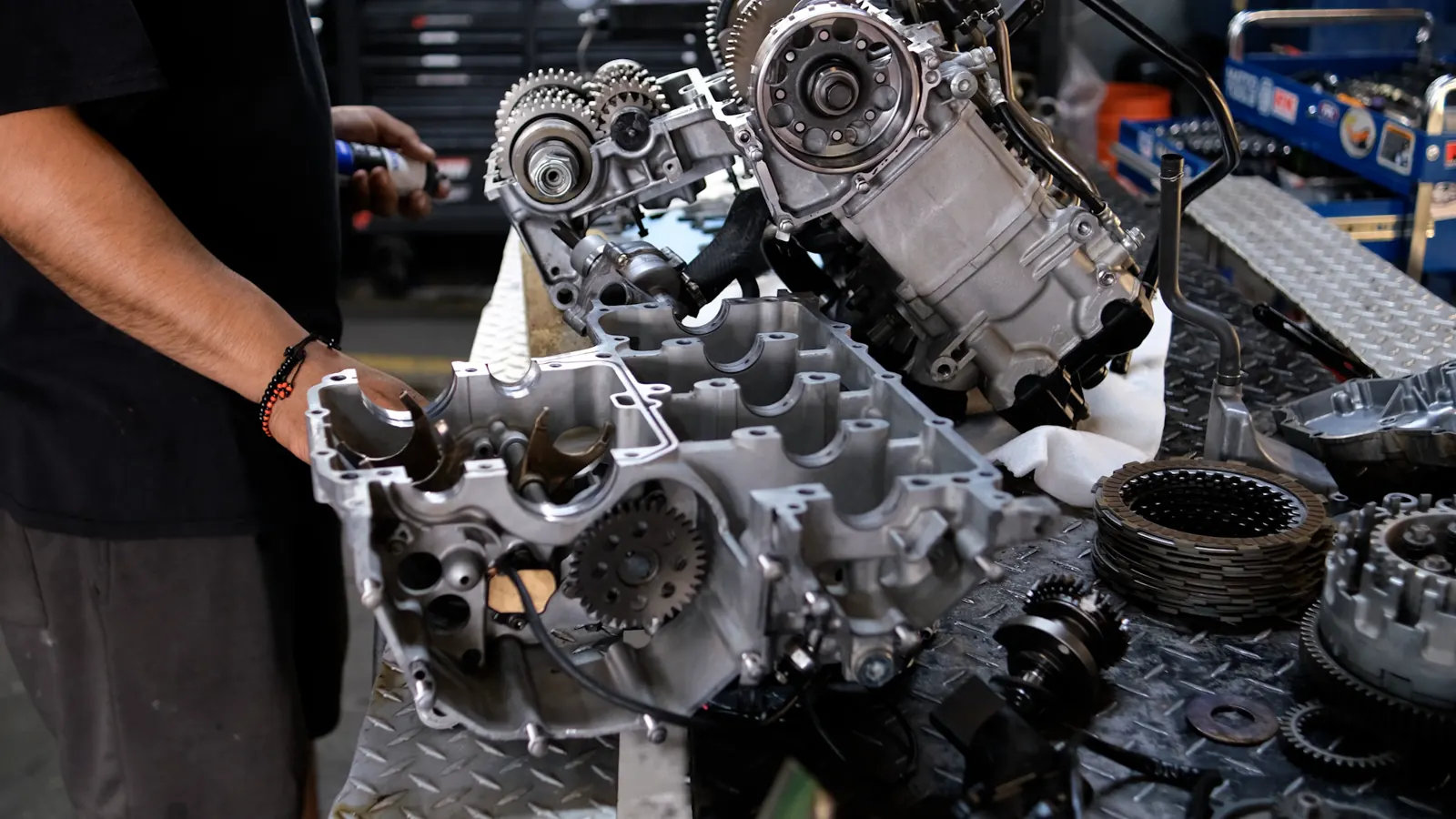
Catching it early isn't about being fussy. It's about paying for one part instead of three.
Why it happens faster in Smyrna
Smyrna riders actually ride, and that’s the first thing worth saying out loud. This is the most commuter-heavy rider market we serve. You sit right outside the perimeter with Cumberland, The Battery, Buckhead and Midtown all a short hop away, so a fifteen-minute ride to the office beats circling a deck looking for car parking. Bikes here pile up trips instead of highway miles. Georgia doesn’t allow lane splitting either, so your bike sits in the same stop-and-go heat a car does, working the clutch, the pads, the chain and the cooling system the entire time.
Short trips carry a quieter cost too. A fifteen-minute ride often never gets the engine all the way hot, which means moisture never fully burns out of the oil and the crankcase. Do that five days a week and you end up with damp oil, corrosion working on the exhaust, and a battery that never quite finishes charging before you shut it off. Then you wonder why it cranks slow on the first cool morning of October. We put together a longer piece on why that problem shows up on commuter bikes, and what it looks like once we’re inside the engine.
Pavement matters as well. Smyrna is a 1950s and 60s street grid living under constant teardown and rebuild, so you get utility cuts, steel plates, gravel tracked off job sites, and more manhole covers, metal grates and painted crosswalks per mile than anywhere else we cover. Every bit of that goes slick after one of our near-daily summer thunderstorms, and every bit of it hammers suspension, tires and wheel bearings. Anybody who loops down toward Mavell Road, where the Silver Comet Trail’s eastern trailhead sits, crosses plenty of it on the way out and back.
How we figure it out before we quote you
The internet will tell you one thing. The bikes tell us another. Forums love hard numbers, and they’ll swear you must change this at exactly that mileage. Real bikes don’t read forums. Your owner’s manual sets your service intervals, and it’s the only mileage figure worth trusting for your specific machine. What we add is the part a manual can’t know: how you ride, where you park it, and what a Georgia July does to an engine that never fully warms up.
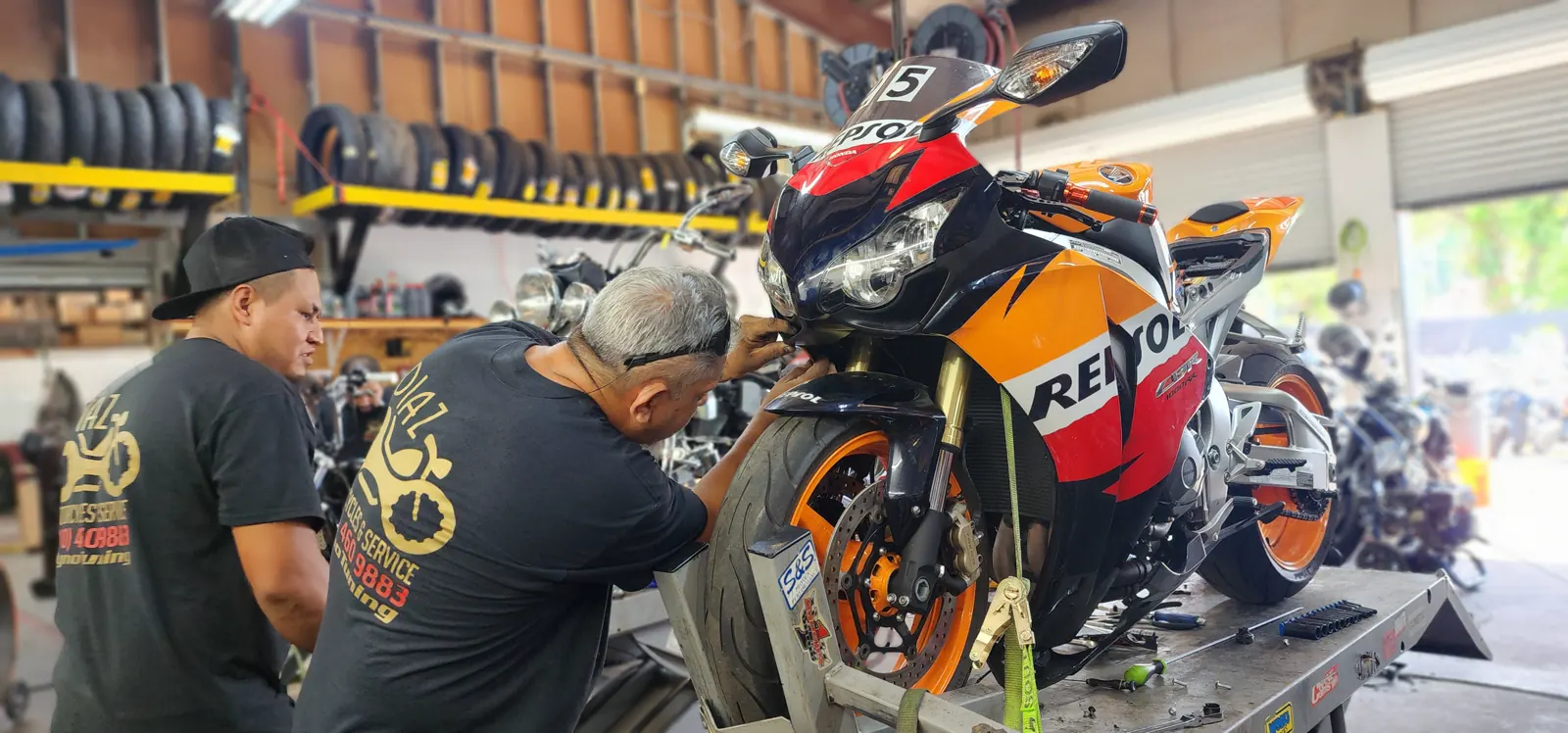
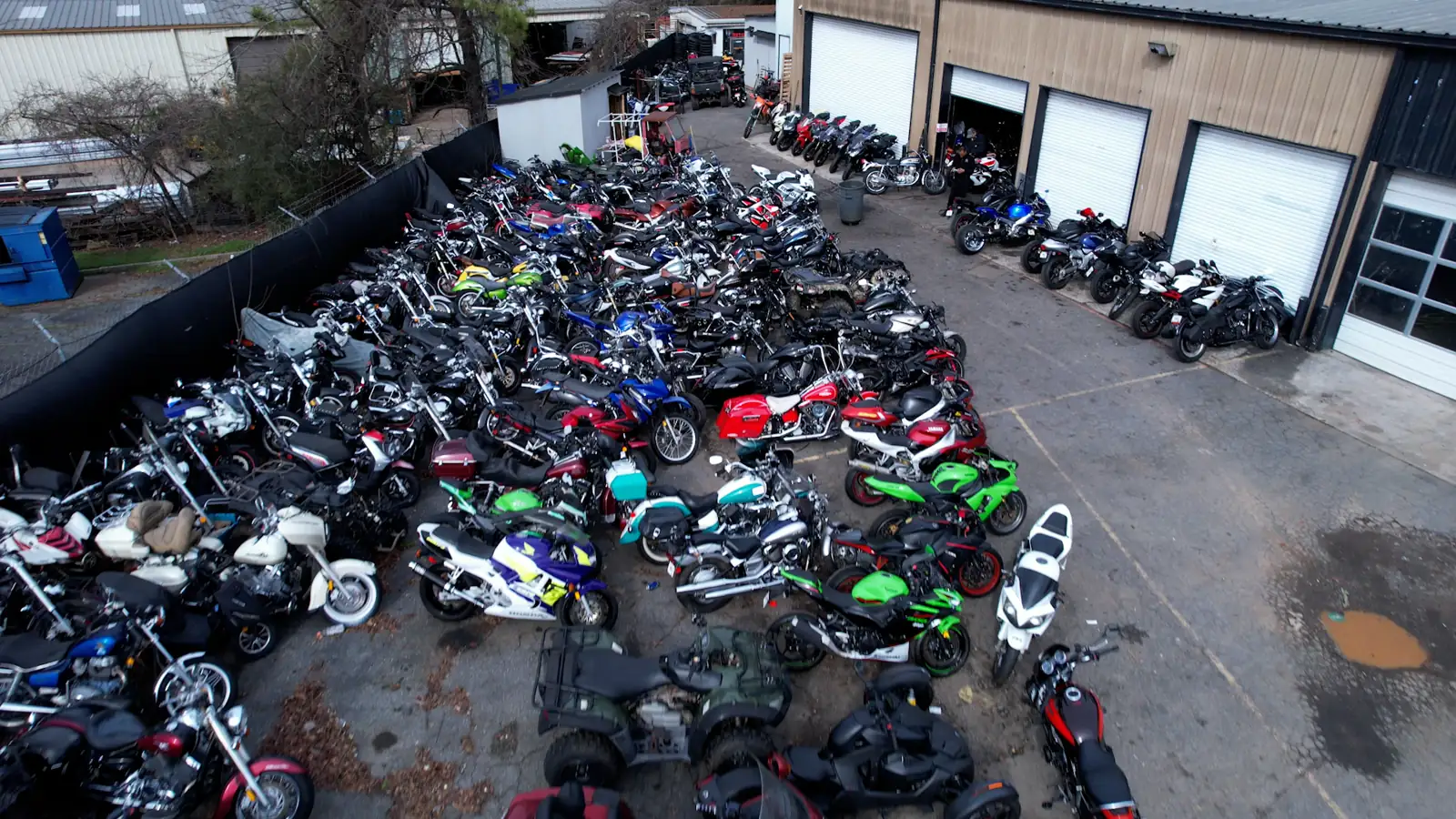
So we don’t guess, and we don’t quote from a phone call. Text us what the bike is doing in your own words, and we’ll tell you what we suspect. Then we get hands on it. Diagnosis is the step that protects your money, because replacing the wrong part is the most expensive habit in this entire business. Plenty of bikes come to us after somebody already threw two parts at a noise that turned out to be a loose fastener. We’d rather spend twenty quiet minutes finding the real cause than sell you a guess in a nice box.
- You text us the symptom — the noise, the feel, when it shows up, what changed.
- We run it or ride it when that’s safe, because a symptom you can feel beats a symptom described.
- In short we check the boring stuff first: fluids, chain, sprockets, pads, rotors, tires, bearings, cables and fasteners.
- We separate what’s causing your problem from what’s simply worn and coming due later.
- We text or call you with what we found, what it needs now, what can wait, and how long it takes.
That last step is the one riders tell us they remember. Not everything we find needs doing today. A tire at half life gets a note, not an invoice. We’d much rather you know what’s coming in three months than get surprised by it in a parking spot beside the Village Green while an outdoor concert is letting out.
What a service actually includes
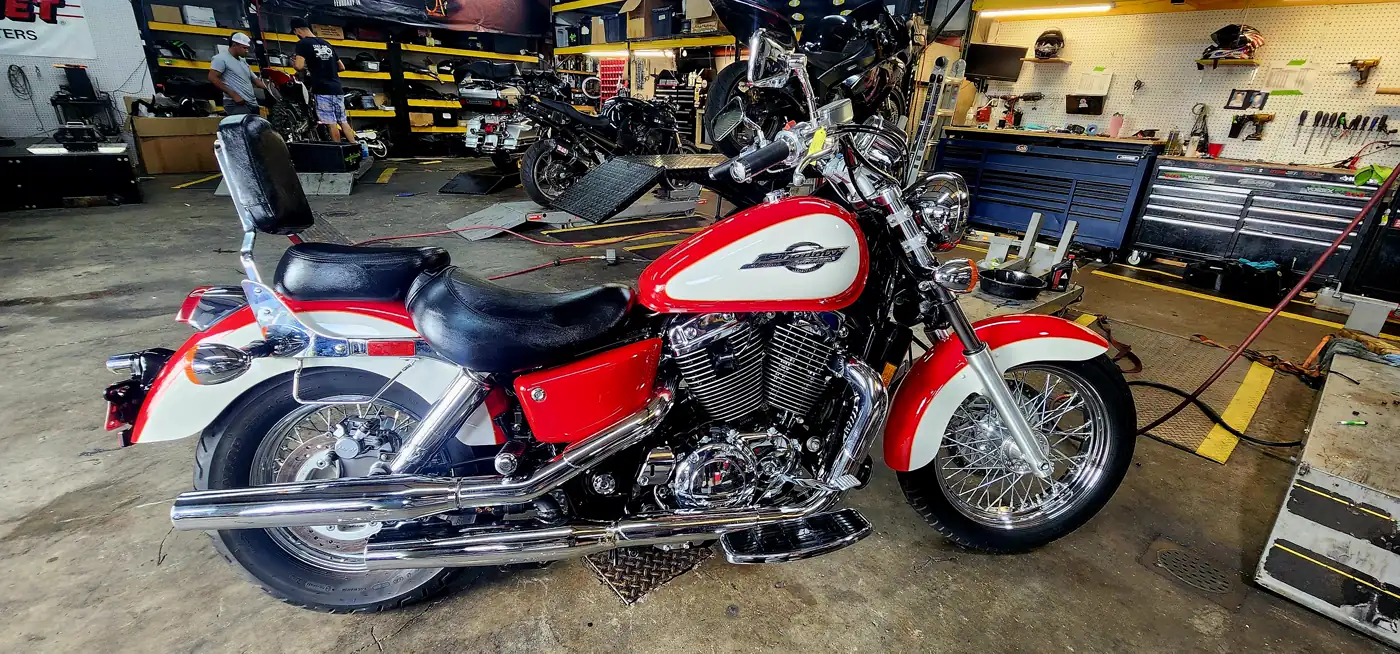
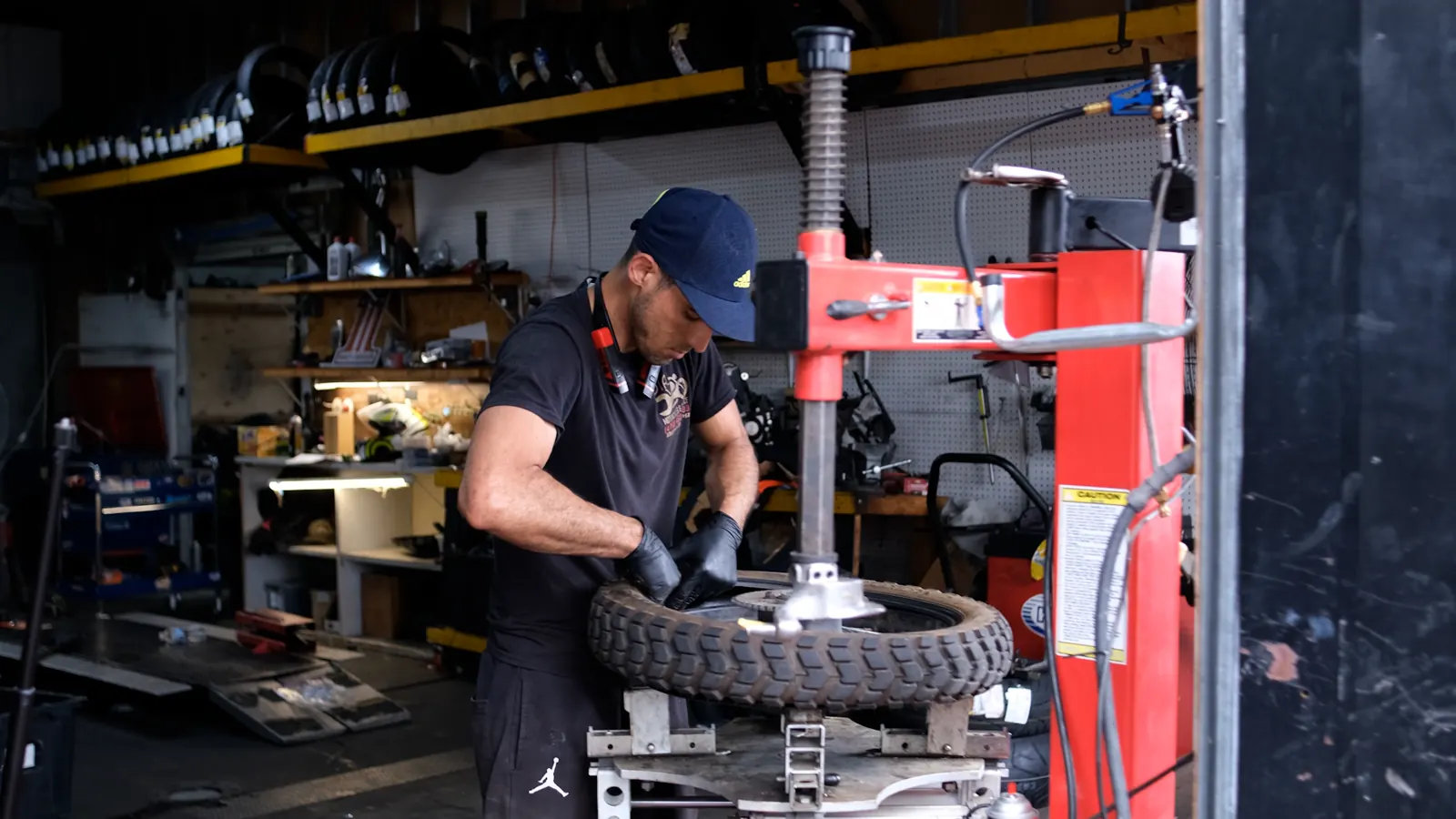
A routine service isn’t one single thing. It’s a checklist, and most of it is looking rather than replacing. When we say we’re servicing your bike, this is what’s happening in the bay while you’re at work.
- Oil and filter, plus a good look at what came out — metal flake, moisture and smell all tell a story.
- Chain and sprockets: clean, lube, set the slack, and hunt for tight spots and hooked teeth.
- Brakes: pad thickness, rotor wear, fluid condition, and whether the calipers still move freely.
- Tires: tread depth, age, pressure, and the uneven wear that points at something else going on.
- Air filter, plugs, coolant and brake lines, checked against what your owner’s manual asks for.
- Cables, levers, bearings, lights and fasteners — the small stuff that quietly walks loose in traffic.
- A ride afterward, because a bike that passes on the stand should also pass on the road.
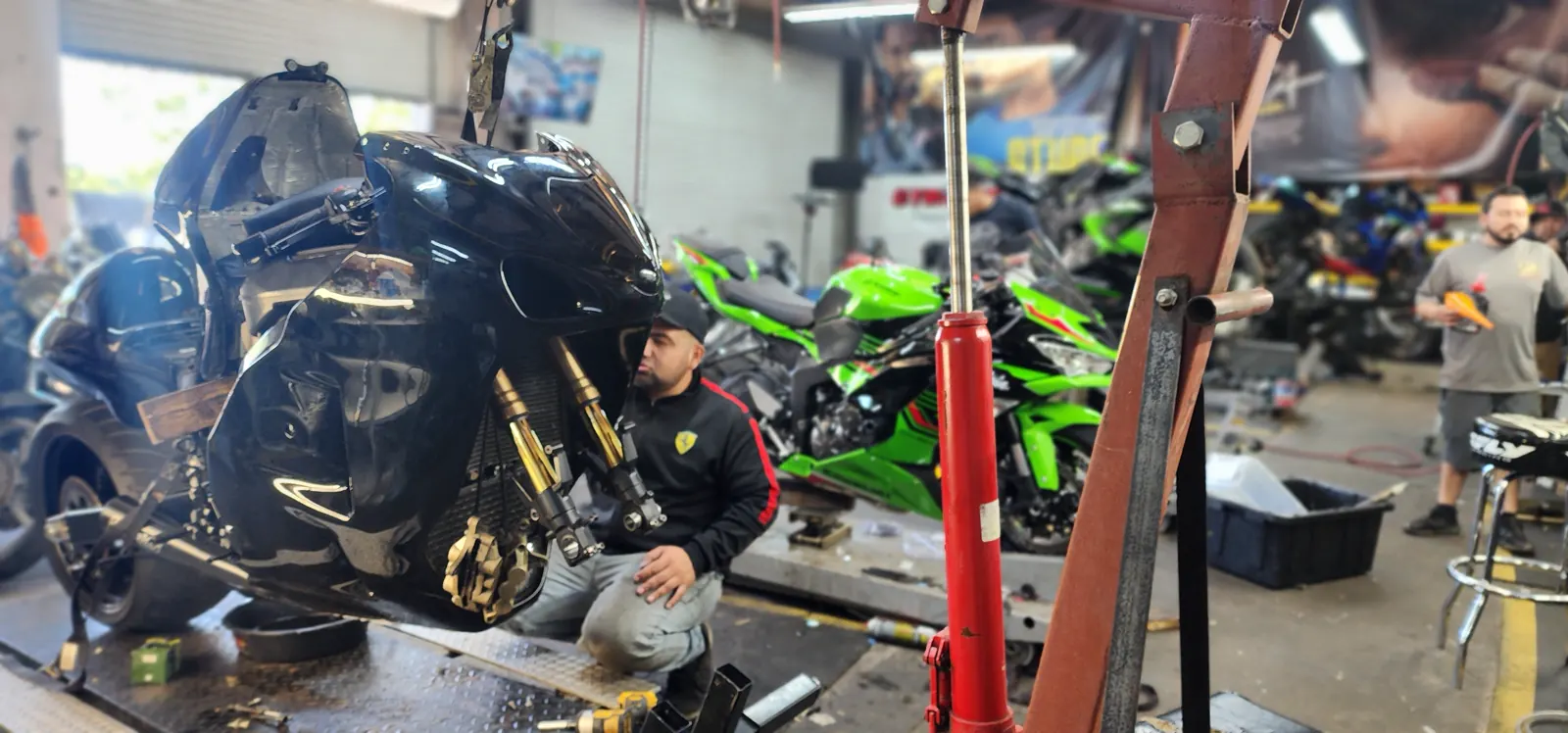
How long it takes depends on the bike and on what we find. Straightforward service work is often same-day or next-day. If we get in there and the chain is done or the pads are down to backing plate, we’ll message you before we touch anything beyond what you approved. Here’s what we take care of here if you want the full menu, from routine upkeep to the bigger teardown jobs.
Where you park it matters more than you'd think
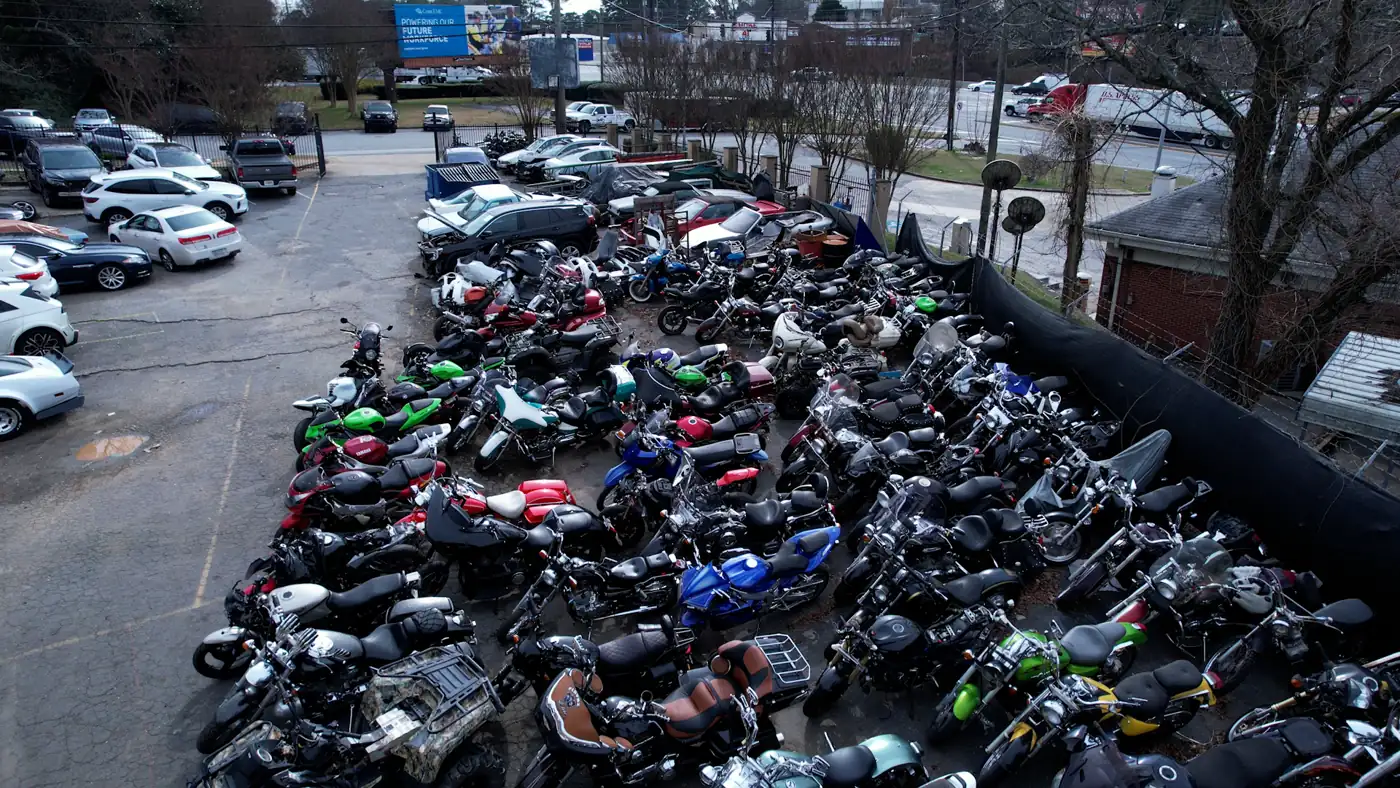
Storage in Smyrna is all over the map, and it shows up plainly in the work we see. New builds and gut-renovated homes have two-car garages. The original ranches have carports and driveways. Then a big and growing share of riders near Market Village, Windy Hill and Cumberland live in townhomes and apartments with open lot parking and no garage at all. That last group deals with battery tenders, covers that don’t fit right, corrosion, stale fuel and theft prevention. Riders in Williams Park, a short walk from downtown between The Highlands and Belmont, land somewhere in the middle, while riders in Archerfield usually have the garage. None of it is unsolvable. It just changes the plan we build for you. A bike that lives outside near the Village Green needs different habits than one tucked in a garage, and we’ll tell you which ones actually matter instead of selling you a shelf of products.
Traffic shapes it too. When the Braves are home, everything around Truist Park and The Battery Atlanta thickens up, and a twelve-minute ride becomes a twenty-five-minute one with your clutch hand doing all the labor. School mornings near Campbell High School run the same way, with Campbell Middle and King Springs Elementary feeding the same few roads. More heat, more clutch, more brake. If you’re newer to riding in that kind of density, the Georgia Motorcycle Safety Program is a genuinely good use of a weekend.
A quick story, because it makes this concrete. A friend we helped commutes from near the Village Green over the Chattahoochee River crossings toward Vinings most mornings, Paces Ferry out and Paces Ferry back. He brought the bike to us for two little annoyances: a slow crank and a chain he was adjusting every other week. The slow crank turned out to be a battery that never got a full charge on a fifteen-minute ride. The chain was worn past adjustment and had started working on the sprockets. Two small things, both caught before either turned into a tow truck and a bad afternoon. He rode it home that same day.
Getting your bike to us, or us to your bike
There’s no full-service motorcycle shop inside Smyrna city limits, which is a funny thing for a city that rides this much. Your realistic options are the Cobb Parkway strip, a mobile mechanic, or us. If you’re on an Indian or a Polaris Slingshot, Indian Motorcycle of Marietta at 1750 Cobb Pkwy S runs Tuesday through Saturday, 10 to 5, closed Sunday and Monday. From Market Village we’re about eleven miles out, roughly twenty-two to twenty-eight minutes, usually South Cobb Drive or Atlanta Road north into Marietta and then Roswell Road east.
And when that ride isn’t happening — bike won’t start, no trailer, no free morning — we’ll come get it. That’s the part Smyrna riders are most surprised by, and it’s the reason the geography stops mattering. It works the same for riders over in Canton, who run the same math from the opposite side of the county.
JUST TEXT US
Describe the noise in your own words. A ten-second voice memo works even better. We’ll tell you what we think it is, what it takes to know for sure, and when we can get you in — no phone tag during your lunch break.
What you actually get out of it
You get to stop wondering. Honestly, that’s the real product. Steady motorcycle maintenance Smyrna commuters keep up with turns the bike back into the thing you don’t think about, the one that starts on the first press and pulls straight and quiet through the river crossings on a Tuesday morning. Whether you’ve been riding twenty years or you just finished sorting out Georgia Class M licensing last month, the goal is identical.
As for what it costs, the honest answer is that the bike decides. Displacement, how many fairings have to come off, what parts your model uses, and how long you waited all move the number, which is exactly why we look before we quote. Chasing more power instead of chasing a problem is a separate conversation, and we wrote the full rundown on it for the riders who want that. For everyone else, keep it simple: tell us what changed, and let us handle the translating.
Questions Smyrna riders ask us
What's actually included in a routine service?
Oil and filter, chain and sprocket check, brakes, tires, air filter, plugs, coolant, cables, bearings and fasteners, plus a test ride afterward. Most of it is inspection, not replacement. Your owner’s manual sets the intervals for your specific bike, and we work from that instead of a generic schedule.
How long will you have my bike?
Straightforward service work is often same-day or next-day. Bigger jobs depend on parts and on how much bodywork has to come off. We’ll give you a real time estimate once we’ve looked at it, and we’ll text you if anything changes.
Do you work on my brand?
Almost certainly. We see Japanese, European and American bikes every week — naked bikes, modern classics, sportbikes, ADV and sport-touring, scooters and small-displacement machines. If yours is unusual, text us the year, make and model and we’ll tell you straight.
Do I need an appointment?
It helps a lot, especially in summer when everybody rides. Text us first and we’ll hold a slot so your bike isn’t sitting in line. Drop-ins are welcome too, we just can’t promise same-day turnaround without a heads-up.
Can you pick my bike up in Smyrna?
Yes. If it won’t start, you don’t have a trailer, or your week is packed, we’ll come to you. That’s a normal request from Smyrna riders, since there’s no full-service shop inside city limits. Text us your address and what the bike is doing.
How do I know it's time for service?
If something feels different, it’s time. A chain needing frequent adjustment, a longer brake lever pull, slow cranking, or dark gritty oil all count. Beyond that, follow the intervals in your owner’s manual and adjust for short commutes and stop-and-go heat.
We keep bikes running for riders all over the west side of metro Atlanta. Along with Smyrna, we regularly see riders from Marietta, Vinings, Mableton and Austell, plus folks coming in from Atlanta, Buckhead and Sandy Springs when the traffic gods allow it. East Cobb, Fair Oaks and Kennesaw riders are here most weeks, and we get plenty of bikes from Powder Springs and Douglasville too. If you’re somewhere in that stretch and your bike won’t cooperate, we can usually come to you.
TELL US WHAT CHANGED
If your bike in Smyrna is doing something new — a noise, a shudder, a lazy start — text us and describe it however it comes out. We’ll tell you what we suspect, what it takes to confirm it, and when we can get you in. Can’t get it to Marietta? Say the word and we’ll come pick it up.
470-460-9883Diaz Motorcycles and Service, LLC · 847 Barnes Mill Road, Marietta, GA 30062