Motorcycle Not Starting Cartersville — Why It Happens
The slow crank, the click, the dead dash — here's what each one is telling you, and when it's still safe to ride.
It started small. Half a second longer on the button. The kind of pause you notice, shrug at, and forget by the second traffic light. Maybe the headlight dipped when you thumbed the starter, then snapped right back like nothing happened. So you rode. Of course you rode. Then one morning the button gave you a click and a whole lot of silence. That slow slide from huh, weird to nothing is the most common version of a motorcycle not starting Cartersville riders bring us, and here’s the part worth hearing first: the cause is almost always something small, and small things are the easiest kind to fix.
The short answer first
A bike that won’t start is missing one of three things. Power, fuel, or spark. That’s the whole list. Everything else is just a branch off one of those three trunks. When the engine turns over slow and lazy, you’re looking at power. After that, when it cranks strong and fast but never catches, you’re usually looking at fuel or spark. When you press the button and hear a single sharp click with no turning at all, that’s power again, and it’s often just a battery or a connection that’s gone green and crusty.
Roughly speaking, the battery is the culprit far more often than anything else. It’s not close. After that comes stale fuel and gummed-up jets or injectors, then a tired starter relay, then plugs, then the wiring and switches that have to all agree before your bike is allowed to run. So before you start picturing a torn-down engine, take a breath. Most of the time we hand a bike back the same week, and the owner rides off wondering why they worried.
THE THREE-SECOND TEST
Turn the key and hit the horn. Strong and loud means you probably have battery voltage. Weak and sad means start there. It’s not a lab test, but it’s saved a lot of people a lot of guessing in a driveway.
What actually drives the problem around here
Bartow is hard on batteries, and it’s not the riding that does it. It’s the sitting. Most bikes in this county live in a garage, an outbuilding, or a pole barn, and a lot of that storage is detached and unheated. Great for a project bike you’re slowly waking up. Rough on a battery, a fuel system, and anything chrome. Over in West End, where the housing stock runs pre-1940, we see a lot of charming old detached garages that breathe humidity all summer long. Surface rust shows up on hardware. Terminals fuzz over. The battery loses a little every month it sits.
Fuel is the other half of the sitting problem. Pump gas with ethanol in it pulls moisture out of humid air, and after a few months it turns into varnish. That varnish doesn’t leave. It settles into pilot jets, injector tips, and the tiny passages that matter most at idle and startup. A carbureted bike that sat all winter in a barn near Kingston will crank happily and refuse to fire, because the fuel it’s trying to use has quietly turned into something closer to syrup. Bikes are polite about this. They just don’t mention it until spring.
- Battery low, old, or never fully charged between short rides
- Corroded or loose terminals, ground straps, and connectors
- Stale fuel and varnish in jets or injectors after storage
- Failing starter relay or solenoid, the classic single click
- Fouled or worn spark plugs and tired plug caps
- Safety switches doing their job — kickstand, clutch, kill switch, neutral
Now, the part nobody mentions until you’re already paying for it. A no-start is rarely one failure. It’s usually a weak part plus a second weak part, and the bike hid it for months. A battery at eighty percent will still fire a healthy engine. Add a lazy starter, and the pair of them push each other over the edge on the first cold morning. That’s why chasing one symptom at a time gets expensive and slow. We’d rather test the whole starting circuit once, find both soft spots, and be done. If you want a fuller picture of what changes the total on a repair like this, we broke that down separately.
What we check, and the order we check it in
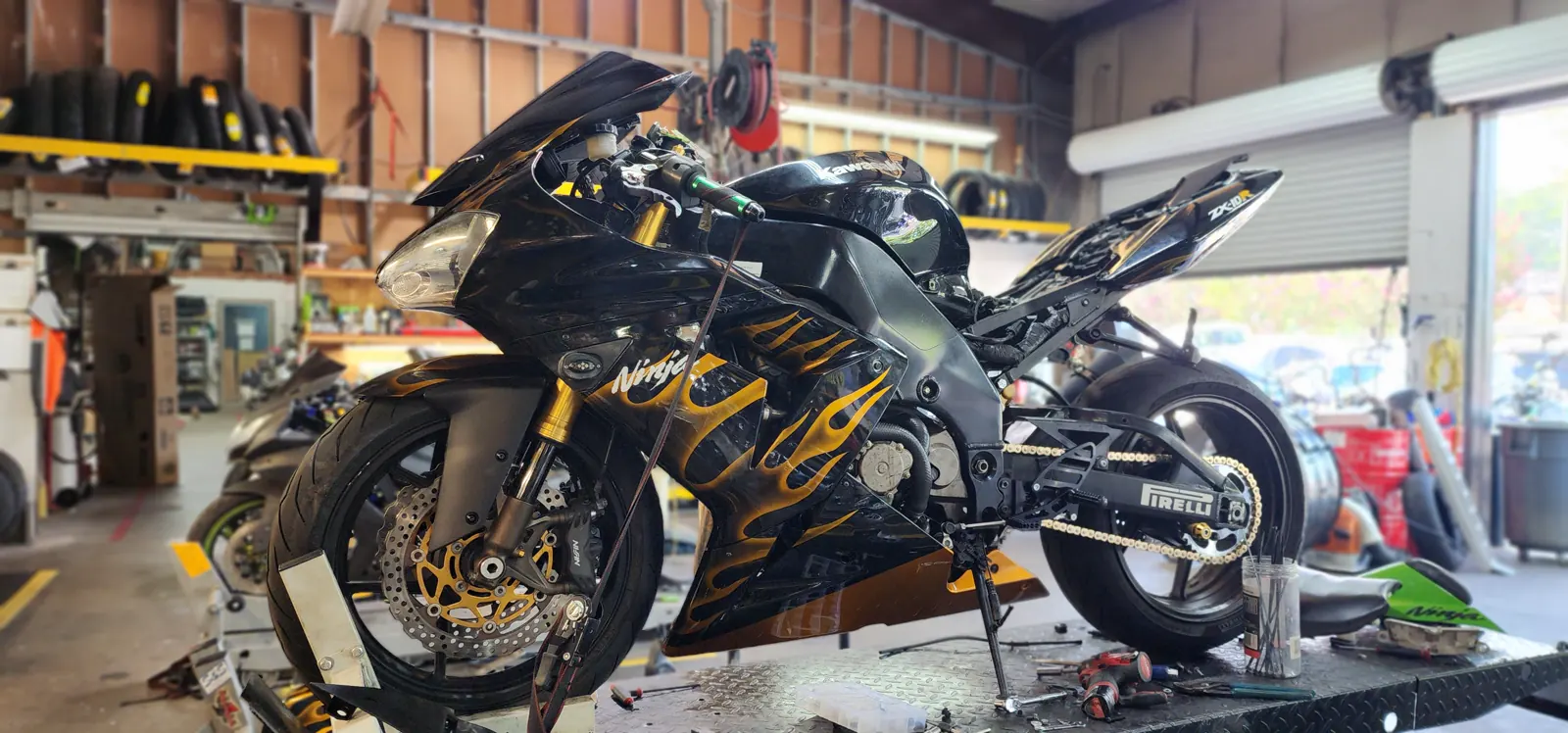
Diagnosis is boring on purpose. Boring is how you avoid replacing parts that were fine. Every motorcycle not starting Cartersville job that rolls through the door gets the same march down the same checklist, whether it’s a bagger or a barn-find. We start at the battery and work outward along the same path electricity has to take, testing under load rather than trusting a resting number. A battery can read fine sitting still and collapse the moment the starter asks it for real current. That gap is where a lot of guesswork lives.
- Load-test the battery and confirm the charging system is actually putting current back in
- Clean and check terminals, ground straps, main fuse and connectors for corrosion
- Test the starter relay and the starter draw, since a dragging starter fakes a dead battery
- Pull plugs, read them, and check for spark at the right time
- Check fuel delivery, pressure, and whether the fuel in the tank is even usable anymore
- Verify the safety switches and any stored fault codes before touching a single part
Reading plugs is one of the most useful five minutes in the whole process. A dry plug on a bike that cranks well points at fuel. A soaked plug points at spark or too much fuel. Sooty black tells one story, chalky white tells another. It’s a free look inside the engine, and it keeps us honest. Riders who like specifics tend to like this part, and Bartow is a specifics kind of county. Show a Shaw Industries maintenance guy a torque spec and a part number and he’ll relax. Show him adjectives and he’ll go somewhere else, which is completely fair.
When it's safe to ride, and when it isn't
Here’s the clear line. If the bike starts but cranks slow, you can ride it, but ride it straight to a shop or a charger, and don’t shut it off somewhere you’d hate to be stranded. What’s more, if it starts only with a jump, treat it as a bike that will not restart, because that’s exactly what it is. If it stumbles, cuts out at idle, or dies when you roll off the throttle, stop riding it in traffic. Stalling on US-41 in front of a truck is a bad way to learn about a fuel filter. And if you smell fuel, see a wet spot under the bike, or the headlight browns out while riding, park it. That last one means the charging system is losing the fight, and the bike is running on borrowed time.
Mistakes we'd love you to skip
Nearly every one of these comes from good intentions. Nobody’s careless. People just try the cheapest fix first, which is smart right up until it isn’t. The most common pattern we see is three parts replaced in a row, none of which were broken, and then the bike arrives with a bag of old parts and a very tired owner. We’ve all been there. It’s a rite of passage, honestly, and it’s still worth avoiding.
- Throwing a new battery at it before testing the charging system, so the new one dies too
- Jump-starting repeatedly, which hides the real fault and cooks the battery
- Spraying starting fluid into a bike with a fuel problem instead of fixing the fuel
- Draining the tank but never cleaning the jets, injectors, or filter
- Ignoring the kickstand switch, then rebuilding half a carburetor for nothing
- Leaving a bike parked all winter with a half-full tank and no tender
And then there’s the part that’s just about riding again. Because that’s the real point. A no-start isn’t only a mechanical problem, it’s a stolen Saturday. It’s the ride you’d planned up US-411 that turned into an afternoon of watching videos on your phone in the garage. That matters more than any diagnostic chart, and it’s the reason we push people toward prevention instead of heroics. If you’re curious how this same work looks a county over, here’s what East Cobb riders run into.
Cartersville, Bartow, and the roads that make it worse
Cartersville is a riding town in a way most of the northwest metro isn’t. The Downtown Business District, one of the city’s five locally designated historic districts, is where people park and stand around and talk bikes on a nice evening. You’ll see riders swing past the Booth Western Art Museum, which locals just call the Booth and which happens to hold the world’s largest permanent exhibition space for Western art across 120,000 square feet. Others loop west past Rose Lawn Museum, the old house museum just off downtown, on their way out of town. Newer arrivals out at Parkside at Carter Grove are discovering the same thing everybody else here already knows, which is that this city is a staging point, not a destination.
That’s why a no-start stings extra here. From Cartersville you can run GA-61 south toward Dallas and Paulding County, or point north and string together the Johns Mountain to Cloudland Canyon route, seventy-two miles of GA-136, Armuchee Road, Pocket Road and Floyd Springs Road plus the Lookout Mountain Scenic Highway, picked up through Villanow and at its absolute best in autumn. Meanwhile the roads themselves chew on bikes. I-75 through Bartow is rutted concrete, expansion joints and shredded truck retreads. US-411 north carries quarry traffic that drops gravel on the exact pavement riders use to reach the mountains. Freeze-thaw potholes run February through April, and pollen season coats everything and clogs air filters right when you want to ride.
A bike that won't start is a stolen Saturday. That's the real repair.
What getting it sorted actually looks like
Bartow is well covered for some brands. Bartow Powersports out on Powersports Circle handles Suzuki machines and ATVs from its spot off I-75, and the Harley community here is as organized as any in the region, with H.O.G. Chapter #1593 running poker runs, toy runs and charity rides. What’s thinner on the ground is the multi-line independent side, which is where we come in. We work on cruisers, baggers, sportbikes, tourers and stubborn old project bikes, and we do the diagnostic work first so the parts list stays short. Take a look at the full list of what we do if you’re wondering whether your bike fits.
Prevention here is genuinely easy. Put a tender on the battery when the bike sits more than two weeks. Use fuel stabilizer before storage and fill the tank most of the way so there’s less air to sweat inside it. Clean your terminals once a year and hit them with dielectric grease. Ride the bike now and then, because short trips to the store never fully recharge a battery. Keep your tires honest too, since Dunlop’s technical resources will tell you the same thing we do about pressure and age. Newer riders, or anyone shaking off rust after a few years off, get real value out of an MSF Basic RiderCourse as well. Do those few things and the odds of a dead morning drop hard. And if you’re weighing shops in general, here’s what the work covers when it’s done properly.
So if your bike is clicking, cranking slow, or just sitting there being dramatic, you now know roughly what it’s telling you. Power, fuel, or spark. Test before you replace. Ride it if it’s healthy enough to be trusted, and don’t if it isn’t. That’s the whole thing. Clear head, short list, and a bike that fires the first time again.
Questions Cartersville riders ask us
Could it be something other than the battery?
Absolutely, and it often is. A dragging starter, a bad relay, corroded grounds, stale fuel, or a fouled plug all look like a dead battery from the seat. That’s exactly why we test the whole starting circuit instead of swapping the first suspect.
Is it safe to ride if it starts but cranks slow?
Short answer, yes, but ride it straight to a charger or a shop. A slow crank means the bike may not restart once you shut it off. If it only fires with a jump, or if the headlight browns out while you’re riding, park it and get it looked at.
What usually causes a no-start after the bike has been sitting?
Two things, almost every time. The battery loses charge over the months, and ethanol fuel turns to varnish in the jets or injectors. Bikes stored in detached, unheated garages around Bartow see both problems together more than most.
Can I fix this myself in the garage?
Some of it, sure. Cleaning terminals, charging the battery, checking the kickstand and clutch switches, and swapping plugs are all reasonable driveway jobs. Testing starter draw, charging output and fuel pressure needs proper tools, and that’s where guessing gets costly.
Will it get worse if I keep jump-starting it?
Usually yes. Repeated jumps mask the real fault and hammer a battery that’s already weak, and a failing charging system will keep killing whatever you put in. Better to find the cause once, fix it, and stop repeating the ritual.
How long does diagnosis take?
Most no-start diagnoses are quick once the bike is on the lift, because the tests follow a set order. Parts availability is usually the longer part of the wait, especially on older or less common machines. We’ll tell you what we found before anything gets replaced.
We look after riders across Bartow County and the counties that touch it, so bikes come to us from Cartersville, Emerson, White, Adairsville, Kingston, Euharlee, Rydal and Taylorsville on the Bartow side, and from Acworth, Kennesaw, Woodstock, Canton and Dallas as riders head south and east toward the shop. Plenty of those folks are passing through anyway on their way to or from the mountain roads, so the trip rarely feels like a detour.
LET'S GET IT FIRING AGAIN
If your bike is clicking, cranking slow, or refusing to wake up at all, text or call us and tell us what it’s doing. We’ll talk it through, tell you honestly whether it’s a driveway fix or a lift job, and get a Cartersville bike back on US-411 where it belongs.
470-460-9883Diaz Motorcycles and Service, LLC · 847 Barnes Mill Road, Marietta, GA 30062