Motorcycle Not Starting Lawrenceville — What to Check
The bike was fine on Friday. Here's what's usually going on, and how to tell if it's safe to ride once it fires.
Meanwhile, most weeks, the bike that comes through our door isn’t broken in some dramatic way. In fact, that said, It’s a clean, well-loved sportbike that fired up fine on Friday and did absolutely nothing on Saturday morning. For example, the owner stands there with a helmet in one hand and a look we know by heart. So if you typed motorcycle not starting Lawrenceville into your phone at seven in the morning with your thumb still on a dead starter button, you are in extremely normal company. After that, this is the single most common thing we see all year.
Here’s the good news up front. What’s more, a bike that won’t start is almost never a bike that’s dying. So and Better yet, It’s a bike that’s missing one of three things, and all three are cheap to check in your own garage before anybody touches a wrench. Once you know which one is missing, the whole thing stops feeling like a mystery and starts feeling like a chore. Chores are fine. Chores get done.
The myth: a dead button means a dead engine
Still, Riders talk themselves into the worst version fast. Plus, the starter clicks, nothing happens, and the brain jumps straight to a seized motor or a fried ECU. Of course, we hear it on the phone constantly. Then again, Somebody in Collins Hill Heights calls us convinced their two-year-old Ninja is finished, and it turns out the battery has been slowly starving on a tender that quit working over the winter.
Engines are stubborn things. Even so, they do not quietly die overnight in a garage. Meanwhile, a real internal failure gives you loud, ugly warning first. Knocking. Metal in the oil. Power that fades over weeks. If your bike ran clean on the last ride and simply won’t wake up now, the odds are overwhelming that the engine is perfectly healthy and something in front of it is not passing the message along.
In fact, that said, That’s the frame to keep in your head. For example, your engine needs spark, fuel and air, plus enough electricity to spin it fast enough to matter. Even so, take away any one of those and you get the same silence. Meanwhile, the silence doesn’t tell you which one is missing. That’s the whole problem, and that’s why guessing gets expensive.
The reality: five causes, most common first
In fact, that said, we keep a mental tally, and the order barely changes from year to year. Battery first, and it isn’t close. Then connections, then fuel, then the safety switches, then everything else combined. For example, let’s walk them in that order, because that’s the order a good shop checks them in too.
1. The battery, by a mile
After that, Motorcycle batteries are small, and small batteries lose the argument fast. Short trips never fully recharge them. What’s more, Alarms, trackers and USB ports pull a little current all night. So and Better yet, Heat cooks them in summer, and Georgia summers are extremely good at cooking things. A battery can read fine on a meter and still collapse the second the starter asks for real current. That’s why a load test matters more than a voltage number.
Signs it’s the battery: the dash lights dim when you hit the button, the starter groans slow instead of spinning, or you get a rapid machine-gun clicking. If the horn sounds weak and the headlight goes brown when you crank, you’ve basically found your answer.
2. Connections and grounds
A perfect battery still can’t help you through a corroded terminal. Vibration loosens things. Moisture creeps into a ground strap. Somebody installed a fender eliminator or a horn last spring and pinched a wire behind a bracket. We see this a lot, because this is a modified-bike county and every accessory is one more connection that can quietly go bad.
3. Fuel and the pump
If the bike cranks strong but never catches, you’ve moved out of the electrical column and into fuel. Turn the key and listen. Most fuel-injected bikes give you a two-second whirr from the pump before it goes quiet. No whirr, no fuel pressure, no start. Old gas that sat all winter turns gummy and clogs things, and a filter can choke slowly enough that you never noticed the bike getting lazy.
4. The safety switches
Every bike has a little committee of switches that all have to agree before the starter works. Kickstand down. Clutch in. Neutral or gear. Kill switch up. Any one of those sensors can get dirty or bent and veto the whole operation. It’s the most anticlimactic repair in motorcycling and one of the most satisfying, because you get your bike back in about ten minutes.
5. Spark and everything else
Coils, plugs, stator, regulator-rectifier. These are real and they do fail, especially on bikes with high annual mileage. But they sit at the bottom of the list on purpose. Chasing a stator on a bike with a four-year-old battery is how people spend a weekend and end up right back where they started.
That’s the common version. The real story is a little different, and it’s the part almost nobody tells you.
Around here, a surprising number of no-start calls trace back to modifications. Gwinnett rides hard and modifies harder. Slip-ons, full systems, high-flow filters, gearing changes. A bike running lean after an exhaust swap gets progressively harder to start cold, and riders read that as a battery problem for months before the real cause surfaces. Then spring pollen coats the new filter, the mixture goes further sideways, and one damp morning the bike simply refuses. The battery gets blamed. Honestly, the battery was innocent.
The actual process we use
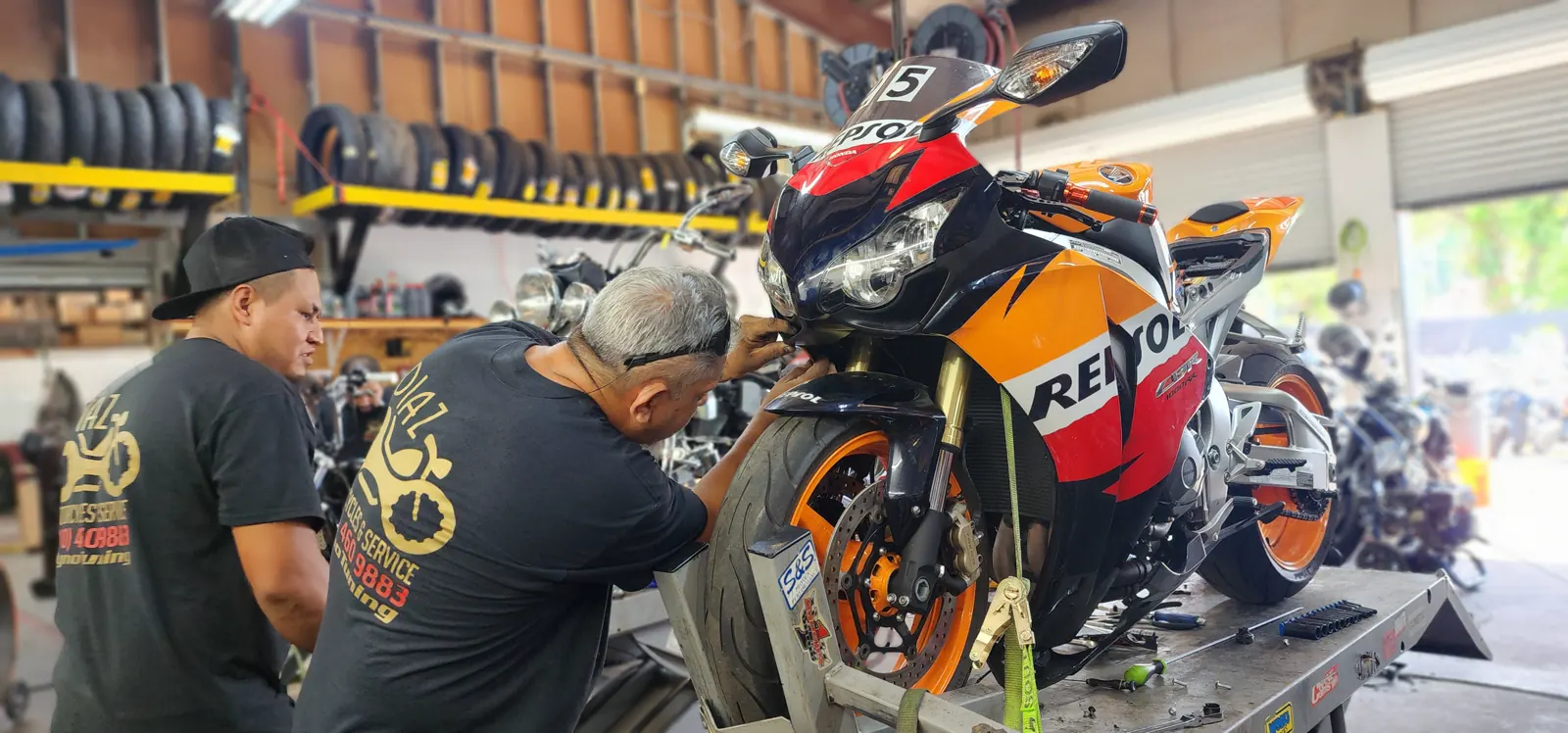
Diagnosis isn’t magic. Every motorcycle not starting Lawrenceville riders bring us gets the same sequence, and it’s boring on purpose. Boring means repeatable, and repeatable means we don’t hand you parts you didn’t need.
- Load test the battery under real current, not a resting voltage reading.
- Check the charging system output at idle and at a few thousand rpm, so we know whether the battery was killed by something else.
- Inspect and clean every main connection, ground strap and accessory tap added after the bike left the factory.
- Confirm fuel pump prime, fuel pressure and filter condition.
- Verify the safety switch circuit, one switch at a time.
- Pull plugs and check for spark, color and fouling, which also tells us whether the bike has been running lean.
- Scan for stored codes and read live sensor data while cranking.
By step seven we almost always have it. And frequently we’ve found a second thing on the way, like a chain gone dry or a coolant level creeping down, which is the kind of catch that saves a ride later. If you want the longer version of what happens in our bays, it’s laid out there step by step.
Now the question every rider actually wants answered. Is it safe to ride once it finally fires? Sometimes yes, sometimes absolutely not, and the line is clearer than you’d think.
SAFE TO RIDE, PROBABLY
It started slow but runs clean, headlight is bright at idle, no warning lights, and it’s a short trip home or to the shop. Ride it, but don’t shut it off along the way.
DON'T RIDE IT
It needed a jump, the headlight dims badly at idle, the bike stalls at stops, you smell fuel, or the temperature light came on. A charging failure will strand you mid-lane, and stop-and-go traffic is the worst possible place to lose power. Call us and we’ll come get it.
How to tell a good shop from a parts cannon
A shop that starts by selling you a battery, then a pump, then a stator is not diagnosing. It’s guessing with your wallet. You can spot the difference in the first phone call, and here’s what to listen for.
- They ask what the bike does, not just what it doesn’t do. Clicks, cranks and silence are three different problems.
- They ask what’s been changed on the bike lately, because modifications matter more than model year.
- Even so, they test the charging system before replacing a battery, every single time.
- They tell you what they found, in words you can repeat to a friend.
- They put the small stuff first and the expensive stuff last.
We wrote a whole piece on what separates a good shop if you want the full checklist. The short version is that good shops explain, and guessy shops upsell. You’ll feel it in thirty seconds.
One rider off I-85 put it better than we could.
I didn't need a mechanic to fix it. I needed one to tell me what was wrong so I'd stop being scared of my own bike.
That’s the whole job. The repair is the easy part. Understanding your machine is what makes you comfortable riding it again, and comfortable riders make better decisions in traffic. If you want to sharpen that side of things, the MSF rider courses are worth a weekend.
Why this happens the way it does in Gwinnett
Location shapes failures. Riders in Flowers Crossing and the older established streets tend to have garages, which is genuinely good for a bike, but garage-kept bikes get ridden in short bursts and short bursts starve batteries. Out east toward the Alcovy River, the newer construction around Alcovy Falls, Alcovy Reserve, Alcovy Springs and Alcovy Landing skews toward apartment and driveway parking, where bikes sit uncovered through pollen season and heat cycles. Different problems, same silent starter button.
Then there’s how people ride here. Gwinnett is one of the highest-volume motorcycle counties in the state and easily the densest sportbike market out this way. Commuting by bike is genuinely common, because GA-316 and I-85 congestion make two wheels faster for some trips. High mileage means consumables wear out on a real schedule instead of a theoretical one. Batteries, plugs, chains and filters all come due sooner than the owner’s manual made it sound.
The roads add their own flavor. I-85 sits about eight to twelve minutes west via GA-316, and that freight corridor throws debris that finds radiators, chains and wiring. Running US-78 and GA-316 east toward Athens is flat and fast and one of the best reasons to own a bike in this county, but constant road widening means steel plates, milled pavement and gravel at construction entrances all year. Vibration loosens connectors. Connectors cause no-starts. It’s a straight line.
There’s a supply gap here too, and it’s worth naming. Lawrenceville has real independent shops. Black Dagger Cycles is a solid repair and custom shop in town. What the area doesn’t have is a tuning house, so riders modify heavily and then have nowhere close by to make those modifications actually work together. That’s why so many lean-running, hard-starting bikes end up on our dyno. If you’re curious how that side works, Dynojet’s dyno center explains the equipment plainly.
And yes, we know you’re OTP and we’re on the other side of the metro. From the Gwinnett Historic Courthouse on the downtown Square, the anchor of the whole city since 1885, it’s roughly thirty-three to thirty-eight miles to our door and usually somewhere between forty-five minutes and a bit over an hour, depending on the route and the hour. That’s our estimate from the map, not a stopwatch. It’s also why we run pickup and delivery, so you never have to trailer a dead bike across town on a Saturday.
What you walk away with
A no-start is a puzzle with a small number of pieces. Battery, connections, fuel, switches, spark. Check them in that order and you’ll solve most of them in your own driveway with a meter and twenty minutes. When it goes deeper than that, you want somebody who tests instead of guesses. Plenty of good technicians around here came up through Gwinnett Technical College, and the ones worth knowing all share the same habit: they find the cause before they open a parts box.
Every bike that leaves us leaves with an explanation attached, not just a repair. That’s the same standard we hold on the Sandy Springs side of things, and it’s exactly how we handle that job anywhere in the metro. Spring is our busiest window, since everybody installs winter parts in March and April and pollen fouls filters right on schedule, so if your bike has been getting lazier each morning, don’t wait for the day it says no.
You should finish this knowing more about your own bike than you did five minutes ago. That’s the point. A rider who understands the machine isn’t at the mercy of it, and that feeling is worth more than any part we could sell you.
Questions Lawrenceville riders ask us
What actually causes a motorcycle to not start?
Usually one of five things, and they show up in a predictable order. Battery is first by a wide margin, then loose or corroded connections, then fuel delivery, then a safety switch, then spark components. The engine itself is almost never the cause when the bike ran fine on its last ride.
How do you find the cause instead of guessing?
We run the same sequence every time. Load test the battery, check charging output, inspect grounds and accessory wiring, confirm fuel pump prime and pressure, test the safety switch circuit, then pull plugs and scan for codes. By the end of that list we know what happened and why, and we can show you.
Could it be something other than the battery?
Absolutely, and it often is on a modified bike. A slip-on or full exhaust without a proper map makes a bike run lean, and lean bikes get harder and harder to start cold. Riders replace two batteries before anyone checks the fuel mixture. That’s why we ask what’s been changed before we ask what’s been replaced.
Is it safe to ride once it finally starts?
Sometimes. If it runs clean, the headlight is bright at idle and there are no warning lights, a short trip home is fine. If it needed a jump, dims at idle, stalls at stops or smells like fuel, don’t ride it. A charging failure can leave you stopped in live traffic, and that’s a risk with no upside.
What happens if I just keep ignoring it?
Small no-start problems rarely stay small. A weak battery makes the charging system work harder, a lean tune slowly bakes plugs and valves, and a chafed wire eventually becomes a short. Catching it early usually means one part and one afternoon instead of a much longer visit.
Can you pick the bike up if it won't run at all?
Yes, and we’d rather you let us. We run pickup and delivery across the metro, including Lawrenceville and the rest of Gwinnett, so a dead bike doesn’t turn into a trailer-borrowing project. Text us, tell us where it’s parked, and we’ll handle the rest.
We ride out to Lawrenceville constantly, and to most of Gwinnett along with it. That includes Duluth and Suwanee up the corridor, Buford and Sugar Hill toward the lake, and Dacula out east past the Alcovy side of town. We work with riders in Snellville, Grayson and Loganville down south, Lilburn and Norcross closer in, and Tucker and Stone Mountain where Gwinnett starts blending into DeKalb. If your bike won’t start and you’re anywhere in that stretch, we can come get it.
LET'S FIGURE OUT WHY IT WON'T START
Text us what your bike is doing, in your own words. Clicks, cranks, or total silence, plus anything you’ve added to it lately. We’ll tell you what it probably is before you spend a dime on parts, and if it needs to come to the shop we’ll pick it up in Lawrenceville and bring it back running. Diaz Motorcycles, 847 Barnes Mill Road, Marietta.
470-460-9883Diaz Motorcycles and Service, LLC · 847 Barnes Mill Road, Marietta, GA 30062