Motorcycle Not Starting in Roswell — What to Check First
A click, a whir, or dead silence in the driveway — here's what your bike is actually telling you, and what to do next.
Some mornings the bike just says no. You thumb the starter and get a click, a lazy whir, or nothing at all — and now you’re standing in the driveway in full gear with a meeting on the calendar. If you’ve typed motorcycle not starting Roswell into your phone while still holding your helmet, you’re in good company. Good news? The cause is usually small, and you can understand it in about five minutes.
Here’s the thing about riding in this city. GA 400 southbound toward Perimeter and Buckhead is one of the few runs in this metro where people genuinely ride to work all year. Motorcycles can legally use the GA 400 HOV lanes, and that perk alone converts a lot of riders. Georgia doesn’t allow lane filtering, though, so commuting on two wheels here is really about parking and range rather than slipping past traffic.
So your bike isn’t a weekend toy. It’s transportation, and it takes a cold start five days a week, every week. That daily rhythm is exactly what wears down the parts that make a bike fire up. It’s also why a no-start almost never comes out of nowhere — the bike usually hinted at it first, and we just didn’t catch the hint.
The short answer, before anything else
Real talk: when a bike won’t start, the problem lives in one of four places. Power, fuel, spark, or a safety switch that thinks you’re doing something unsafe. That’s it. Everything else is a detail hanging off one of those four branches, so once you know which branch you’re on, the mystery shrinks fast.
The sound the bike makes is your best clue, and it costs nothing to listen. A sharp single click points one way. Better yet, a slow, sad crank points another. Total silence points somewhere else entirely, and a bike that cranks strong but never catches is telling you something very different from all three.
- One click, then nothing: usually a weak battery, a loose ground, or a tired starter relay.
- Slow, dragging crank: almost always low battery voltage, and sometimes old, thick oil in cold weather.
- Dead silence, no dash lights: a dead battery, a blown main fuse, or a corroded connection at the terminals.
- Dash lights but no crank at all: often a safety switch — kickstand down, clutch out, or the kill switch bumped.
- Cranks fine but won’t fire: now we’re looking at fuel, spark, or a sensor that’s fibbing to the ECU.
Notice that battery trouble shows up on three of those five lines. That’s not an accident. Batteries take the blame for the majority of no-starts we see, and honestly, they’ve earned it.
What actually drives this work
A motorcycle battery lives a harder life than a car battery. It’s smaller, it sits closer to engine heat, and it gets asked to spin a high-compression engine over on a cold morning. Then, on a short commute, the charging system barely has time to put back what the starter pulled out. Do that five days a week and the battery slowly runs a deficit it never recovers from.
Heat matters here too. Georgia summers cook a battery from the inside, and the damage doesn’t show up until the first cool morning of the season, when the same battery suddenly can’t deliver. That’s why we see a wave of no-start calls in the fall, even though the real harm happened back in July. Batteries are dramatic like that — they fail on the worst possible day, never on a Saturday afternoon.
Fuel is the second big driver. Modern pump gas doesn’t love sitting still, and a bike that gets parked for a few weeks can end up with gummy injectors, a clogged filter, or a fuel pump that whines instead of priming. Plus, pollen season from late February through April packs air filters solid and coats radiators and oil coolers, so the engine is already fighting for clean air before you even hit the starter.
Then there are the small electrical gremlins. A kickstand switch full of road grit. And a ground strap that vibrated loose. A relay that clicks but doesn’t pass current. None of these are dramatic repairs, and most of them take less time to fix than it takes to explain them. Still, they’ll strand you just as thoroughly as a seized engine would.
QUICK WIN
Before anything else, put the bike in neutral, pull the clutch in, and try again with the kickstand fully up. A surprising number of no-starts end right there — and we promise we won’t tell anyone.
Something changes once you know what to look for
Here’s where riders stop feeling helpless. Once you understand those four branches, a no-start stops being a scary mystery and becomes a short list of questions. You go from “my bike is broken” to “my bike has weak power,” and those are two completely different feelings to carry around.
You start noticing the warning signs early, too. The starter that sounds a half-beat slower than last month. So the headlight that dims when you hit the horn. The bike that fires instantly when it’s warm but grumbles when it’s cold. Those are all the same message in different accents, and now you can read it. That’s the whole point of learning this stuff, and it’s also what separates a good shop from a parts-swapper.
What we check, in order
When a bike comes in with a no-start, we don’t guess and we don’t start throwing parts at it. We follow the same path every time, because the fastest route to the answer is the boring one. Here’s the order.
- Load-test the battery, not just a voltage reading. A battery can show a healthy number and still collapse the moment the starter pulls on it.
- Check the terminals, grounds and main fuse for corrosion, looseness or green fuzz.
- Test the charging system at idle and at higher revs, so we know whether the battery was the victim or the culprit.
- Run through the safety switches — kickstand, clutch, neutral, kill switch — since any one of them can veto the whole show.
- Confirm fuel: does the pump prime, is the filter clear, are the injectors delivering, and is the fuel actually fresh?
- Confirm spark: plugs, coils, and the sensors that tell the ECU when to fire.
- Pull codes and live data, then compare what the ECU thinks is happening to what’s really happening.
- Compression test, but only if everything above checks out clean.
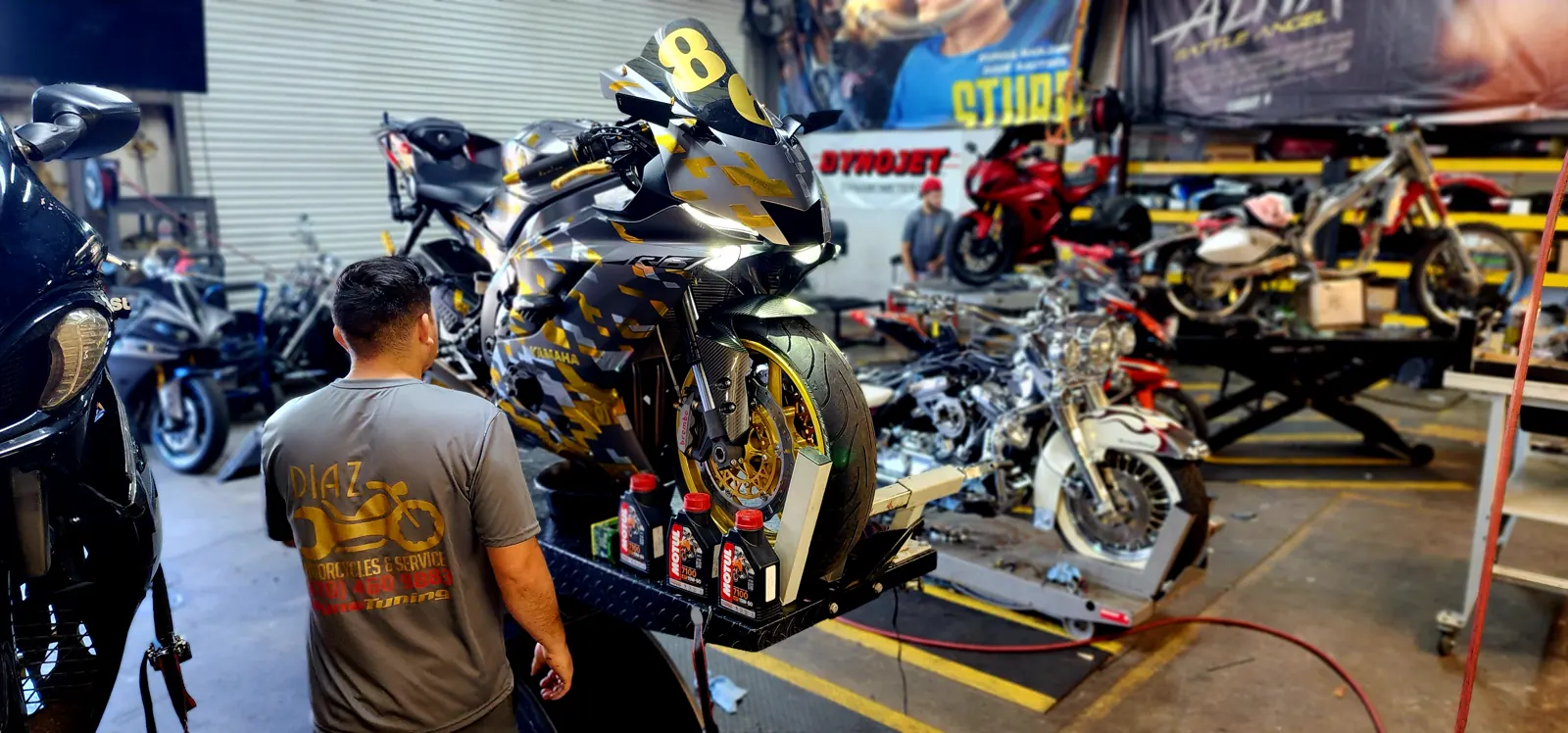
Nine times out of ten we’ve found it before step five. However, we still run the rest, because a bike that stranded you once has already lost your trust, and half a diagnosis doesn’t earn it back. You can see more of the work we do in house if you’re curious how deep the bench goes.
Mistakes to avoid
Nobody’s judging anyone here. We’ve all done at least two of these, and a few of us have done all of them in one weekend. But avoiding them saves real time, so they’re worth naming.
- Buying a battery first. If the charging system is the real problem, the new battery dies too, and now you own two problems.
- Jump-starting off a car with the engine running. That’s a lot of current heading toward small motorcycle electronics.
- Cranking over and over. Long cranks cook the starter, flood the engine, and drain what little charge is left.
- Adding fuel treatment to bad fuel. Old gas doesn’t get young again, so drain it and start fresh.
- Ignoring a slow crank for weeks. The bike warned you politely, and it will eventually stop being polite.
- Skipping the trickle charger over winter. A bike that sits from December to March without one is writing a no-start into its own future.
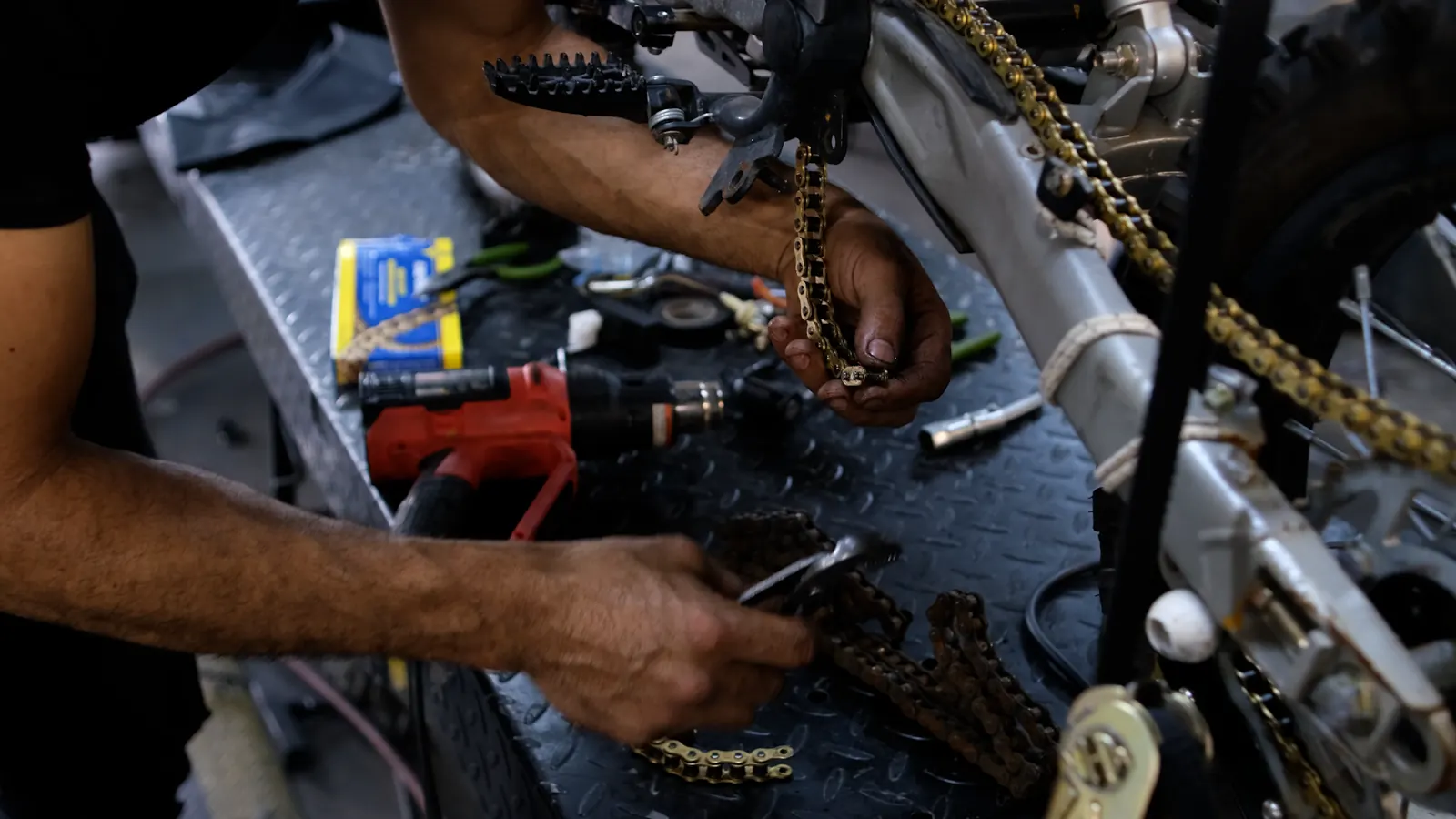
Also, keep your tire and chain maintenance on schedule while you’re at it. It’s not directly a starting issue, but a bike that gets consistent attention rarely surprises you. If you want to go deeper on rubber, Dunlop’s technical resources are a solid, no-hype place to read up.
Is it safe to ride like this?
Straight answer, because you deserve one. If the bike starts but only after a long, struggling crank, you can usually ride it — but ride it straight to a shop, and don’t shut it off at a gas station halfway there. A bike that barely starts in your garage will absolutely refuse to start in a parking lot, and that’s a much worse place to discover it.
If the headlight dims hard at idle, or the dash flickers while you ride, stop riding it. That’s the charging system, and once the battery is drained the bike can shut down while moving. Same goes for a bike that stalls at stoplights and needs a restart every time. Those symptoms are asking for a trailer, not a test ride, and there’s no shame in that at all.
But if it cranks strong and simply won’t fire, you’re not going anywhere anyway, so the decision makes itself. In that case the good news is that it’s stationary and safe, and we can come get it.
Now for the part that has nothing to do with parts at all
Because honestly, a lot of no-starts around here are made by roads and habits, not by defective components. Where you live in this city changes what your bike goes through, and that shows up on the lift.
Take the Historic Roswell and Canton Street district, that 1840s mill-town core of Craftsman bungalows and newer infill townhomes. Historic Canton Street is a Georgia Great Street and the reference point for the whole city, and it’s beautiful — but the townhome and condo infill around it means a lot of bikes sleep under a cover on a driveway or in a shared lot. More weather, more damp, more dew soaking into connectors. That alone shortens battery life.
Then there are the established neighborhoods like Martin’s Landing, roughly two thousand homes from the 1970s and 80s built around a 53-acre lake, with pools, tennis and trails. Lake Charles and Lake Charles Estates sit in the same established, lake-named world. Bikes there almost always live in a garage, which is great, except those garages are older two-car spaces already shared with cars. There’s room to park, but not room to work, and no compressor in sight.
Pavement plays a role too. Roswell has a citywide resurfacing and reconstruction program running in 2026 covering roughly fourteen miles, with Bulloch Avenue, Canton Street, Riverside Road and Old Roswell Road among the named targets. So the historic district and the river roads have known pavement problems, active construction and utility-cut seams right now. Riverside Road, Willeo Road, Azalea Drive and Old Alabama Road all run through that world along the Chattahoochee River National Recreation Area, where the Vickery Creek, Island Ford and Gold Branch units all touch the city.
Why does pavement matter to a no-start? Because vibration is the quiet enemy of every electrical connection on a motorcycle. Rough seams loosen grounds, chafe wiring, crack battery terminal solder and shake fuse boxes. Meanwhile the same roads bend rims and eat tires, which is a separate conversation for a separate day.
Roswell riders know their bikes — and their options
This city punches above its size for motorcycling. Alpharetta Highway is North Fulton’s motorcycle row, with several shops sitting within about half a mile of each other, and BMW Motorcycles of Roswell at 11240 Alpharetta Hwy anchors that stretch as a 9,000-square-foot flagship BMW Motorrad store with factory-trained service. It’s a genuinely impressive place, and it’s brand-exclusive by design.
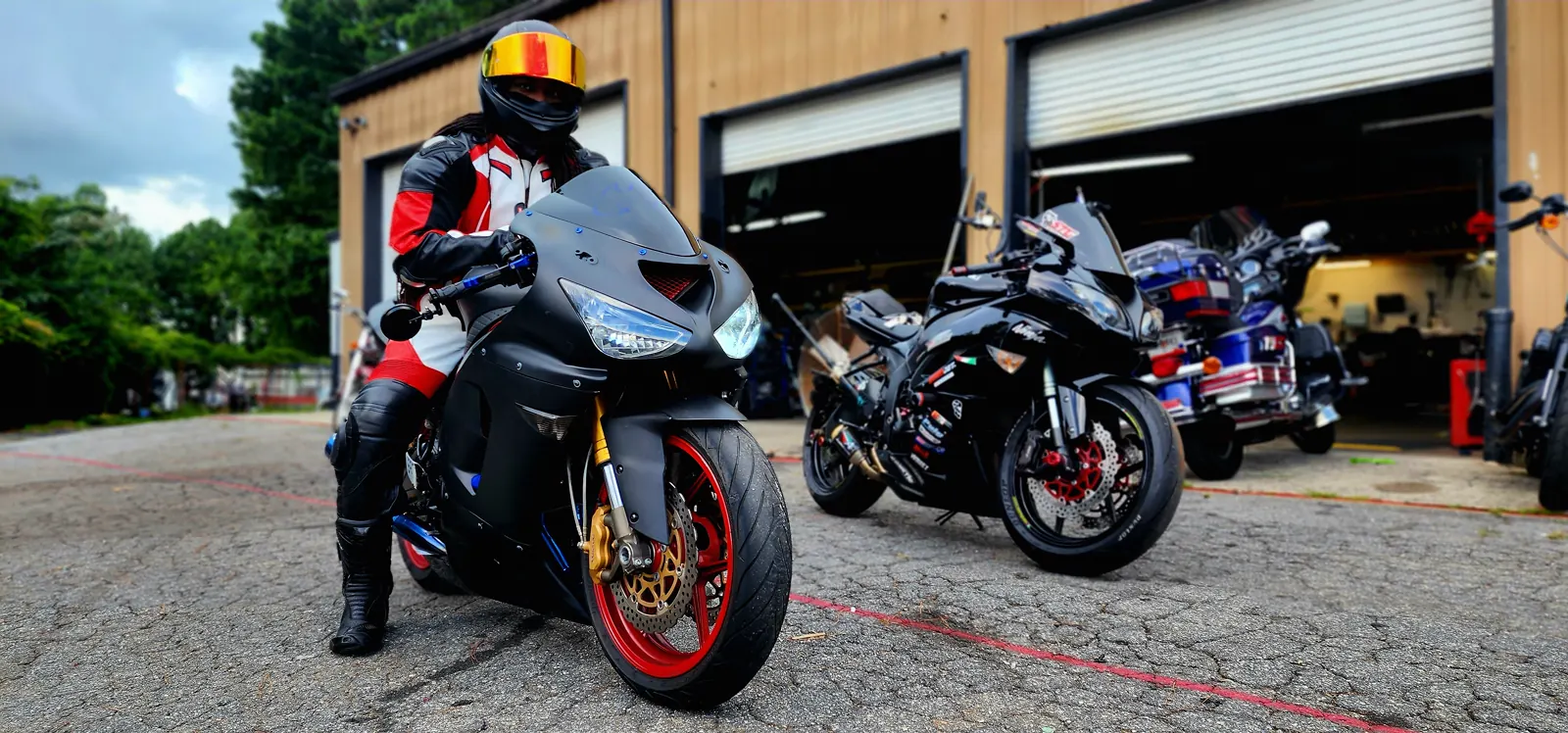
That’s the wrinkle. The row is brand-siloed — the BMW store works on BMWs, the Harley store works on Harleys, and the big powersports dealer runs on volume. So if you own a sportbike, an older Italian bike, or something that’s been modified past factory spec, you can be surrounded by motorcycle businesses and still have nowhere to take it. We built our shop for exactly that rider, and we’re happy on any badge.
Riders here also use their bikes hard on real roads, not just parking-lot loops. GA 372, Birmingham Highway toward Ball Ground, is the classic first leg out of North Fulton into Cherokee County, and it’s the reason we see so much tire, brake, chain and suspension work rather than plain oil changes. If you’re newer to that kind of riding, the MSF Basic RiderCourse is time well spent.
A bike that starts every single time changes how you feel about Monday.
What the fix actually looks like
Most of the time, this ends quietly. We load-test, we find the weak link, we replace it, and we verify the charging system so the same thing doesn’t happen again in six weeks. Then we hand the bike back and tell you exactly what we found in plain words, because you’re an adult and you can handle the truth about a relay.
Occasionally it’s deeper — a failing stator, a wiring harness that got chewed, or a sensor sending nonsense. Even then it’s fixable, and it’s usually less involved than people fear. Since we keep paint, dyno, ECU flash, restoration and transport under one roof, we can also handle the odd jobs that come to light while a bike is already apart. If your tank got scuffed in the process, here’s how we handle that job.
And if you’re reading this from just up the road, the same rules apply one city over — we wrote up the Alpharetta side of things as well, since the symptoms travel but the roads change.
The feeling at the end is the whole reason we do this. You walk out, hit the starter, and the bike catches on the first beat like it’s slightly offended you doubted it. No hesitation, no crossed fingers, no backup plan for getting to work. That’s what being in control feels like, and every rider deserves it.
Questions Roswell riders ask us
What actually causes a motorcycle not to start?
Most often it’s power — a weak battery, a loose ground, or a tired starter relay. After that it’s fuel that’s gone stale or a clogged filter, then spark, then a safety switch like the kickstand or clutch. The sound the bike makes narrows it down fast, so pay attention to whether it clicks, cranks slowly, or cranks strong without firing.
What happens if I just ignore it and keep jump-starting?
You’ll usually get away with it for a little while, and then you won’t. Repeated deep discharges wreck a battery for good, long cranks overheat the starter, and if the charging system is the real cause it keeps getting worse in the background. The fix is almost always simpler when you catch it early, so it’s worth a look now rather than later.
How do you find the cause instead of guessing?
We load-test the battery, check grounds and fuses, then test the charging system at idle and at revs. From there we walk the safety switches, confirm fuel delivery and spark, and pull codes plus live data from the ECU. It’s a fixed order every time, because following the sequence is faster than swapping parts and hoping.
Could it be something other than the battery?
Definitely, and we see it regularly. A stator or regulator that isn’t charging, a kickstand switch full of grit, a fuel pump that won’t prime, fouled plugs, or a sensor sending bad data can all look identical from the saddle. That’s exactly why a proper diagnosis beats a parts swap.
Is it safe to ride a bike that barely starts?
If it fires after a struggle, ride it straight to a shop and don’t shut it off along the way. If the lights dim at idle, the dash flickers, or it stalls at stoplights, don’t ride it at all — the bike can shut down while moving. A trailer or a pickup is the smarter call there, and we can arrange transport.
Do you work on bikes the dealers turn away?
Yes, and it’s a big part of what we do. Modified bikes, older European machines, and anything outside a single brand’s silo are all welcome here. We handle diagnosis, repair, paint, dyno and ECU work in house, so one stop usually covers it.
We take care of riders all over North Fulton and the northwest side of the metro. Alongside Roswell, we regularly see bikes from Alpharetta, Milton, Johns Creek and Crabapple, plus East Cobb and Marietta just across the Chattahoochee. Sandy Springs and Dunwoody riders come up GA 400 to us, while folks from Woodstock and Kennesaw drop in on their way back from the north Georgia roads. Mountain Park sends us its share too, and plenty of Atlanta riders make the trip out because breadth of work beats proximity when your bike needs something specific.
LET'S GET YOU STARTING FIRST TRY
If your bike is sitting in a Roswell garage refusing to cooperate, text or call us and describe the sound it makes — that alone tells us a lot before you ever roll in. We’ll load-test, diagnose properly, and tell you exactly what we found in plain words. And if it won’t move, we’ll come get it.
470-460-9883Diaz Motorcycles and Service, LLC · 847 Barnes Mill Road, Marietta, GA 30062