Motorcycle Running Lean in Cartersville — Why It Happens
That rough, hungry stumble on the first warm ride has a cause, and it has a fix.
Still, the first truly warm Saturday of the year has a sound to it. Plus, Garage doors roll up all over Bartow. Batteries get their first charge since fall. You wheel the bike out, thumb the starter, and it fires — then it stumbles. It surges at idle, it coughs when you crack the throttle, and it starts running hot before you’ve even reached the end of the street. Riders have a name for that hungry, uneven running, and it’s a motorcycle running lean Cartersville sees a fresh wave of it every spring. Better yet, it’s one of the most fixable problems that ever rolls through our door.
So take a breath. A stumbling bike on day one feels like bad news, but usually it’s just your machine telling you something honest. Around here, most bikes sleep in detached, unheated garages, pole barns and outbuildings all winter. That’s great for a project and rough on a fuel system. Fuel sits, ethanol turns to varnish, and tiny passages gum up. Then the sun comes out, you want to ride, and the bike wants a proper meal. Let’s walk through what “lean” really means, what causes it, and when it’s safe to ride versus when you should trailer it.
The Myth: "It'll Loosen Up Once I Ride It"
Here’s the story that gets a lot of good bikes in trouble. A rider feels the stumble, shrugs, and figures a few hard miles will “blow it out.” So they lug it onto GA-20, the Knox Bridge Highway, and ride toward Canton hoping the cobwebs clear. Sometimes the surging eases for a minute and it feels like a win. It isn’t. Nothing loosened up. The engine just warmed enough to mask the symptom, while the real cause kept doing quiet damage underneath.
At the same time the myth sticks because lean running can feel almost sporty at first. The throttle snaps. As a result the bike seems eager. But that eager feel is your engine burning too much air for the fuel it’s getting, which means more heat than the parts were built to take. Riding harder doesn’t cure a lean condition. Riding harder feeds it. The truth is simpler and a lot kinder to your wallet: find the cause, correct the mixture, and the bike stops fighting you.
A lean engine doesn't loosen up. It just gets hotter while you're not looking.
The Reality: What "Lean" Actually Means
Your engine runs on a mix of air and fuel. Picture a campfire. Not enough wood and the flame is thin and pale. Too much wood and it smokes and chokes. An engine is the same idea, just faster. When there’s too much air for the fuel, we call it lean. When there’s too much fuel for the air, we call it rich. Both feel wrong, but they feel wrong in different ways, and lean is the one that quietly bakes parts. A lean bike often idles high or hunts up and down, pops on decel, and gets hot fast.
Why does a bike go lean? Let’s go most common first, because in Bartow the usual suspect is almost always the same. Number one is winter gunk. Fuel that sat for months leaves varnish in tiny jets and injectors, so the bike can’t pull enough fuel and the air wins. Number two is an air leak — a cracked intake boot, a loose clamp, or a tired gasket letting in air the computer never planned for. Number three is a fresh pipe or filter with no tune, so a Yoshimura exhaust flows more air than the stock map knows about. Further down the list sit weak fuel pressure and a lying sensor.
- Ethanol varnish in carbs or injectors after a long winter sit — the number-one Bartow cause
- An air leak at an intake boot, clamp or gasket letting in unmeasured air
- A clogged pilot jet or dirty fuel starving the low end
- A new exhaust or intake bolted on with no tune to match
- Weak fuel pressure from a tired pump or a clogged filter
- A failing sensor feeding the ECU the wrong numbers
Now for the part that catches people off guard. There’s a second failure that hides behind the first one. A rider fixes the obvious thing — say they clean the carbs — and the surging calms down, so they call it done. But the heat from weeks of lean running may have already cooked a spark plug, glazed a valve, or dried out an intake seal that’s now leaking on its own. So the bike runs okay for a week, then the stumble creeps back, and it feels like the repair failed. It didn’t. The first problem just uncovered a second one that was hiding in its shadow.
A motorcycle running lean Cartersville riders bring us is rarely just one simple thing, which is exactly why guessing gets expensive. You can swap parts one at a time and hope, or you can measure. Measuring is where the dyno earns its keep, because it shows the mixture across the whole rev range instead of the one spot you happened to notice in the driveway. It’s the same headache a lot of neighbors run into, and it’s worth seeing what Mableton riders run into on this same problem, since the pattern repeats city to city. The bikes change. On the other hand the physics don’t.
The Actual Process: How a Dyno Finds the Truth
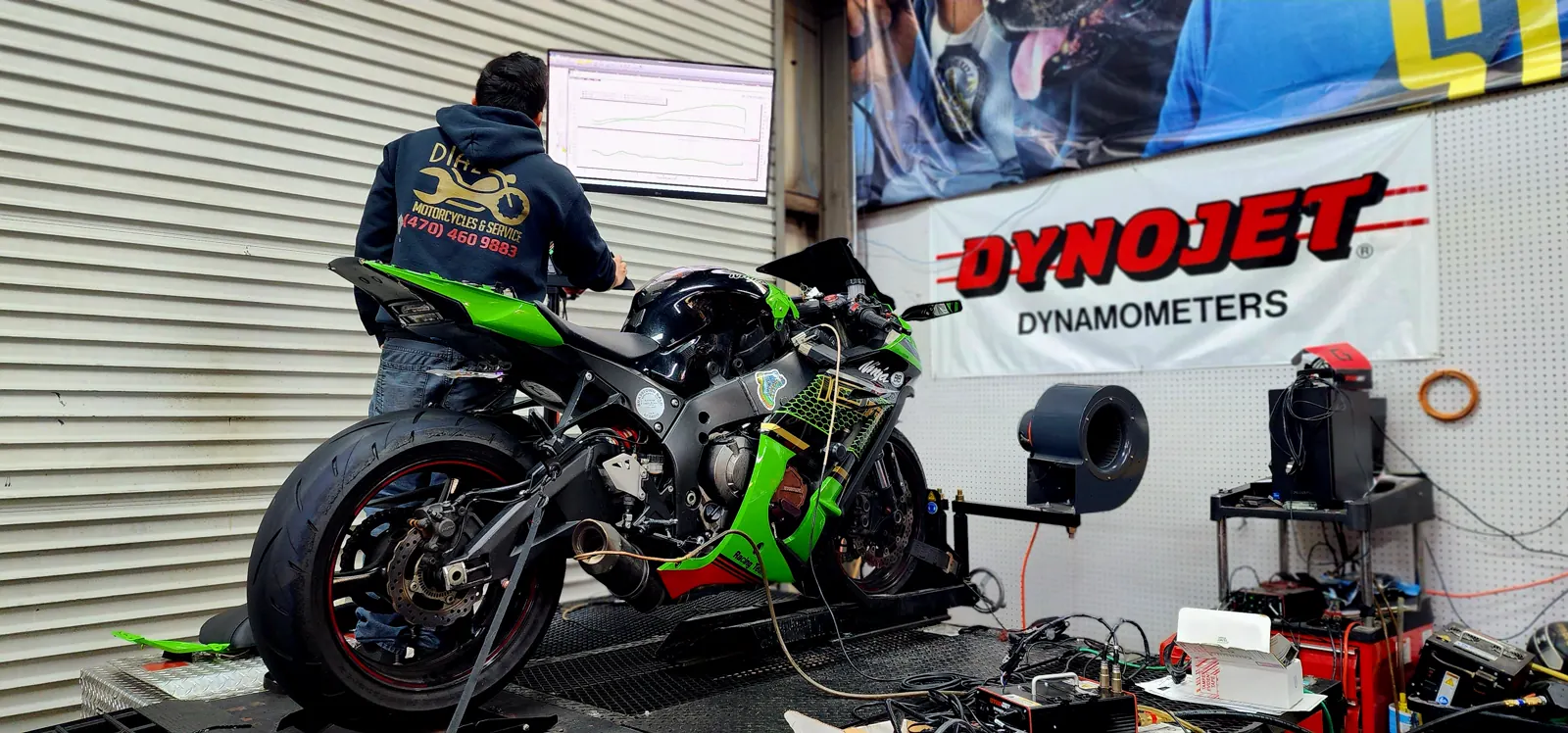
A dyno sounds fancy, but the idea is friendly. We strap the bike down so the rear wheel spins a big drum, then we run the engine through its range while sensors watch. A wideband oxygen sensor goes in the exhaust and reads the real air-fuel ratio at every rpm. So instead of “it feels lean down low,” we get an actual line on a screen showing where it’s lean, where it’s rich, and by how much. That’s the whole trick. We stop guessing and start reading.
- Strap the bike to the dyno and drop a wideband sensor into the exhaust
- Make a baseline pull and read the air-fuel ratio across the whole rev range
- Adjust fueling with an ECU flash or a Power Commander, point by point
- Re-run and re-check until the mixture is right from idle to redline
- Road-verify the feel so the numbers match how it rides
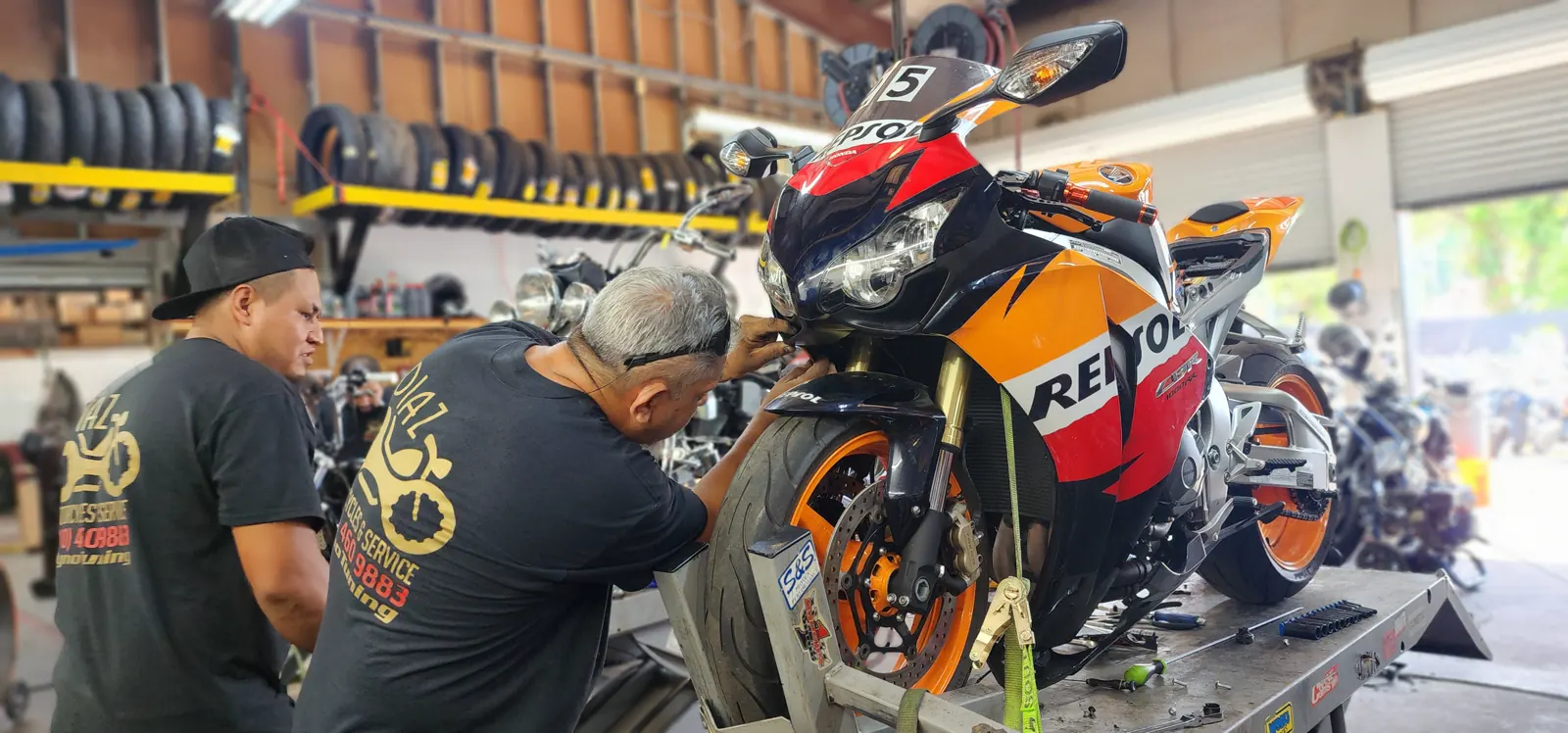
From there we correct the mixture with the tools that bike accepts. Some machines take an ECU flash, where we rewrite the fuel map right in the brain. Others get a Power Commander, a small module that trims fuel on the fly. Either way, custom mapping means the tune is built for your exact bike and your exact mods, not a one-size file pulled off a shelf. If you want the play-by-play, here’s a closer look at what happens in our bays, and if you like the science, Dynojet’s dyno center lays out the hardware in plain terms too.
SAFE TO RIDE?
A light stumble that clears after a carb clean and a few easy miles? Usually fine to ride gently. But if it pings or knocks, runs hot fast, pops hard on the throttle, or surges under load — don’t ride it hard. Trailer it or make one short, careful trip. Lean plus heat is how good engines get hurt.
How to Tell a Good Shop From a Guessing One
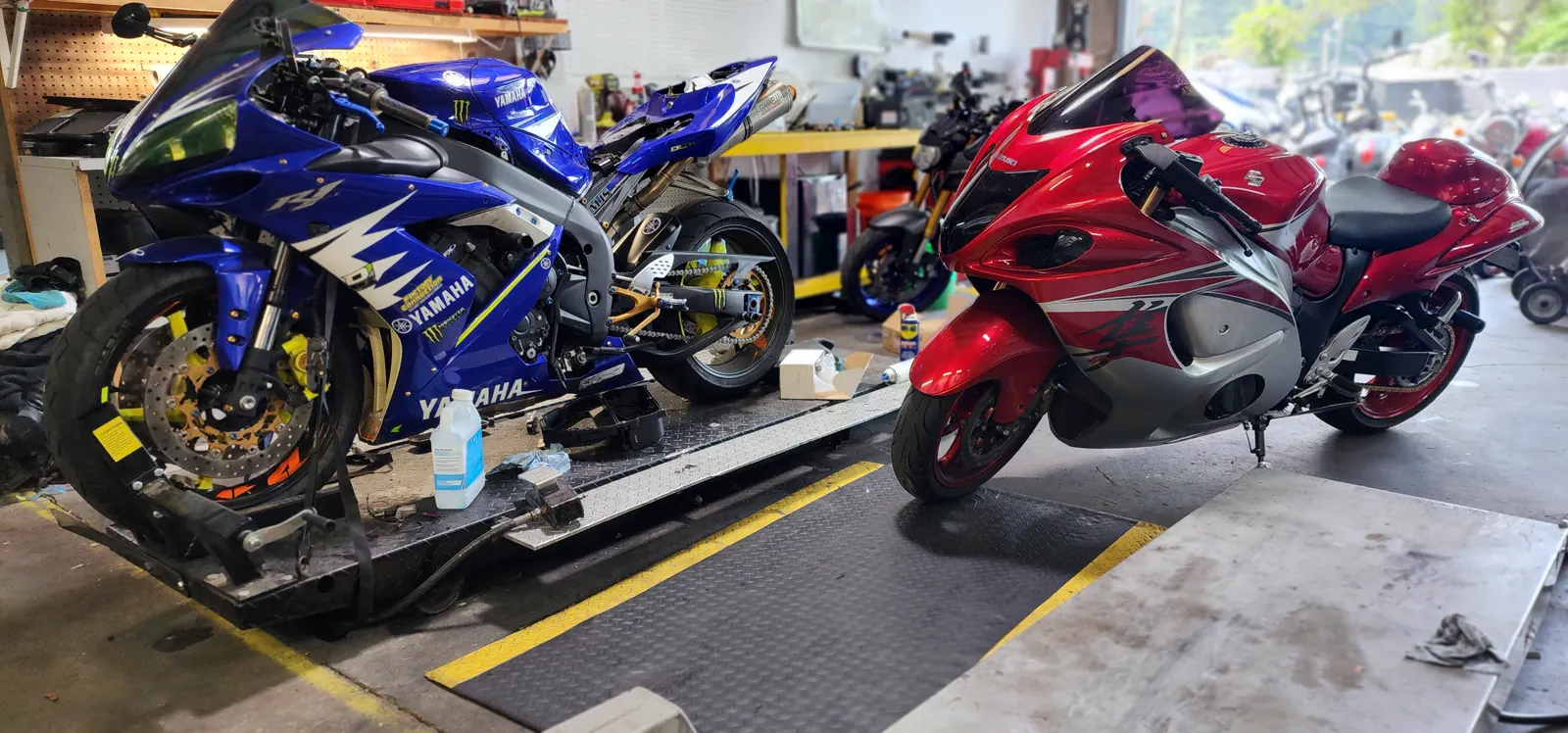
Bartow is a show-me county. Folks here work in plants and trades, and they size up a shop the way they’d size up a machine — by whether it can prove what it says. So when you’re choosing where to fix a lean bike, ask the plain questions. Does the shop have a dyno in-house, or does it ship your bike somewhere else? Does it measure with a wideband sensor and show you the graph? Will it build a map for your bike, or flash a canned file and send you home? A good shop answers in numbers, not adjectives.
- An in-house dyno, so your tune is measured, not mailed out
- A wideband reading you can see, not a promise you can’t check
- A custom map for your bike and your mods, not a shelf file
- Straight talk in numbers — before-and-after mixture, not just “runs better”
- Works on Japanese, European and custom bikes, not one badge only
That last point matters more than it sounds. A brand dealer tunes the brand it sells, and that’s it. Bring in a Japanese sportbike, a European twin, or a home-built custom and the answer is often a shrug. A true multi-line shop treats all of them the same way — measure, map, verify. If you want to see the range of that work laid out, here’s a rundown of what the work covers on the tuning side, so you know what “custom” really means before you drop the bike off.
Local Context: Why Bartow Bikes Go Lean More Often
Cartersville isn’t a generic dot on a map, and its bikes carry local fingerprints. This is an old town with deep roots — the Downtown Business District is the historic commercial core, one of five locally designated historic districts, and Cherokee-Cassville sits out as the fifth of that group. That old-town character means old, detached, unheated storage, which is exactly the kind of place fuel goes stale. Whether a bike lives behind a house in Grove Park or in a barn out past the Rose Lawn Museum, a winter of sitting sets up the same lean stumble. Even the crowd that drifts over from the Savoy Automobile Museum with a classic in the garage knows this dance — engines that sleep get thirsty in a way engines that run never do.
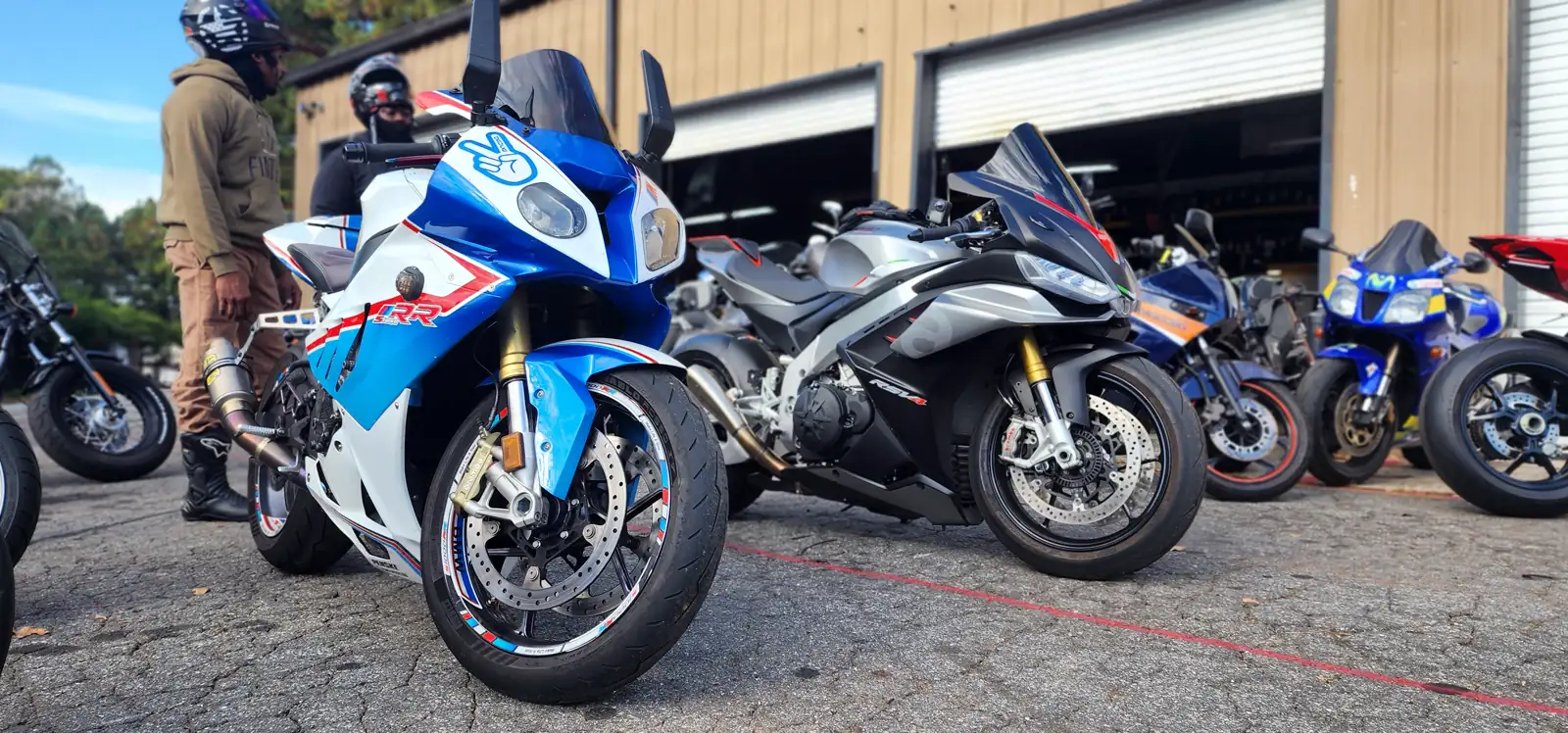
The roads pile on too. GA-20, the Knox Bridge Highway, runs east across Lake Allatoona toward Canton and west toward Rome, and it carries heavy truck traffic that keeps you working the throttle in a way a lean bike hates. Then there’s the fun stuff: US-411 north to Fairmount, GA-53 east to Jasper, GA-5 and I-575 south to Canton, and GA-20 and GA-108 back west. That loop climbs into the base of the mountains, and GA-53 is the challenging bit — curvy, partly carved into a cliff, with a well-earned biker stop at Bigguns BBQ near Jasper. A bike that surges and pops isn’t the bike you want on a road like that. Down in town, Bartow Powersports handles Suzuki, but a sportbike, a European twin or a custom needs a shop that speaks every language.
And here’s the honest part about location. We’re in East Cobb, roughly 35 to 40 miles south, and yes, that’s a drive. Riders make it anyway because a real dyno and a custom map beat a guess every time, and because the total cost of doing it right the first time usually beats fixing a botched job twice. If you’re weighing it out, here’s an honest breakdown of what changes the total, so there are no surprises. Bring the bike once, get it measured, get it mapped, and roll home with an engine that finally agrees with you.
The Outcome: The Ride You Earned
Picture the version of this where you caught it early. It’s a clean fall morning. You caught the stumble back in March, brought the bike in, and had it measured before the heat could hurt anything. Now you’re pulling out for the whole northwest Georgia circuit, US-411 stretching north toward the mountains, and the engine just breathes. No surge at idle. So No cough off the line. No running hot on the climb. Just crisp, even, honest power that does exactly what your wrist asks. That’s not luck. That’s a lean condition caught, measured, and fixed while it was still small.
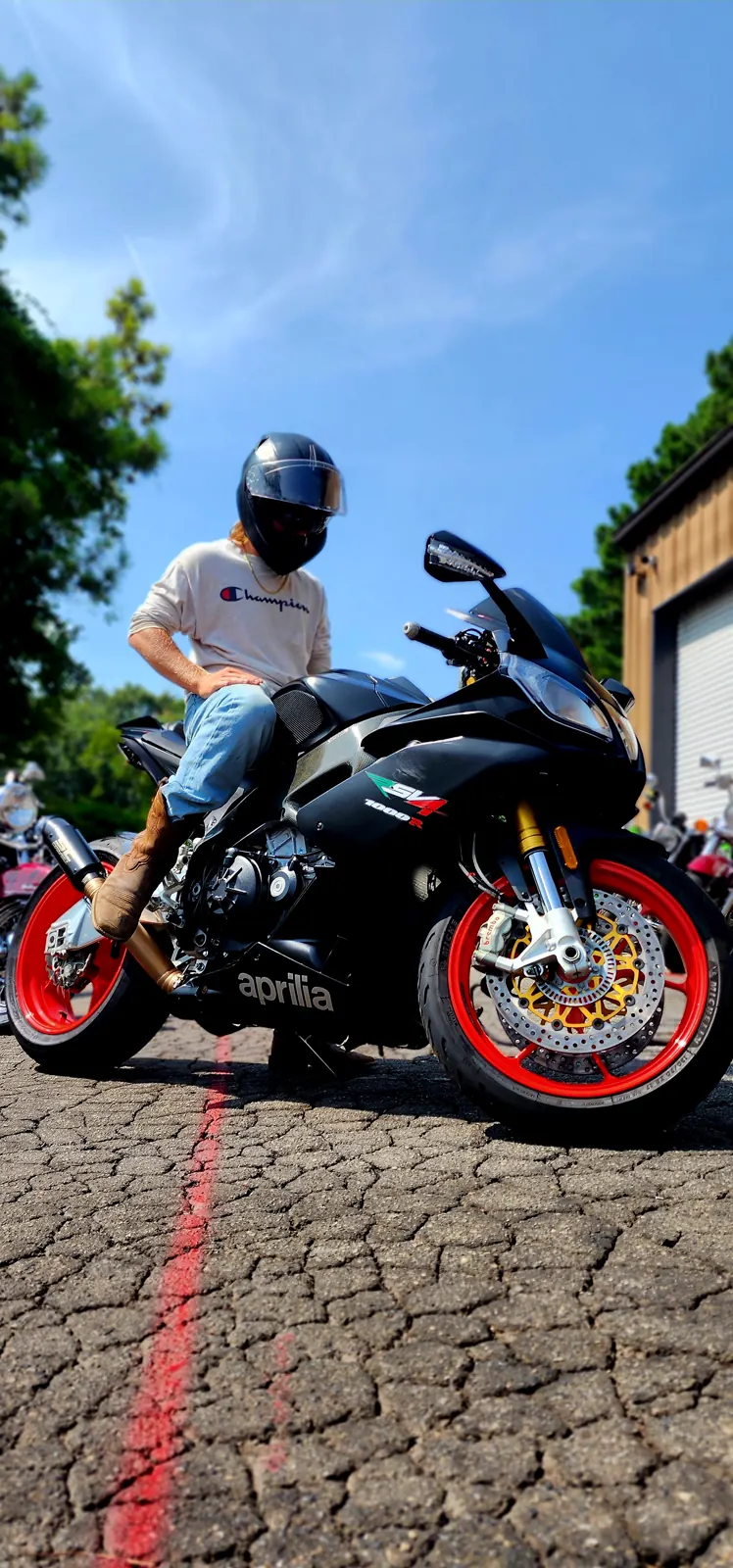
There’s a quiet pride in that. You didn’t ignore the stumble and you didn’t throw parts at it hoping. You had it read, you had it dialed in, and now you understand your own machine better than the guy who just rides and prays. That pride shows up on the road, and it shows up when you keep sharpening your own skills too — a few MSF rider courses pair nicely with a bike that finally runs true. Fix the mixture, trust the throttle, and the rest of the season is yours.
Catch it early, measure it once, and the whole season opens up in front of you.
Questions Cartersville riders ask us
Will a lean condition get worse if I keep riding?
Usually, yes. Lean running makes extra heat, and heat is what damages parts over time. The stumble you feel today is the mild version. Catch it now and the fix stays small.
How urgent is it, really?
It depends on how it acts. A light stumble that clears with a carb clean can wait a little. But pinging, knocking, hard popping or fast overheating means park it soon. Those are the signs heat is already building where it shouldn’t.
What happens if I just ignore it?
The engine keeps running hotter than it should, and small damage adds up. A cooked plug becomes a tired valve, and a tired valve becomes a bigger bill. Ignoring lean rarely saves money — it just moves the repair down the road and makes it larger.
How do you actually find the cause?
We put the bike on the dyno and read the real air-fuel ratio at every rpm with a wideband sensor. That shows exactly where it’s lean instead of us guessing. From there we check the usual causes — varnish, air leaks, fueling — and fix the one the numbers point to.
Could it be something other than lean?
Sometimes. A rough-running bike can also be ignition, a weak battery, or a clogged fuel filter mimicking a lean feel. That’s the point of measuring first — the dyno and a good inspection tell us whether it’s truly lean or a lookalike, so we fix the right thing once.
Do I have to ride it down to you if it's stumbling?
Not if it’s acting up badly. If it pings, overheats or surges under load, trailer it instead of pushing it hard on GA-20 or I-75. If it’s just a mild first-day stumble, a short, easy trip is usually fine. When in doubt, text us and we’ll help you decide.
We tune and fix lean-running bikes for riders all across Bartow County and the ring around it. That includes Acworth, Emerson and Kennesaw just to the south, plus White, Adairsville and Rydal up north where the mountain roads start. We see plenty from Euharlee, Kingston and Taylorsville out west, and riders roll in from Canton, Woodstock and Dallas too. Wherever your garage sits in the northwest metro, the dyno reads your bike the same honest way.
TEXT US AND STOP GUESSING
If your bike is stumbling, surging or running hot on the first warm days, don’t ride it hard hoping it clears — a motorcycle running lean in Cartersville only gets worse when you feed it heat. Text us a quick note about what it’s doing and we’ll tell you if it’s safe to ride down or better to trailer. One dyno pull, one honest map, and you’re back on US-411 with an engine that finally agrees with you.
470-460-9883Diaz Motorcycles and Service, LLC · 847 Barnes Mill Road, Marietta, GA 30062