Motorcycle Running Lean Marietta — How to Fix It
The stumble, the hanging idle, the popping on downshifts — here's what's really going on, and how we find it.
The bag was packed Saturday night. Then again, Sunday morning you rolled the bike out, thumbed the starter, and it caught — then stumbled. The idle climbed on its own. Even so, it surged at small throttle openings and popped on every downshift, loud enough that the neighbor’s dog joined the conversation. Twenty minutes later you were back in the garage with your helmet still on, and the loop out Dallas Highway never happened. If you spent that afternoon typing motorcycle running lean Marietta into your phone, you already found the right words for it. Meanwhile, Better news: this is a fixable problem, not a broken bike.
In fact, that said, Riders almost never use the word lean. They say the bike feels flat. It hesitates when they crack the throttle coming out of a corner. For example, it hangs at a few thousand rpm for a beat after they close it, like the engine didn’t hear them. After that, Cold starts need more warm-up than they used to. What’s more, the headers turn blue near the ports. So and Better yet, On a hot afternoon it gets cranky in traffic, then cleans up once air is moving again. Still, Any one of those alone is easy to shrug off. Together they make a pattern, and the pattern points somewhere specific.
What "lean" actually means
An engine burns two things: air and fuel. Your bike mixes them, lights the mix, and turns that into forward motion. There’s a ratio it likes best, and every engine has its own. Lean means too much air for the fuel showing up. Rich means the opposite, extra fuel that never gets burned. Rich smells like gas and fouls plugs. Lean runs hot, because fuel is part of how an engine keeps its own temperature down. That’s the entire concept. No engineering degree needed.
That explains how the bike feels. A lean mix burns fast and sharp, so power shows up unevenly. Tiny throttle openings get twitchy. The engine makes extra heat, so the fan runs longer and your right leg cooks at every light. Push it further and you get popping on decel, which is unburned mix lighting off in a hot pipe. The bike isn’t being dramatic. It’s handing you information.
THE SHORT VERSION
Lean means the engine is getting more air than the fuel can keep up with. It runs hot, feels flat down low, and pops on the overrun. Nearly every cause is something small that changed.
Why bikes go lean in the first place
Nearly every motorcycle running lean Marietta riders bring us turns out to have a plain cause, and plain is good news. Something changed, and the fuel side never got told. Here are the usual suspects, most common first.
- An exhaust, filter or intake swap with no tune. New pipe, more airflow, same old fuel map.
- A vacuum or intake leak. A cracked rubber boot or a loose clamp lets in air nothing measured.
- Old fuel and a gummed-up fuel system. Bikes that sit collect varnish, and a partly blocked pilot jet or injector leans out the low end first.
- A tired fuel pump or a clogged filter. Plenty of pressure at idle, not enough when you ask for real throttle.
- A lazy oxygen sensor feeding the ECU bad information all day long.
- Carb jetting that never matched the bike after a previous owner’s weekend project.
Georgia weather stacks the deck too. Hot, heavy summer air and pump gas with ethanol in it are hard on fuel systems, especially on bikes parked outside under a cover in an apartment lot. Riding here runs basically year-round, with March through November as the busy stretch, so a bike that sat through a rainy few weeks in the spring can come back with a fuel system that’s slightly off in a way you feel but can’t name. If you’re weighing a factory map against a custom one, we broke down the tradeoffs between them in plain language.
Can you still ride it?
Straight answer, because you deserve one. Mild popping on decel, an idle that sits a little high, and a bike that still pulls clean with normal temps? Ride it gently and get it looked at in the next week or two. You’re not hurting anything at a calm pace.
Park it and get it hauled if you see the other list: temperature climbing well past normal, pinging or rattling under load, power dropping off on the highway, stalling at stops, or a bike that won’t hold an idle at all. Heat is what makes lean expensive, and heat is cumulative. Nobody enjoys hearing “trailer it,” though it beats the alternative by a mile.
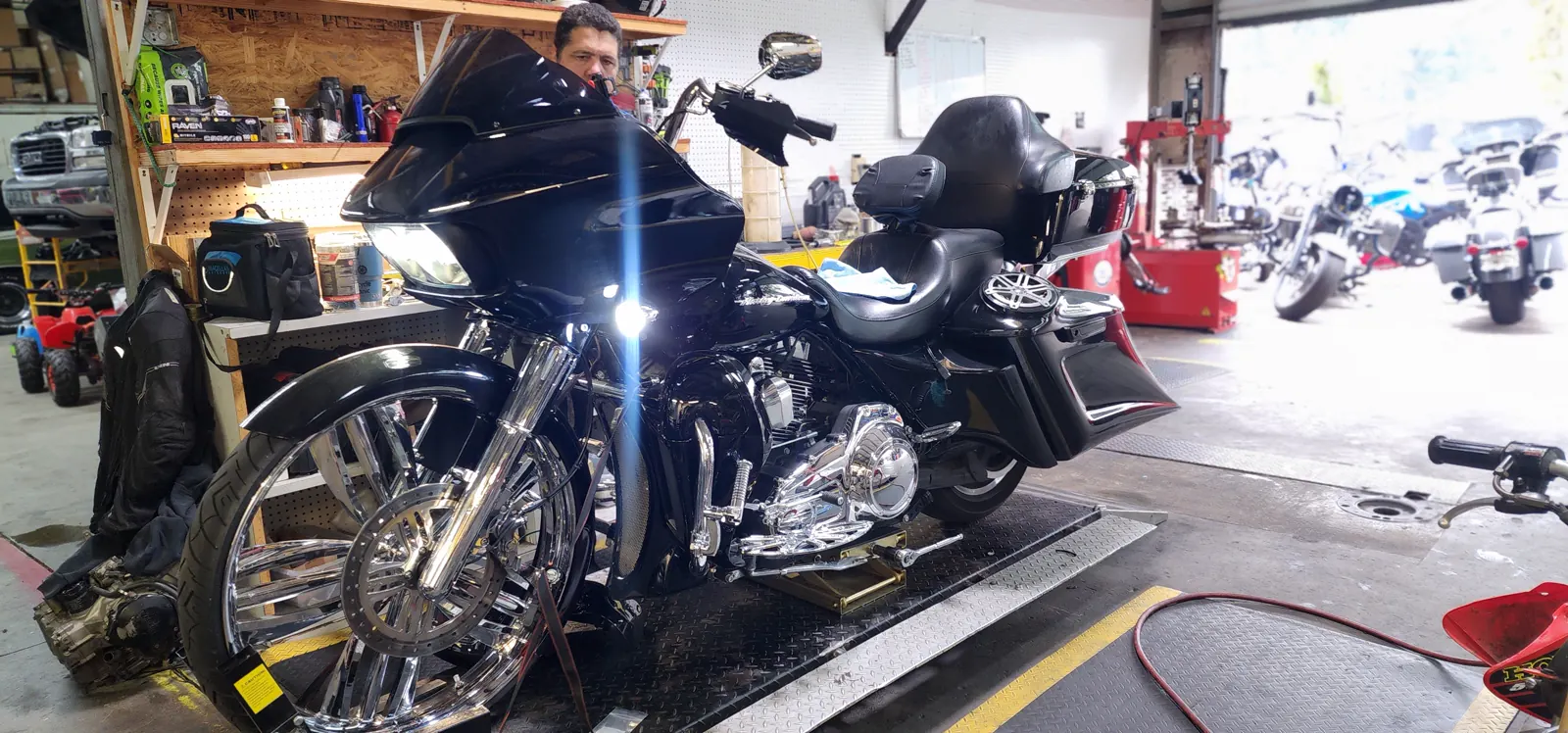
Here’s what a good shop checks that a rushed one skips. A rushed diagnosis reads a code, clears it, sells you a sensor, and sends you home hoping. A real one starts with the cheap physical stuff, proves the fuel side under load, and only then touches a map. Skipping that order is how a bike comes back three times for the same complaint.
How we find the cause
We start with the unglamorous checks, because that’s where the answer usually hides. Fuel pressure at the rail, measured, not guessed. A leak test around the intake boots and throttle bodies. Spark plug color, which tells a long story in a small space. Air filter condition. Battery and charging voltage, since a weak system can make an ECU behave strangely. Then we look at what’s been changed on the bike, and by whom.
After that, the dyno. A dyno is a heavy drum the rear tire spins against while the bike is strapped down. It measures how hard your engine can push that drum through the whole rev range, and a probe in the exhaust reads the air-fuel ratio at the same time. So instead of guessing, we get a picture: exactly where the bike is lean, at what rpm, at what throttle position. Dynojet’s dyno center covers the hardware side if you like reading about the machines. Our own page on everything we cover walks through how a session runs, start to finish.
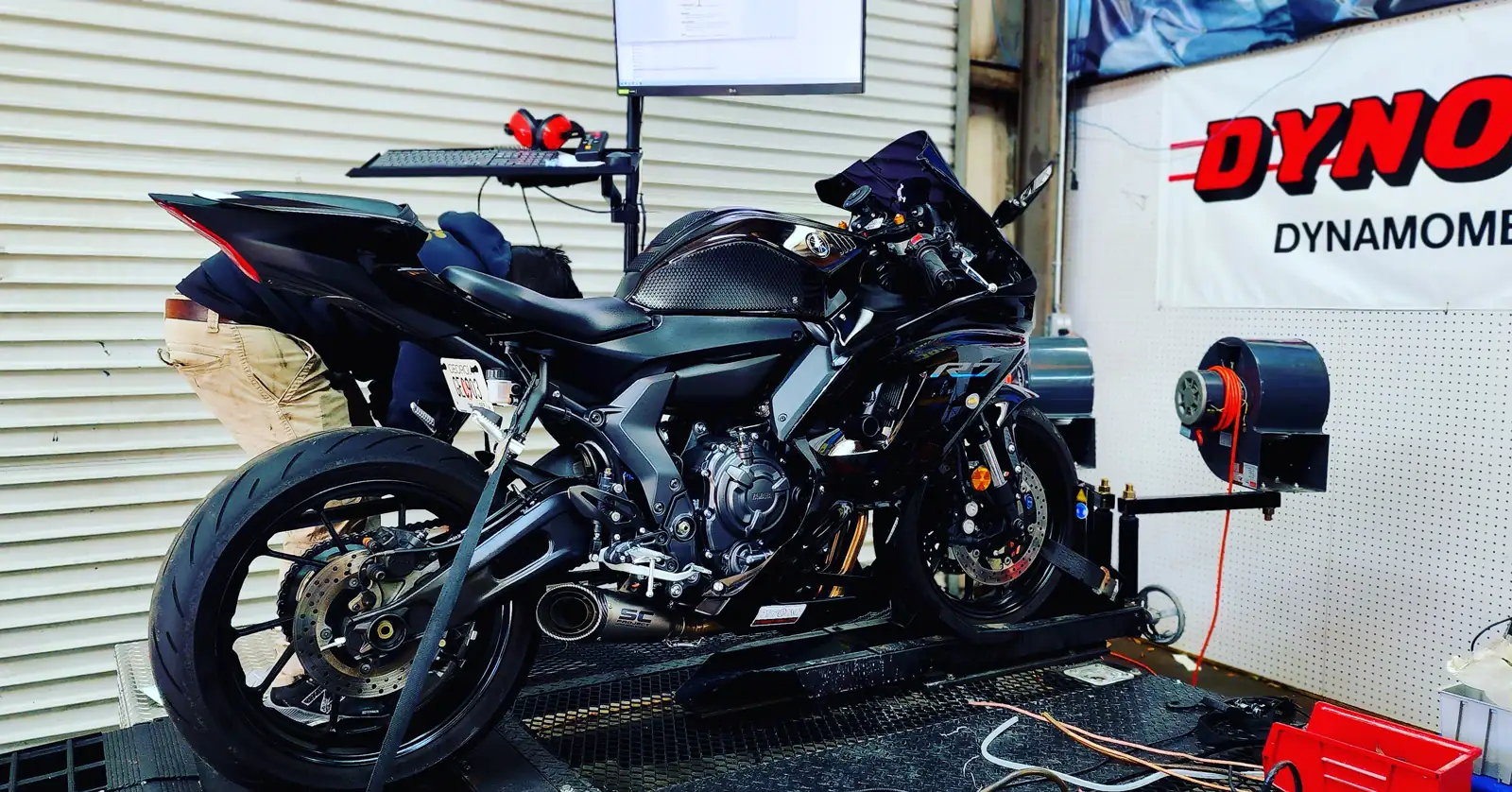
That difference matters more than it sounds. “Your bike is lean” is a symptom. “Your bike is lean from a quarter throttle to half throttle between four and six thousand rpm, and it’s fine everywhere else” is a diagnosis. One of those you can actually fix. Riders north of us deal with the same thing on the same roads, and we walked through how this plays out in Canton if you want a second angle on it.
What the fix involves
Mechanical faults get fixed first, always. A tune cannot patch a vacuum leak or a dying pump. It just paints over it, and the problem comes back on the first hot day. Once the hardware is honest, we adjust the fuel side one of two ways. On many modern bikes we flash the ECU, which rewrites the factory instructions directly. On others we add a fuel controller like a Power Commander, which sits between the ECU and the injectors and adjusts what they deliver. Older carbureted bikes get jetting and needle work instead, same idea with different tools.
- Baseline pull on the dyno so we know exactly what you’re starting with.
- Repair anything mechanical: leaks, filters, pumps, sensors, plugs.
- Build or load the map, then adjust it in small steps across the rev range.
- Verify with more pulls until the air-fuel ratio is where the engine wants it.
- Road test, because a drum in a shop isn’t Roswell Road at five o’clock.
None of that is mysterious, and we’ll show you the graphs when it’s done. If you want the longer version, here’s what that service actually involves from the tuning side.
A tune can't fix a leak. Fix the bike first, then teach it to breathe right.
Here’s how this played out for someone over by Kennesaw Mountain National Battlefield Park. He’d put slip-ons and a filter on a middleweight twin, loved the sound, and lived with a hanging idle for a season because everyone told him that was just how it sounded now. The park itself covers 2,923 acres with more than eighteen miles of trails and an 1,800-foot summit straddling Marietta and Kennesaw, and he’d been meeting friends near the base of it most Saturdays. He’d stopped going. The bike embarrassed him at stoplights.
The pipes weren’t the problem by themselves. A cracked intake boot was letting in extra air on top of the extra flow, so the engine was fighting on two fronts. New boot, then a session on the dyno, and the whole personality changed. Same bike, same exhaust, same rider. He just got his Saturdays back.
Why this comes up so much around Marietta
This city sits at the center of the densest stretch of motorcycle retail in metro Atlanta. Five significant dealers line about four miles of Cobb Parkway, plus a Harley-Davidson store on South Cobb Drive, and there are good independents scattered around too, like The Motor Cycle Shop LLC over at 2041 Shallowford Rd on the northeast side. Lots of places to buy a bike. Far fewer that can put one on a dyno and write it a custom map in house.
The riding mix here is wide, which is exactly why one-size fuel maps disappoint people. Baggers head west out Dallas Highway on Sunday mornings. Sportbikes come out of the neighborhoods off Roswell Road, the stretch of GA-120 running east from the Square that Barnes Mill Road branches from. We see European sport-tourers from the golf-community streets around Marietta Country Club, tidy commuters from the 1980s and 90s houses in Eagle Point, and vintage Japanese projects rolling out of garages behind the Greek Revival and early-1900s homes of the Whitlock Avenue Historic District, all 82 acres and 101 contributing buildings of it, listed on the National Register back in 1989.
Traffic matters here too. Georgia doesn’t allow lane splitting, so you sit in the same stop-and-go everyone else does on I-75, and air-cooled engines feel every minute of it in July. A lean bike in that environment gets hot, then hotter. Fixing the mixture is partly about power and mostly about a bike that behaves when the pavement is baking.
Getting here is easy, which is half the point. We’re about three miles from Marietta Square, eight to twelve minutes out Roswell Road, and no corner of the city is more than roughly twenty minutes away. If you’re the kind of rider who parks at the Square and wanders through the Marietta History Center in the old Kennesaw House, tied to the Great Locomotive Chase, you already know the drive. It’s short.
What it feels like when it's right
A properly sorted bike is quietly obvious. The throttle does what your wrist asks, right now, with no lag and no lurch. Idle settles where it belongs and stays there. Heat drops to normal. The popping goes quiet, or nearly so. Fuel mileage often improves a little, which nobody expects but everybody enjoys. You stop managing the bike and start riding it, and that’s the whole goal.
That confidence is worth protecting. Plenty of riders pair a sorted bike with a refresher class, and the MSF rider courses are a solid way to spend a weekend once your machine is behaving. A bike you trust makes every mile better, whether that’s a commute down Cobb Parkway past the Big Chicken or a long Sunday loop west.
So if your bike has been flat, hot and cranky, don’t write it off as character. Every motorcycle running lean Marietta sends our way has a specific cause, that cause is findable, and the fix is routine work for a shop with a dyno in the building. Bring it by and let’s read what the engine is telling us.
Questions Marietta riders ask us
Can I fix a lean condition myself?
Some of it, yes. Checking your air filter, replacing old fuel, cleaning connections and looking for a cracked intake boot are all fair game in a home garage. What you can’t do at home is measure air-fuel ratio under load across the whole rev range. That part needs a dyno, and guessing at a map without one usually costs more time than it saves.
Will it get worse if I leave it alone?
Usually, yes, and slowly enough that you get used to it. Heat is the issue: a lean engine runs hotter, and heat is hard on valves, pistons and oil. A small leak also tends to grow. The good news is that catching it early keeps the repair simple.
How urgent is this really?
It depends on how the bike acts. Mild popping and a slightly high idle with normal temps means schedule a visit soon and ride easy until then. Overheating, pinging under load, stalling or losing power on the highway means stop riding it and get it hauled in. When in doubt, call us and describe what it’s doing.
What happens if I just ignore it?
Best case, you spend a season with a bike that feels flat and cooks you in traffic. Worse case, sustained heat and detonation damage parts that were fine when the trouble started. A fuel problem is a small repair. An engine repair is not. We’d much rather see you at the small stage.
How do you actually find the cause?
We check the physical stuff first: fuel pressure, intake leaks, plug color, filter, charging system. Then the bike goes on the dyno so we can watch air-fuel ratio at every rpm and throttle position. That tells us whether it’s a mechanical fault, a map problem, or both, and we fix them in that order.
Do I need a full tune, or just a repair?
Plenty of bikes only need the repair. If nothing has been modified and the fuel system was simply dirty or leaking, fixing that often puts everything back where it belongs. A tune becomes the right call when the bike has an aftermarket exhaust, intake or cams, or when the factory map was never a great fit for how you ride.
We take care of riders all over Cobb County and well past it. Alongside Marietta, we regularly see bikes from East Cobb, Kennesaw, Smyrna, Acworth, Powder Springs, Mableton, Austell and Vinings, and riders come down from Woodstock or over from Roswell and Sandy Springs when they want real in-house tuning. Folks out toward Dallas make the run too, since it’s an easy trip in either direction. If you’re in the northwest metro and your bike is running hot and flat, you’re close enough.
LET'S READ WHAT YOUR ENGINE IS SAYING
A lean bike in Marietta traffic is miserable, and it doesn’t have to stay that way. Bring it to Barnes Mill Road and we’ll check the mechanical side first, then put it on our dyno and see exactly where the mixture goes wrong. You’ll leave with a bike that responds when you ask, runs cooler in stop-and-go, and feels like the machine you bought. Call or text us and tell us what it’s doing.
470-460-9883Diaz Motorcycles and Service, LLC · 847 Barnes Mill Road, Marietta, GA 30062