Motorcycle Transport Sandy Springs — What It Actually Costs to Move Your Bike
Why no honest shop can price your bike's move over the phone, and how we handle it instead.
In short call around about moving a motorcycle, and you’ll notice something fast. At the same time every shop gives you a different answer, and most of them sound made up on the spot. Here’s the honest version. As a result Nobody can hand you a real number for motorcycle transport Sandy Springs over the phone, because the price lives in details they can’t see yet. Where the bike sits. Whether it rolls. What’s in the way. On the other hand get those wrong, and the quote falls apart the second the trailer shows up.
That probably sounds like a dodge. It isn’t. So a bike parked in a flat driveway with a working clutch is a ten-minute load. Still, the same bike wedged into a condo deck with a flat rear tire and a dead battery is a different job entirely. Plus, Same motorcycle, same address, two honest prices. So when a shop quotes you fast and firm without asking a single question, that’s the answer worth being careful with.
First, what's actually keeping your bike from getting here
Meanwhile, most of the calls we get fall into a handful of buckets. Of course, None of them are unusual, and all of them are fixable. Read down this short list, and you’ll probably spot your own situation somewhere in it.
- It won’t start or won’t run, so riding it over just isn’t on the table.
- It went down, and now you’re not moving it until someone who knows bikes has hands on it.
- You bought it out of state and need it home in one piece.
- It came to you from family, and it’s been sitting longer than anyone wants to admit.
- You’re moving, or the season’s turning, and the bike simply needs to be somewhere else.
Notice what all five of those share. In every one, the bike can’t come to you, so someone has to come to the bike. That’s the whole job. That’s transport, and it’s built for exactly the rider who can’t or won’t ride in on their own.
What each of those needs from us
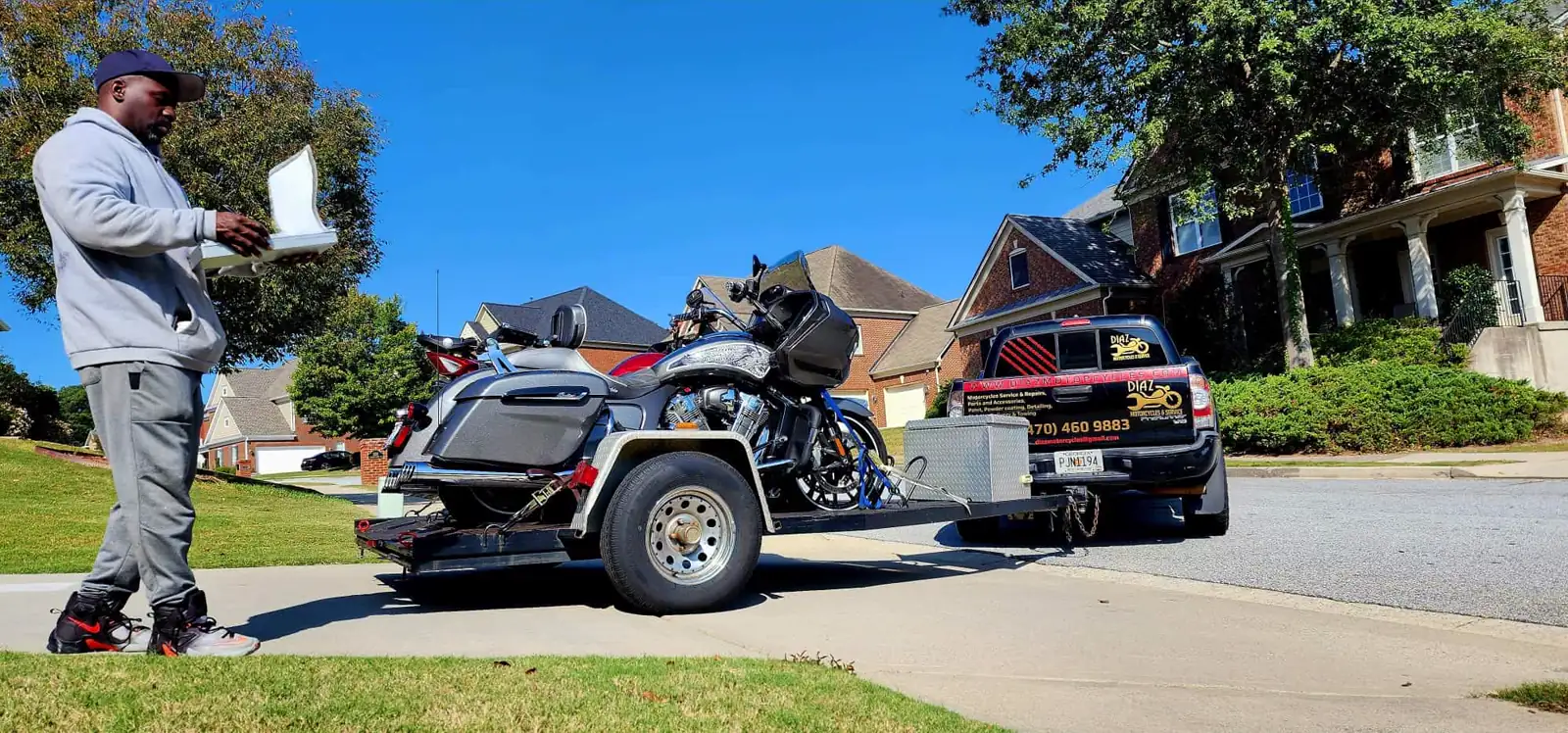
Take the bike that won’t run first. A dead engine changes how we load, not whether we can. We bring a winch and a set of soft straps, and we walk it up the ramp instead of riding it. No clutch needed, no spark needed. If you’re curious about why that problem shows up in the first place, that’s a longer story, but for the move itself a quiet engine is a non-issue.
A bike that’s been down gets treated gently. We don’t force bars straight or roll it on a soft tire. Instead, we photograph it first, load it slow, and strap it so nothing shifts on the road. You’ll get the full rundown on it once it’s up on the bench, but the transport step won’t add a single new scratch to what’s already there.
A bike bought out of state, or one that’s genuinely special to you, is where open versus enclosed earns its keep. An open trailer is the everyday workhorse. Your bike rides out in the air, strapped tight, the same way bikes have been hauled a thousand times over. Enclosed means four walls and a roof between your paint and the highway, so road grime, weather, and prying eyes all stay outside. For a long haul, a show bike, or a fresh restoration, enclosed is worth it. For a quick run across town, open is plenty.
An inherited bike is its own kind of job, and we treat it that way. A bike that came from a parent or an old friend usually carries more than just a title. It’s also been sitting, often for years, so the tires are flat-spotted and the fuel has turned to varnish. None of that stops the move. We roll it up carefully, note the shape it’s in, and bring it home so you can decide what to do with it once it’s somewhere dry and safe.
Seasonal moves are the easy ones, honestly. Maybe you’re heading out of town for a stretch, or the garage is getting shuffled, or the bike just needs to be somewhere else for a while. We schedule those on your timeline, not ours. Storage, service, or a straight point-to-point haul all work the same way from your side: one text, and the bike is handled. No stress, no scramble, no borrowing a buddy’s truck at the last minute.
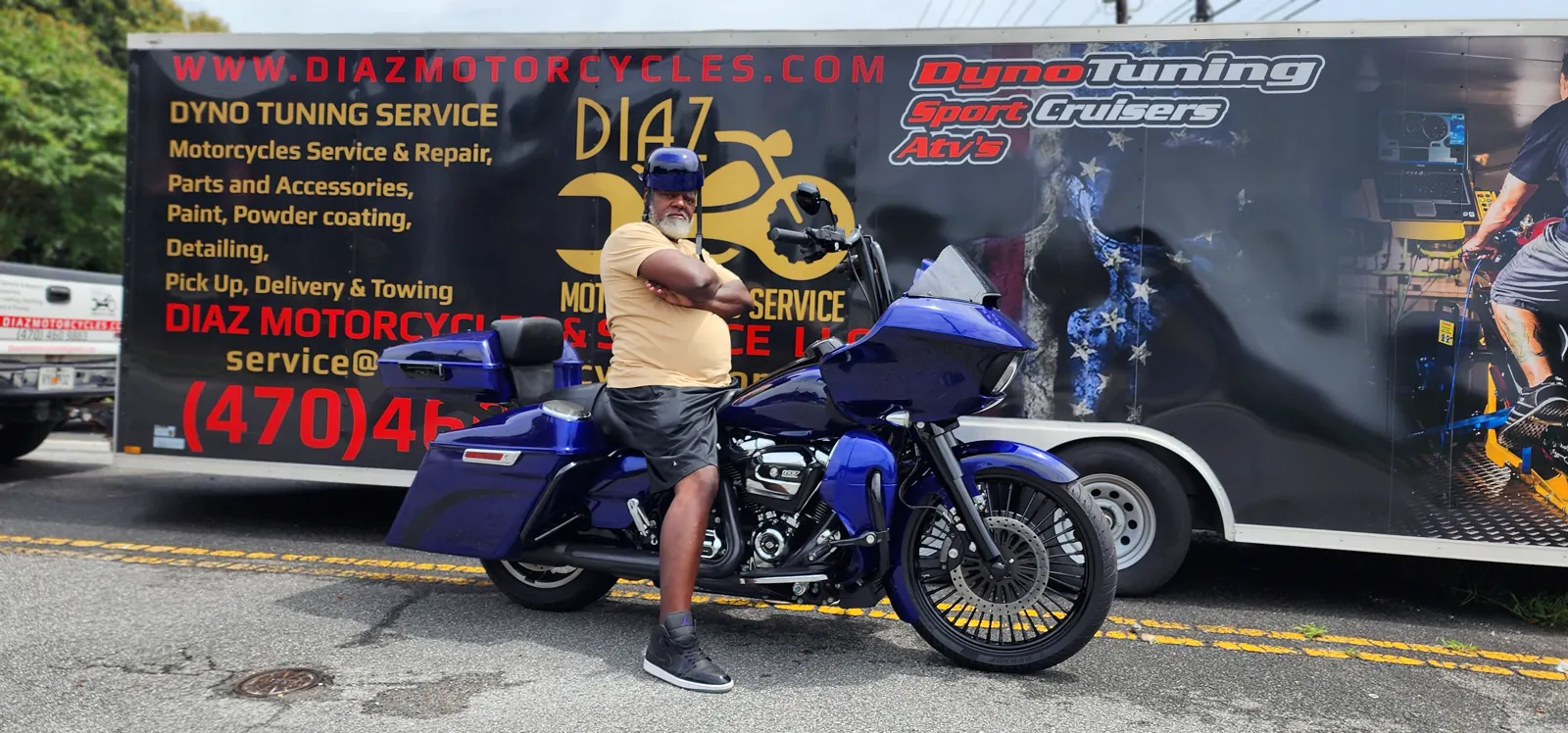
Riders sometimes assume enclosed is always better and open is always risky. It really isn’t that simple. A well-strapped bike on an open trailer is safe, full stop. The choice comes down to weather, distance, and how precious the finish is to you. Either way, we’ll tell you straight which one your bike actually needs, not which one costs us more.
Before we go further, one thing worth clearing up. Transport and a repair estimate run on two different clocks. Getting your bike here safely is the easy, predictable part. What it costs to fix once it’s here depends on what we find, and we won’t pretend to know that from a phone call either. The move is one thing. The work is another. We keep them separate on purpose, so you always know which number you’re looking at.
How we strap a bike down without hurting it
Loading a motorcycle isn’t complicated, but it’s easy to do badly. A lazy tie-down job is how bikes tip, drop, or show up with dents that weren’t there before. Here’s the order we run, every single time.
- We roll the bike onto the trailer and set the front wheel into a chock so it can’t wander side to side.
- Soft straps loop around solid frame points only, never around brake lines, plastics, or anything that bends.
- We compress the front suspension a touch and tie down at all four corners so the bike sits balanced and low.
- Straps get checked, then checked again after the first few minutes of driving, because tension always settles.
Paperwork matters as much as straps. Before we roll, we write down the bike’s condition and take photos of every scratch, every ding, exactly as we found it. You get that record, and so do we. If anyone ever wonders whether a mark was there before the move, the answer is already in writing. That’s not us being paranoid. That’s just how you protect somebody’s motorcycle.
START WITH A PHOTO
Text us a picture of where the bike sits and what’s going on. That one photo tells us more than ten minutes on the phone, and it’s how you get a real answer instead of a guess.
We look before we put a number on it
Here’s how we run the shop side. The bike comes in. We put it on the bench and actually look. Then we call you with what we found and what it’ll take, before we touch a single bolt you didn’t approve. No surprise line items. No work you never okayed. That order matters, and it’s exactly the part cheap operators skip.
Diagnosing before quoting protects you two ways. You never pay for a guess, and you never get a bill for work that didn’t need doing. Plenty has been written about riders getting burned by fuzzy estimates, and the Motorcycle Industry Council is a fine place to start reading. The pattern is always the same: a soft number up front, a hard one at the end. We’d rather be slow and right than fast and wrong.
How the timing usually goes
Most local pickups happen within a day or two of your text, and sometimes same day if the schedule’s open. The drive itself is short. We sit eight to eleven miles from most of Sandy Springs, usually eighteen to twenty-eight minutes by way of Johnson Ferry Road, west across the Chattahoochee into East Cobb. No I-285 required either, which anyone who’s ever sat at that interchange will appreciate.
From the Riverside side, or anywhere near Powers Ferry Road, it’s under fifteen minutes to us. From Perimeter Center it’s more like twenty-five to thirty. Long-distance jobs run longer, of course, and we schedule those around the route so the bike isn’t sitting on a trailer any longer than it has to. Either way, you get a window, not a vague someday.
Sandy Springs riders, and why we come get it
There’s a reason we bring this up on nearly every intake. Sandy Springs is full of good bikes with nowhere close to keep them. It’s an independent city with its own name and its own limits, and it grew up without a single motorcycle shop inside those limits. So riders here are already used to driving somewhere for service. The nearest big option, WOW Motorcycles over in Marietta, sits twelve to fifteen miles west and has done its thing for three decades, but it’s a sales floor first, and it’s still a drive.
The bigger issue is where bikes sleep. A huge share of Sandy Springs is rental, and the mayor has pointed to more than sixty percent of the housing stock spread across dozens of apartment complexes. That means carports, surface lots, condo decks, and street parking, with no outlet for a battery tender anywhere in sight. Neighborhoods like River Chase and Overton Hills have their share of garages, sure, but plenty of riders have none at all. When your bike lives under a cover in an open lot, getting it to a shop on its own power isn’t always an option.
That’s why motorcycle transport Sandy Springs comes down to one simple line here: we come get it. You could be strapping the bike down yourself in the parking lot below your unit, or you could send one text and let us handle the winch, the straps, and the drive. Same bike either way. Very different afternoon. Folks who ride out to Morgan Falls Overlook Park on a Sunday, or launch up GA-400 north out of the Perimeter toward the foothills, would much rather spend the day riding than wrestling a trailer.
We reach the whole area, too, not just one pocket of it. Whether your bike is parked near the Mercedes-Benz USA headquarters over on Abernathy Road, tucked into a garage in Riverside, or sitting at a friend’s place across town, we’ll come to it. We do the same for riders over in Cartersville, so a short local hop doesn’t scare us in the slightest. And if you want the full list of what we do, it’s all laid out plainly on the service page.
What you're left with
Here’s what the whole thing adds up to. You text us where the bike is and what’s going on. We give you an honest read on the move, come get it, look it over, and call you before any real work starts. No riding a sick bike across town. No guessing games on the price. Just your bike, safe on our bench, and a straight answer about what comes next.
The move is the easy part. The honesty is the whole point.
If you’ve been putting this off because the phone calls all felt like a runaround, that’s fair. It usually is. But moving a bike stops being a mystery the moment a shop tells you the truth about what actually drives the cost. Good motorcycle transport Sandy Springs starts with a text, not a runaround. And for good reading while your bike’s in the shop, plenty of riders we’ve helped point straight to RevZilla’s Common Tread.
Questions Sandy Springs riders ask us
Can you actually pick up my bike, or do I have to bring it in?
We come get it. That’s the point of the service. You text us where the bike is parked, and we bring the trailer, the winch, and the straps to your driveway, lot, or condo deck. You don’t ride it, roll it, or lift a finger.
How do I get a quote for the move?
Send us a text with a photo of the bike and where it sits, plus whether it runs and rolls. Those few details are what let us give you a real number instead of a guess. We keep the transport price and any repair estimate separate, so you always know which one you’re looking at.
Do you work on older bikes?
We do, and we like them. Vintage Hondas, Triumphs, old cruisers that have been parked for years — those are some of our favorite jobs. We’ll transport it in gently, look it over, and tell you honestly what it needs before we start anything.
What if the bike needs more work than expected once it's here?
That’s exactly why we look before we quote the repair. If we find something extra on the bench, we call you first with what it is and what it’ll take. Nothing gets done until you say yes. No surprise work, no surprise bill.
What does the transport service actually include?
It covers coming to your location, safely loading and strapping the bike, documenting its condition with photos, and hauling it to the shop. We handle bikes that won’t run, bikes that have been down, out-of-state buys, and inherited bikes that have been sitting. Open or enclosed trailer, depending on what your bike needs.
How fast can you come out?
Most local pickups happen within a day or two of your text, sometimes same day if the schedule’s open. We’re eight to eleven miles from most of Sandy Springs, so the drive is short. You’ll get a real window, not a vague someday.
We come get bikes all over the north metro, not just Sandy Springs. That includes Roswell, Dunwoody, and Brookhaven to the north and east, plus Atlanta and Buckhead when a bike needs to head our way. Right across the river we cover East Cobb, Vinings, Marietta, and Smyrna, and we reach out to Alpharetta, Chamblee, and Doraville too. If your bike is parked somewhere in there and can’t make the trip on its own, one text gets a trailer headed your direction.
TEXT US AND WE'LL COME GET IT
Got a bike in Sandy Springs that can’t ride to us? Don’t wrestle a trailer in your apartment lot. Send us one text with a photo of where it sits and what’s going on, and we’ll give you an honest read on the move, then come get it. Straight answers, no runaround, and your bike safe on our bench.
470-460-9883Diaz Motorcycles and Service, LLC · 847 Barnes Mill Road, Marietta, GA 30062