Running Lean in Sandy Springs — Why It Happens
Your bike feels a little off and you don't know why yet. Let's walk through it in plain words, most common cause first.
On the other hand here’s something plenty of shops will never say out loud: a bike that feels a little off is not always broken. So Sometimes it’s just hungry for the right mix of air and fuel. Still, that pop on decel, the cylinder that runs a touch too hot, the stumble when you crack the throttle from a stop — those are clues, not a death sentence. So if you’ve been searching around running lean Sandy Springs riders deal with every spring, you’re already asking the right question. Good. Plus, let’s answer it in plain words, no jargon wall, and no scare tactics.
Meanwhile, First, let’s name what you’re really asking. You feel a symptom. You don’t yet know the cause. Of course, and underneath that sits a quieter worry: is my engine hurting itself right now? That’s the honest question, and it deserves an honest answer instead of a shrug and a shop ticket. In fact, we fix bikes for a living, so we’ve heard this exact story from folks over in Riverside, near the river with the charter schools, and from the older mid-century streets of High Point. The bike ran fine last fall. It sat through winter. Now it’s acting weird. You’re not imagining it, and you’re not alone.
What "running lean" actually means
For example, an engine wants a specific recipe: so much air, so much fuel, mixed together and lit. When there’s too much air compared to fuel, we call that lean. When there’s too much fuel for the air, we call that rich. That’s the whole idea. Even so, Lean burns hotter and can feel snappy but nervous. What’s more, Rich burns cooler and can feel sluggish, smoky, and thirsty. Neither one is a moral failing on your part — it’s just the recipe drifting off from what the engine likes.
Now, how would you notice a lean condition without any tools? Usually it shows up as feel. The bike surges or hunts at steady, small throttle. It pops and crackles on the way down through the gears. It gets hot fast in traffic and stays hot. Sometimes it hesitates for a beat right off idle, like it took a breath before answering. None of those, by themselves, means disaster. Together, they paint a picture.
The honest answer: here are the likely causes, common first
Most lean conditions have boring, fixable causes. We’ll go from the ones we see most to the ones we see least, because that order saves you worry and saves you time.
Old or bad fuel. This is number one, and it’s not close. Pump gas around here is blended with ethanol, and ethanol loves to pull moisture out of the air. Let a bike sit through a Sandy Springs winter with a half tank and you get fuel that’s gone stale and watery. The engine tries to run on it and leans out because the fuel isn’t carrying the punch it should. A huge share of riders here store outside — under a carport, in a condo deck, in a surface lot — with no garage and no outlet for a battery tender, so bikes sit longer and fuel ages harder. This one is the single most common thing behind a spring bike that suddenly feels off.
Clogged or dirty fuel delivery. Tiny passages in a carburetor, or a fuel injector with a little varnish in it, will pass less fuel than the engine expects. Air keeps flowing at full volume. Fuel doesn’t. That gap reads as lean. Old bikes with carbs are especially prone to it, and Sandy Springs has a real quiet population of 1970s-era Hondas and Triumphs waiting on a shop that’ll take the job.
An air leak. A cracked intake boot, a loose clamp, a tired gasket — any of these lets in extra air the engine never planned for. More air, same fuel, equals lean. These are sneaky because the bike looks perfectly normal sitting still.
A modification the fuel map never learned about. Slap on a louder exhaust or a freer-flowing air filter and you’ve changed how much air moves through the engine. The factory fuel setting doesn’t know that happened, so it keeps delivering the old amount of fuel against a bigger gulp of air. Result: lean, right where you added the part. This is where tuning stops being a repair and starts being a calibration, and it’s the part most people miss.
- Stale or moisture-heavy fuel from a bike that sat — the number-one cause here
- Dirty carb jets or a gummy fuel injector passing too little fuel
- An air leak at an intake boot, clamp, or gasket letting in unplanned air
- Bolt-on exhaust or intake parts the factory fuel map was never told about
- A tired sensor feeding the computer bad information on a fuel-injected bike
Now, the part nobody mentions until you’re already paying for it: chasing a lean symptom with guesswork gets expensive fast. Folks swap a part, then another part, then a third, hoping one of them lands. Each swap feels like progress. None of them measured anything. That’s how a simple fuel issue turns into a long afternoon and a pile of boxes. There’s a better way, and it starts with measuring instead of guessing.
Is it safe to ride like this?
Straight answer, because you deserve one. A mild lean condition — a little popping, a slightly warmer engine, a small stumble — is usually fine for a short, easy ride to get the bike looked at. You’re not going to grenade a motor riding gently across town. Take it slow, keep the revs modest, and don’t lug it or hammer it.
Here’s when to stop and call for a trailer instead. If the engine is running very hot, pinging or knocking under load, losing power, or throwing a warning light, don’t push it. A hard lean condition raises combustion heat, and sustained heat is what actually hurts pistons and valves over time. In that case the smart move is a pickup, not a hero ride. We run pickup and delivery across the whole area for exactly this reason, since so many riders here have no safe garage anyway.
QUICK GUT CHECK
Mild pop and a touch of heat? An easy short ride to get it checked is usually fine. Loud knocking, big heat, lost power, or a warning light? Park it and let us come get it — that’s the ride that can cost you a motor.
What actually changes it: measuring, then tuning
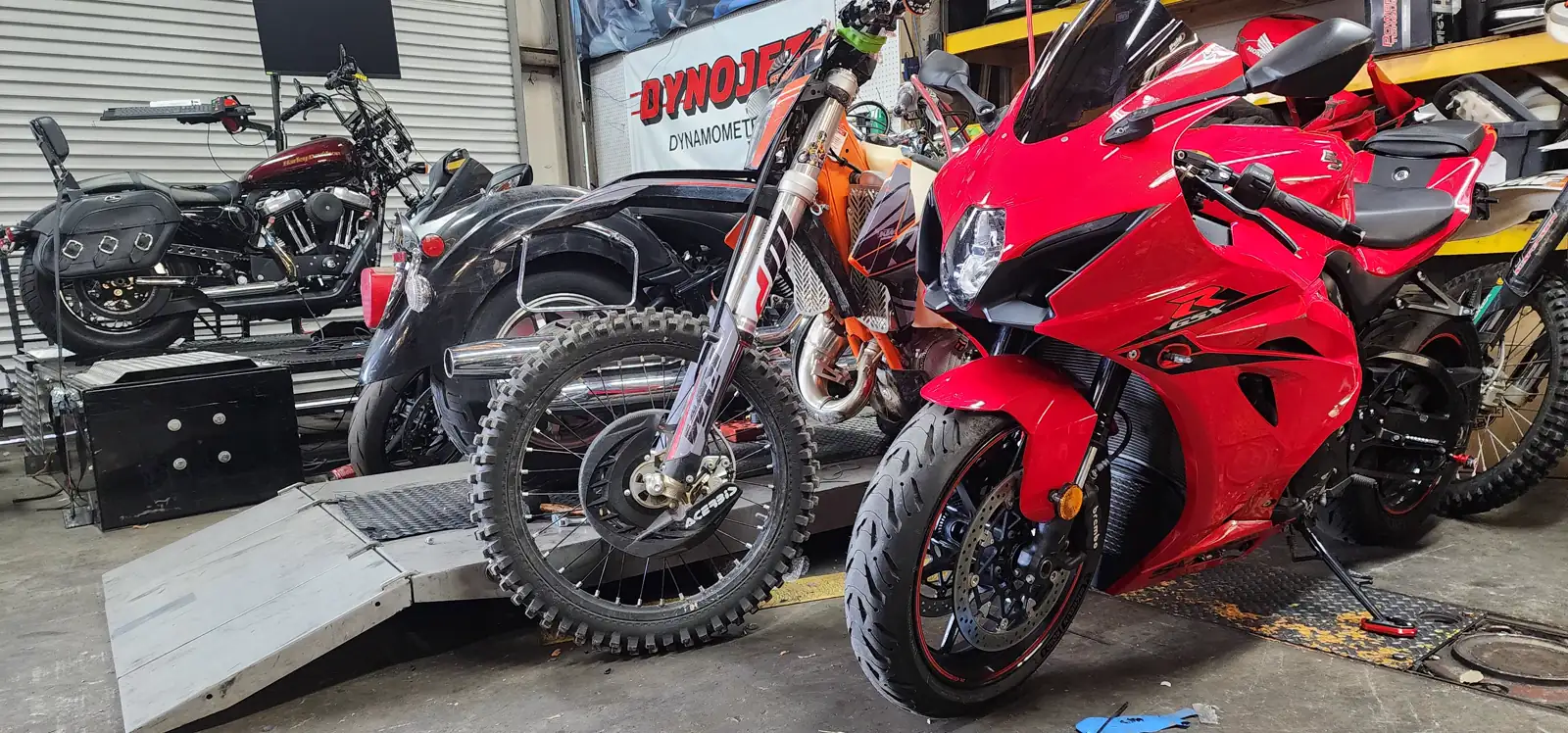
So how do you go from “the bike feels weird” to “the bike is fixed” without the guessing game? You measure. That’s what a dyno is for. A dyno is a big roller the rear wheel spins on while the bike stays put. It lets us run the engine through its whole range under real load and watch what’s happening — how much power it makes, where it makes it, and most importantly, what the air-fuel mix is doing at every throttle position. A sensor in the exhaust reads the mix in real time. Lean spots light up. Rich spots light up. Now we’re not guessing. We’re reading a map of the exact problem.
From there, tuning is just teaching the engine the right recipe again. On a modern bike, that means ECU flashing — rewriting the computer’s fuel and timing tables — or adding a device like a Power Commander that fine-tunes fuel delivery on top of the factory brain. On an older carbureted bike, it means jetting: swapping the little fuel passages and setting them by hand until the mix is right. Either way, the goal is the same. Give the engine the fuel it wants for the air it’s actually breathing. If you want the deeper version of what our team handles, it’s all on one bench, in-house.
And that in-house part matters more than it sounds. Most multi-line dealers along the Cobb Parkway corridor don’t do real custom mapping under their own roof — they send it out, or they don’t offer it at all. A shop with its own dyno, its own ECU flashing tools, and its own Power Commander experience can measure, change, and re-measure in one sitting. That loop is the whole game, and it’s how running lean Sandy Springs bikes actually get sorted for good. Want the checklist version of what the work covers? It’s all laid out there.
How we approach it
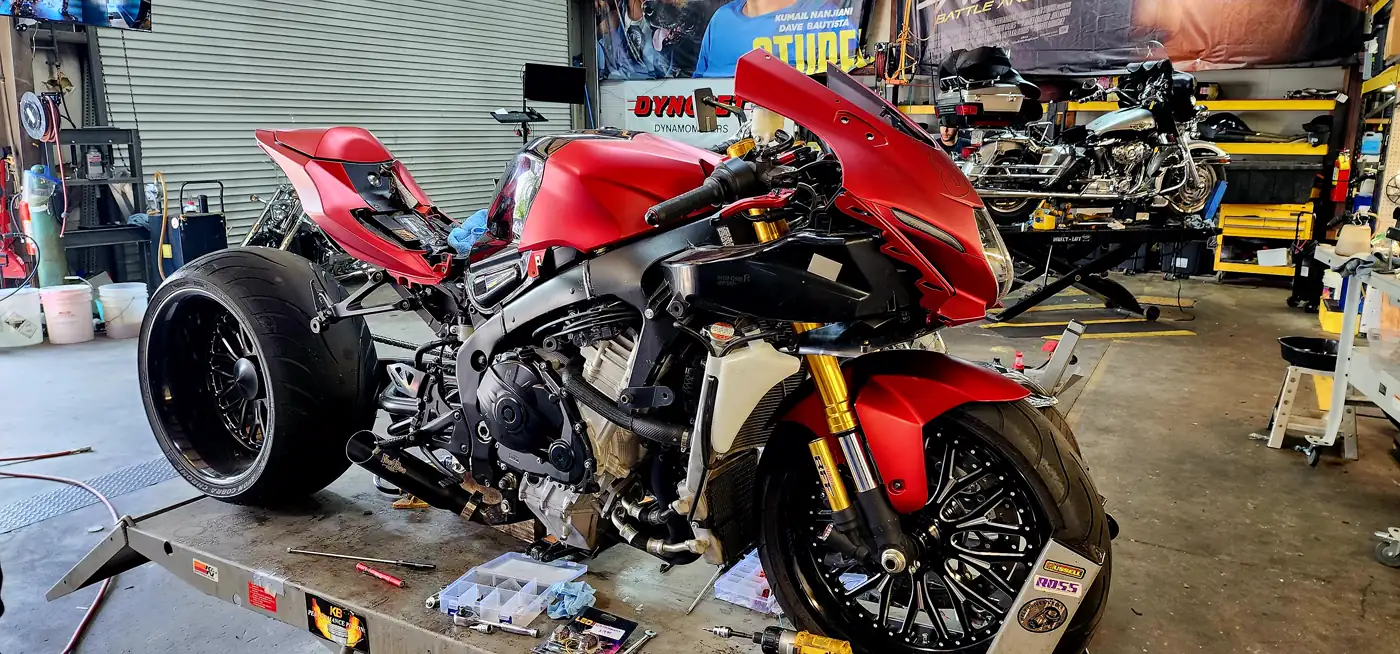
We like to start with the cheap, boring stuff, because it’s usually the answer. Fresh fuel. A clean filter. At the same time a look at the intake for leaks. A battery that actually holds a charge — spring dead batteries are practically an epidemic around here thanks to all the outdoor storage. Nine times out of ten, the fix hides in that first pass, and there’s no reason to touch the tune at all. We’ll tell you that honestly, even when a full dyno session would’ve made us more money.
If the symptom survives the basics, then the bike goes on the dyno and we read the mix directly. We show you the graph. We explain what the lean spot is and where it lives in the throttle. Then we correct it, run it again, and confirm the numbers moved the right direction. No mystery, no “trust us.” A tune is only done when the measurement says it’s done. Curious about what changes the total on a job like this? It comes down to how far off the mix is and whether we’re jetting a carb or flashing a computer — the diagnosis tells us, not a guess.
One more thing worth saying: tires and mix work together on how a bike feels. A nervous, hunting engine gets blamed on tuning when sometimes the chassis is talking too. If you ever want to sanity-check your rubber, Michelin’s motorcycle tire resources are a solid plain-language start. We’d rather point you somewhere useful than pretend everything is a fuel problem.
A tune isn't done when it feels better. It's done when the measurement says it's better.
And then there's the part that's just about riding again
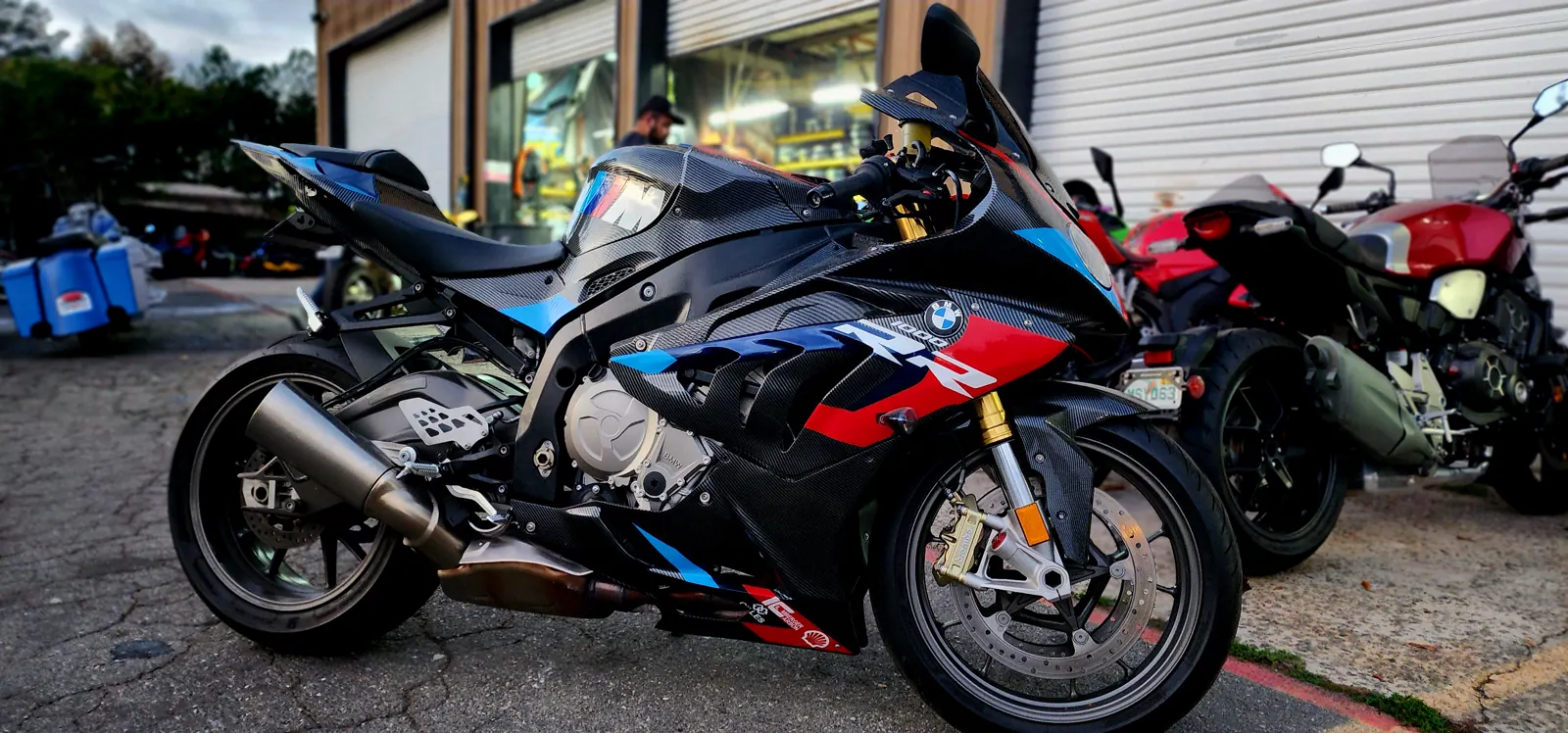
Because that’s the real goal, right? Not a graph. Not a perfect number. The feeling of the bike waking up clean, pulling smooth, and not making you second-guess every stoplight. When the mix is right, a lot of little annoyances vanish at once. The stumble off idle goes away. As a result the engine settles to a calmer temperature in traffic. The decel popping quiets down. Throttle response gets crisp and honest instead of jumpy. You stop babying it and start enjoying it.
That matters extra here, because Sandy Springs riders don’t have much local support. There’s no motorcycle shop inside the city limits — no dedicated repair bay, no dyno, nothing. So a good bike ends up parked in a garage in Winterthur, that established premium enclave, or tucked in a condo deck near the retail bustle around Perimeter Mall, with nowhere close to service it. You’re already driving somewhere for help. The only question is whether that somewhere measures before it wrenches.
Local context: getting to us, and where you'll want to ride after
The good news is we’re close, and the drive is easy. From most of Sandy Springs it’s roughly 8 to 11 miles and about 18 to 28 minutes, straight out Johnson Ferry Road where it crosses the Chattahoochee and drops you right into East Cobb. No interstate slog required. From the Riverside or Powers Ferry side, you might be here in under fifteen minutes, and even from Perimeter Center it’s closer to twenty-five or thirty — still nothing compared to the alternative.
And the alternative is worth naming. The nearest brand-name option, Killer Creek Harley-Davidson up in Roswell, sits about eight to twelve miles north along GA-400 — a franchise floor with dealership pricing and a single brand’s lens on your bike. That’s fine if you ride that one brand and want it. But it’s not custom in-house mapping for a Ducati, a KTM, an S1000RR, or a carbureted classic. That’s the gap we fill, under one roof.
Here’s the fun part of getting the tune right: you finally have a reason to point the bike north. Once your engine runs clean, a run up the Richard Russell Scenic Byway — GA-348 through the Blue Ridge toward Brasstown Bald — is exactly the kind of ride a well-tuned machine was built for. Long pulls, changing elevation, cool mountain air. A lean, hesitant bike makes that ride a chore, while a properly mapped one makes it the whole reason you own a motorcycle. Closer to home, even a lap around the Abernathy Greenway Linear Park feels better when the throttle finally does what your wrist asks.
Road conditions matter too, and they’re another reason to keep your bike healthy. Roswell Road and the older interior streets carry heavy traffic on aging pavement full of utility-cut patches and seams, and the ongoing work around the GA-400 and I-285 interchange adds lane shifts and steel plates. A crisp, predictable engine gives you more attention to spend on the road surface instead of babysitting a stumble. If you like to check ahead on construction, Georgia DOT keeps the current project map.
The outcome you're actually after
Let’s bring it home. A bike running lean is almost never the disaster it feels like at first. Most of the time it’s stale fuel, a small leak, a dirty passage, or a bolt-on part the computer never met. All of those are fixable, and none of them require panic. The trick is to measure before you spend — to read the mix on a dyno instead of throwing parts at a feeling. Do that, and you go from worried to clear-headed in one honest afternoon. Your bike ends up smoother than it’s been in years, and you end up trusting it again, which is the only outcome that ever really mattered.
Questions Sandy Springs riders ask us
Could this be something other than a lean condition?
Absolutely, and it’s smart to ask. A stumble or a hot engine can also come from a weak battery, a tired spark plug, an ignition issue, or even a chassis and tire quirk that only feels like an engine problem. That’s exactly why we measure on the dyno first instead of assuming. The reading tells us whether it’s really the fuel mix or something else wearing that costume.
Is it safe to ride my bike while it's running lean?
A mild case — a little popping and slightly more heat — is usually fine for a short, easy ride to get it checked. Keep the revs low and don’t lug it. But if it’s knocking, running very hot, losing power, or showing a warning light, park it and let us come get it. Sustained hard-lean heat is the thing that actually hurts engines over time.
What causes a bike to run lean in the first place?
Most often it’s stale or moisture-heavy fuel from a bike that sat through winter, which is common here since so many riders store outside with no garage. After that it’s dirty carb jets or injectors, an air leak at an intake boot or gasket, or a bolt-on exhaust or intake the factory fuel map was never told about. We work through those from most common to least.
Can I fix a lean condition myself?
Some of it, yes. Fresh fuel, a clean air filter, and a fully charged battery solve a surprising number of cases, and we’ll never talk you out of the easy stuff. Where it gets tricky is anything that needs measurement — reading the actual air-fuel mix, jetting a carb, or flashing an ECU. That part really does want a dyno and the right tools, because guessing usually costs more than measuring.
Will it get worse if I ignore it?
A mild lean condition can stay mild for a while, but it rarely fixes itself, and a hard one does get worse because heat builds on heat. The good news is catching it early keeps it a small, quick job. The longer a bike runs hot and lean, the more you risk turning a simple tune into a real repair. Sooner is cheaper and easier every time.
Do I have to bring the bike to you, or can you pick it up?
We can come to you. A lot of Sandy Springs riders store under carports, in condo decks, or in surface lots with nowhere to work and no way to safely ride a struggling bike in. Pickup and delivery is a normal part of what we do here, not an extra favor — it’s built into how we serve riders who have no local garage.
We take care of riders all over the north metro, not just Sandy Springs. Folks come to us from Roswell, Dunwoody, and Brookhaven, from Atlanta proper and Buckhead, and from just across the river in East Cobb, Vinings, and Marietta. We also see plenty of bikes from Alpharetta, Chamblee, Smyrna, and Doraville. If you’re within a reasonable ride or a short trailer haul, we’ve almost certainly helped someone on your street already.
LET'S FIND OUT WHY IT'S RUNNING LEAN
If your bike feels off and you’re tired of guessing, let’s put it on the dyno and read the real story. We serve Sandy Springs riders every week — Johnson Ferry Road drops you right to our door, no interstate needed. Text us a quick description of what it’s doing, or ask about pickup if it’s not safe to ride. You’ll leave knowing exactly what’s happening and what it takes to fix it.
470-460-9883Diaz Motorcycles and Service, LLC · 847 Barnes Mill Road, Marietta, GA 30062