Tuning Cost Sandy Springs: What Actually Drives the Price
What a dyno reads, what a tune changes, and why an honest shop looks at your bike before it gives you a number.
So your bike runs sweet for the first mile. Then traffic stacks up near the office decks, the temp climbs, the idle hangs high, and a sharp pop cracks out of the pipe every time you roll off the throttle. It is easy to tell yourself that noise can wait one more month. Here is the part nobody prints on a sticker: a bike that runs wrong does not sit still while you wait — it gets a little worse, quietly, every single ride. A lean engine runs hot and scrubs life off the top end. A rich engine washes oil down the cylinder walls and cakes the plugs with soot. That is the real tuning cost Sandy Springs riders pay when they put it off. Not a number on paper. Real wear you can feel.
What your bike is trying to tell you
Your bike talks to you long before any warning light does. It talks through heat, through sound, and through the way the throttle answers your wrist. On their own, most of the signs below feel small and easy to shrug off. Stacked together, though, they add up to an engine burning the wrong mix of air and fuel. Good news first: every one of these is fixable, and not one of them means your bike is junk.
- Popping or backfiring on decel, especially when you close the throttle coming down a hill
- An idle that hangs high and takes its sweet time settling after you blip it
- Extra heat in slow traffic, so your leg cooks at every red light
- A flat spot or a stumble in the middle of the rev range when you crack it open
- Black exhaust tips, sooty spark plugs, or a strong smell of gas at idle
- Worse fuel range than the bike had a year ago, so you hit reserve sooner than you used to
What each of those signs actually means
Every one of those signs points back to a single thing: the mix of air and fuel feeding the engine. Too much air and not enough fuel is called running lean. Too much fuel and not enough air is called running rich. Your engine wants one specific balance, and it wants a slightly different balance at idle, in the midrange, and at wide-open throttle.
A lean bike runs hot because there isn’t enough fuel in the mix to keep combustion cool. That is your popping on decel, your hanging idle, and the heat baking your leg. Left alone, lean and hot is the exact recipe that wears an engine early. A rich bike, on the other hand, runs cooler but dirty. That is the black exhaust tips, the fouled plugs, the soggy throttle, and the gas you can smell at a light. Rich won’t cook the top end, but it fouls things up and quietly eats your fuel range.
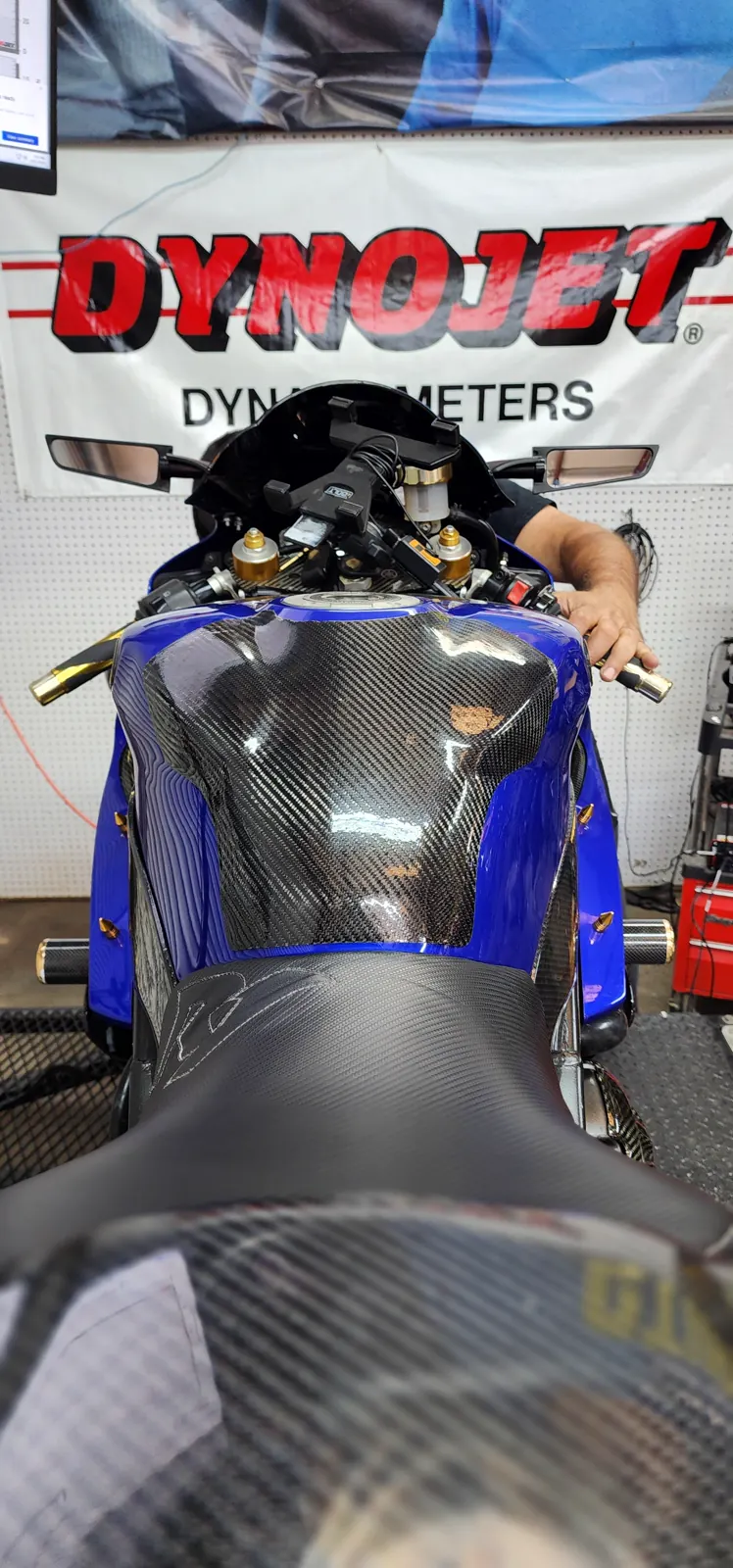
So how do we see the mix instead of guessing at it? That is what a dyno is for. A dyno is a machine built around a big steel drum. We strap your bike down, spin the rear wheel against that drum, and run the engine through its whole rev range while it stays put. Sensors read power at every rpm, and a probe in the exhaust reads the air-fuel mix at each point. Now the guessing is over. We can see precisely where your bike runs lean, where it runs rich, and where it just feels flat.
A dyno turns a vague 'it feels off' into a line on a screen you can actually fix.
What a tune actually changes
Once we can see the mix, we change it. On most modern bikes we do that one of two ways. We flash the ECU, which is the bike’s own little computer, and rewrite the fuel and spark maps stored inside it. Or we add a piggyback unit like a Power Commander that sits between the sensors and the injectors and trims the fuel on the fly. Both methods do the same core job — they feed the engine the right amount of fuel at every rpm instead of the factory’s one-size-fits-all guess.
What you feel afterward is the whole point. The throttle answers cleaner, with no dead spot in the middle. As a result the idle settles instead of hanging. The bike runs cooler when traffic crawls. That snap and pop on decel calms right down, and power comes on smooth instead of lurching. If you want to weigh the tradeoffs between them before you commit, we wrote a whole piece on that too.
STRAIGHT TALK
We won’t promise you an exact horsepower jump before we’ve run your bike. Anyone who does is reading a chart off a different motorcycle. Your numbers come from your bike, on our dyno, every time.
Most people stop reading here. That’s the expensive mistake. They book a tune, feel the difference, and never ask what actually made their job big or small. That one question is where the real answer lives — and it has almost nothing to do with the tune itself.
What happens when you bring it in
None of this is a mystery once you see the order it happens in. Here is the whole thing, start to finish, the way it runs on our floor.
- We talk first. You tell us what the bike does and doesn’t do, what’s been changed, and how you ride. A bike with a full exhaust needs a different plan than a bone-stock one.
- We put it on the dyno and make a baseline pull. This shows us where the bike sits before we touch a thing, lean spots and all.
- We read the air-fuel mix across the entire rev range and mark every trouble zone.
- We build the map. Whether we flash the ECU or dial in a Power Commander, we adjust fuel and spark in careful steps.
- We pull again. And again. Tuning is a loop — change, test, read, repeat — until the mix is right everywhere.
- We hand it back with the numbers off your bike, not a printout from somebody else’s.
What makes one job bigger than another
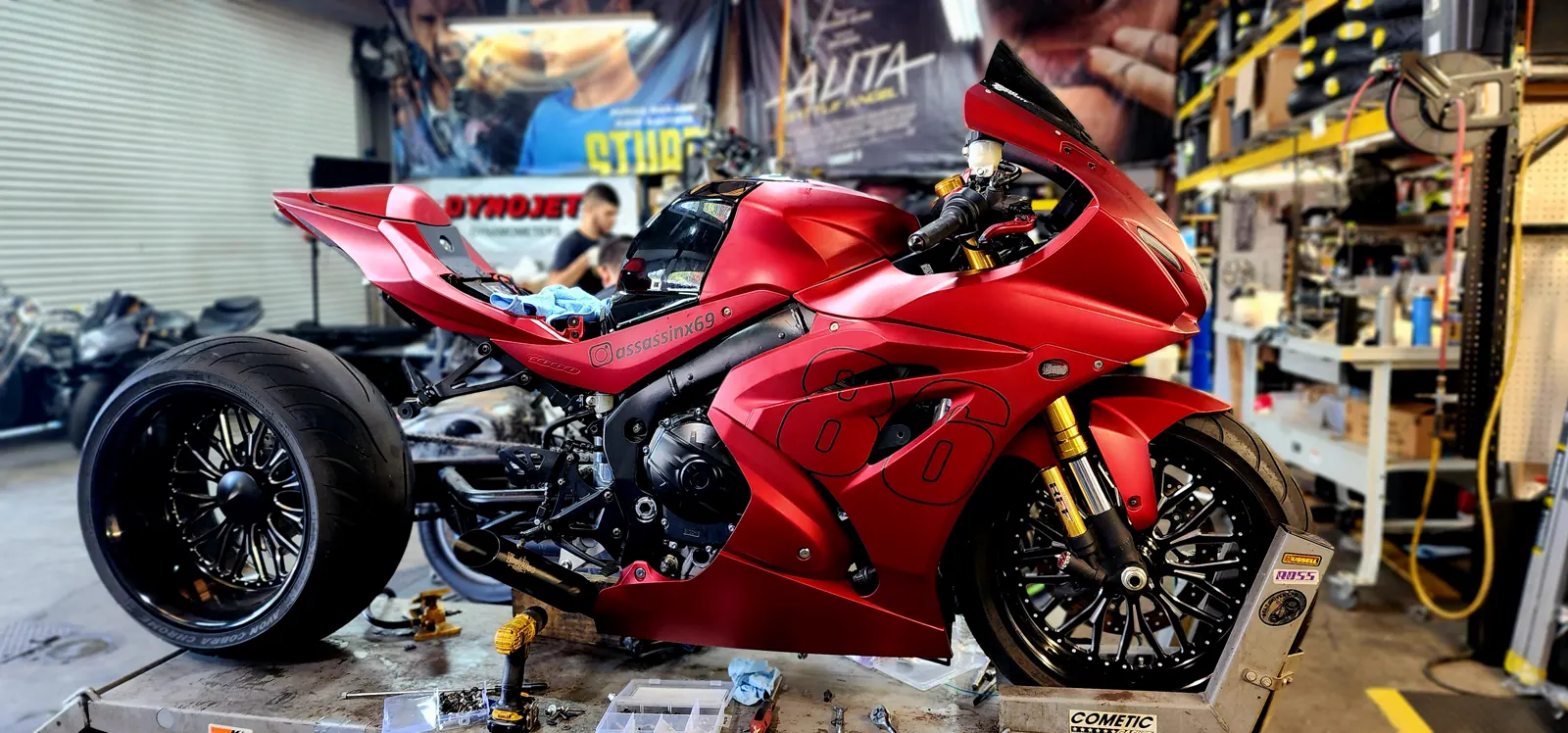
Here is the honest answer to the cost question, minus any number. Two things drive it: parts and labor. The tune itself is labor — our time on the dyno and the hours it takes to get the map right. That part stays fairly steady from bike to bike. That mix of parts and labor is the whole tuning cost Sandy Springs story, and it is exactly why no two honest quotes ever match.
Parts are where jobs split apart. A stock bike that just needs a flash needs no parts at all. A bike that wants more air and a freer exhaust needs those pieces first, because a tune can only balance the air and fuel the hardware allows. And if your plugs are worn or your filter is caked — around here, pollen season from mid-March into late April cakes everything — those get sorted before we tune, or the map gets built on a lie.
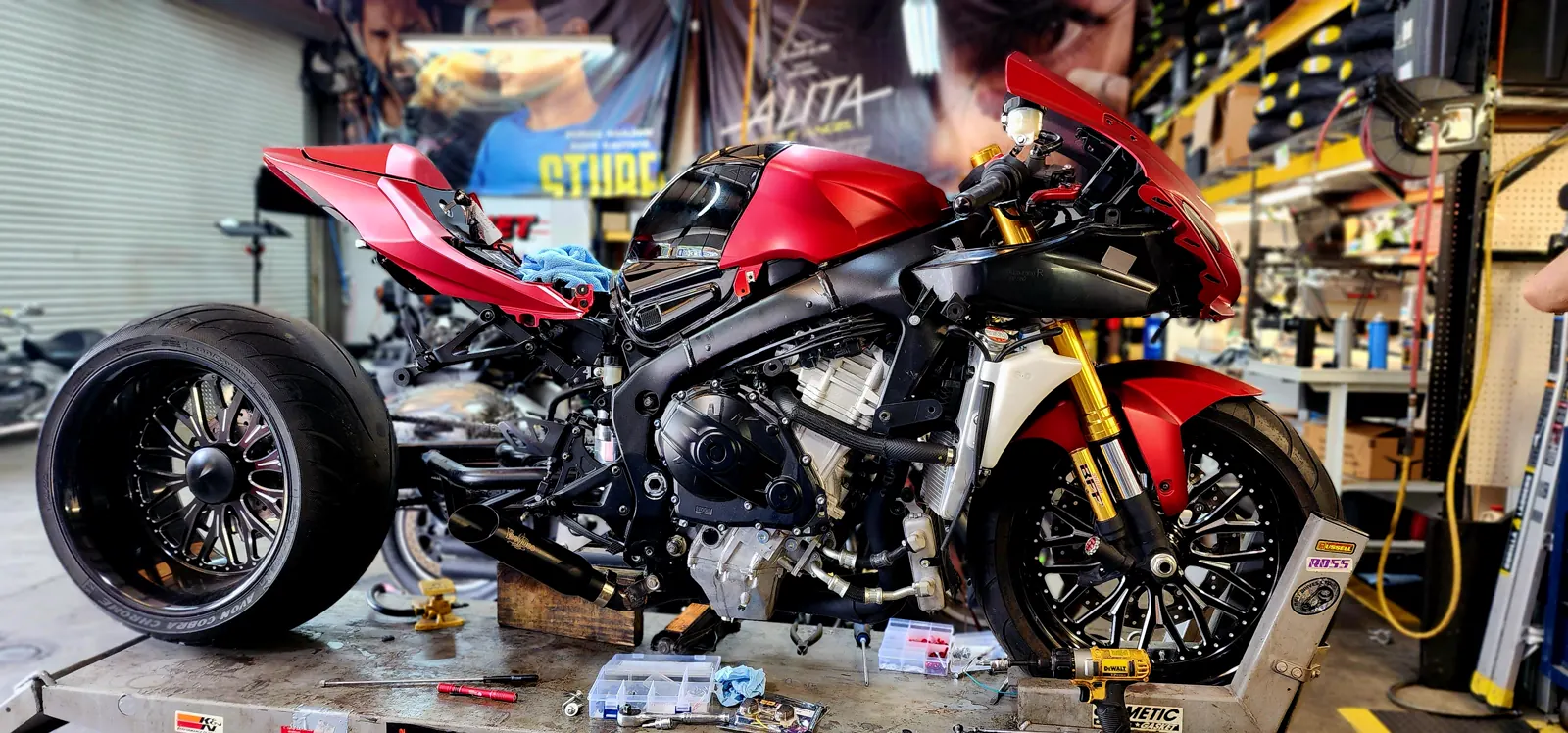
Labor also swings with access. A naked bike with the tank and a panel or two off is quick to reach. A full-faired sportbike or a bagger buried under bodywork takes real time to open up before a single wrench touches the engine. That is why the very same tune can be a short job on one bike and a long one on the next. If you want to see how this plays out in Mableton, we broke the same idea down over there too.
How long does it take
Most tunes are a one-day job. A stock bike getting a flash and a clean-up map can be in and out the same day. A bike that needs parts fitted first, or one buried under fairings, might sit an extra day while we install the hardware and let the dyno work run its full loop. Honestly, we would rather keep it one more night and get the map dead-on than rush it out the door running lean.
Because most riders around here have nowhere to leave a bike torn down at home — more on that in a second — we handle pickup and drop-off. You do not have to trailer it or nervously ride it in mid-tune.
THE PART PEOPLE MISS
The last piece is the one people underestimate: what we find once the bodywork is off. That is exactly why an honest shop won’t hand you a firm number over the phone.
Why we won't quote it sight-unseen
Picture two identical bikes on paper — same year, same model, same color. One lived in a garage on a battery tender. The other sat under a carport in full sun for years, and in Sandy Springs, where a huge share of homes are rentals with no garage and no outlet, that second story is the norm. Pull the panels and those two bikes are not the same at all. One has fresh plugs and clean connectors. The other has crusty grounds, a tired filter, and a vacuum line gone stiff as a pencil.
A shop that quotes you a firm number before it lays eyes on your bike is either padding that number to cover the unknown or planning to surprise you later. Neither one is fair to you. We would rather look first, tell you exactly what we find, and give you a real plan you can trust. That is the whole reason the honest answer to “what’s the tuning cost Sandy Springs” is simply this: let us see it first.
The honest number starts with an honest look.
What this looks like from Sandy Springs
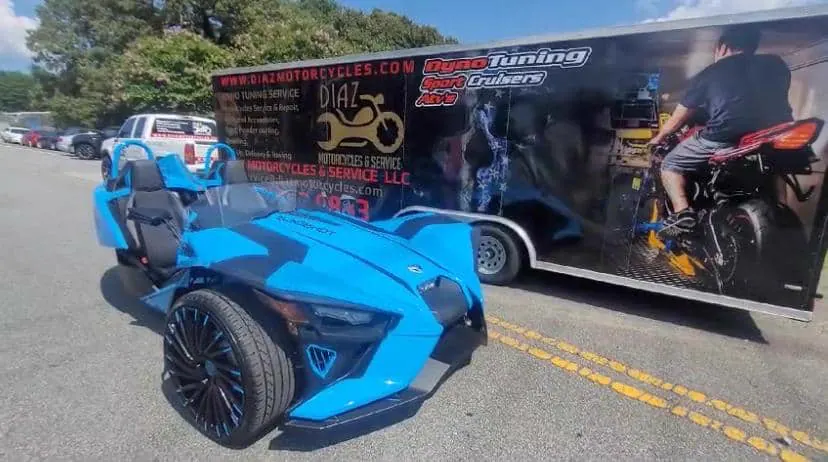
Sandy Springs is a funny spot for riders. It is a real city all its own, with good bikes tucked in a lot of garages and almost nowhere inside its lines to get them serviced. Families out in Riverside near the river and the charter schools, commuters over in Glenridge Close close to the hospital cluster, and folks on the big wooded lots in Lost Forest all share the same headache: no motorcycle shop in town. So you are already driving somewhere. The only real question is where.
The nearest big option is a high-volume, multi-line store — think Mountain Motorsports Roswell, about ten miles out, where the service bay gets spread thin across cars, side-by-sides, and every brand on the floor. Real custom mapping in-house is not what a store like that is built to do. Getting to us is easier than it sounds. From the Riverside and Powers Ferry Road side you are under fifteen minutes; from the Perimeter Center area it is more like twenty-five to thirty. The ride runs west on Johnson Ferry Road across the Chattahoochee into East Cobb — a pretty stretch of pavement, the same one plenty of you already ride for fun — with no interstate loop at all. Call it eight to eleven miles.
You can picture the shape of the market. Everything from the retail anchor at Perimeter Mall — which technically sits just over the line in Dunwoody but does all the heavy lifting as the area’s mall — down past the Mercedes-Benz USA headquarters on Abernathy at Barfield and out to the river, is full of nice bikes with no home shop. That gap is the one we fill, and we like it that way.
We’re bike people, not paperwork people, but a couple of links are worth a bookmark anyway. If you enjoy the research side of riding, the folks at IIHS motorcycle research keep solid data, and if you are still getting street-legal, the state clearly spells out Georgia Class M licensing. Neither one changes your tune — they just help you ride smart.
Where this leaves you
Here is the good part. Once you know what a dyno reads and what a tune changes, you are no longer guessing, and no shop on earth can baffle you with jargon. You know the popping means lean. On the other hand you know the sooty plugs mean rich. You know the tune is mostly labor and the parts depend on your bike and how it was stored. And you know why a real answer always starts with a real look. That right there is the difference between paying for a mystery and buying a fix.
A well-tuned bike is simply more fun. The throttle does exactly what your wrist asks. The engine runs cooler in traffic on those aging inside streets. And the bike lasts longer because it is finally burning the mix it was designed for. Whether you ride a bagger, a European liter bike, or a garage-kept classic, that is what a proper tune buys you. Want the full list of what we do? It is all right there. Rather read up on what that service actually involves first? That works too.
Questions Sandy Springs riders ask us
What's actually included in a tune?
A tune includes a baseline dyno pull, a full read of your air-fuel mix across the rev range, and a custom map built either through an ECU flash or a Power Commander. We test, adjust, and re-test in a loop until the mix is right everywhere. You leave with the numbers off your own bike.
How long does the work take?
Most tunes are a one-day job. A stock bike getting a flash can often be same-day. A bike that needs parts fitted first, or one hidden under full fairings, may sit an extra day so the install and the dyno loop can run right. We would rather take the extra night than rush a map.
Is it mostly parts or mostly labor?
The tune itself is labor — our time on the dyno getting the map dialed in. Parts only enter the picture if your bike needs plugs, a filter, an exhaust, or intake work before we can tune it. A truly stock bike getting a flash may need no parts at all.
Does my bike type change the work?
It can. A naked bike is quick to reach, so the labor is mostly the tune. A full-faired sportbike or a bagger buried under bodywork takes real time to open up first. Baggers, European liter bikes, and older classics each ask for a slightly different plan, which is part of why we look before we quote.
What if you find something else while it's apart?
We call you before we do anything extra. Once the panels come off we sometimes spot a tired filter, worn plugs, or a hardened vacuum line. We tell you what we found, why it matters for the tune, and let you decide. No surprises tacked on at the end.
Do I have to bring the bike to you?
No. Because so many riders here store under carports or in condo decks with no room to work, we handle pickup and delivery. You do not need to trailer it or ride it in while it is running rough. We come across the river and grab it.
We take care of riders all over the north side, not just Sandy Springs. That includes Roswell and Alpharetta up top, Dunwoody, Chamblee, Brookhaven, and Doraville across the way, plus Atlanta and Buckhead in toward town. Closer to the shop we cover East Cobb, Vinings, Smyrna, and of course our home base of Marietta. If your bike runs a little off and you are anywhere in that stretch, we are an easy ride across the Chattahoochee.
LET'S GET IT DIALED IN
If your Sandy Springs bike pops on decel, hangs at idle, or just feels flat where it used to pull, don’t let it ride out another month. Text us a few photos and tell us what it’s doing, and we’ll set up a look — pickup and delivery included, straight across the river into East Cobb. No firm number until we’ve seen it, and no jargon. Just an honest plan and a bike that runs the way it should.
470-460-9883Diaz Motorcycles and Service, LLC · 847 Barnes Mill Road, Marietta, GA 30062