Stranded Motorcycle Pickup Atlanta — How to Fix It
You bought a used bike with a foggy history, and now it won't run. Here's how to read the symptom and get unstuck.
You found it online. What’s more, clean tank, low miles, and a price that felt like a small miracle. The seller swore it ran great, and honestly, it did — right up until the morning it just clicked and went quiet. Now it sits in your garage while you stand over it wondering what you actually bought. That’s the exact moment a stranded motorcycle pickup Atlanta riders trust starts to make real sense.
Buying a bike used is a little like adopting a dog with no paperwork. It might be the best decision you ever make. Then again, it might come with a few surprises the last owner forgot to mention. Either way, you don’t know its history, and the bike can’t tell you. So when it won’t start, won’t idle, or dies at a light, you’re left reading symptoms like tea leaves. Good news up front: those symptoms are readable, and almost every one of them has a fix.
Start by listening to the symptom
Before anyone touches a wrench, the smartest thing you can do is notice exactly how the bike is failing. A no-start is different from a stall. For example, a stall is different from a bike that runs but feels wrong. Each one points down a different path. Here’s how riders usually describe what they’re feeling to us.
- It cranks but won’t catch — the starter spins, the engine turns over, and nothing lights off.
- Plus, it clicks and does nothing — one hard click, then silence, like the battery gave up.
- It starts, then dies — fires for a second or two, then quits as if someone flipped a switch.
- Meanwhile, it idles rough or stalls at stops — fine while moving, miserable the second you pull up to a light.
- It ran, then just stopped mid-ride — no warning, no sputter, simply off.
What each symptom usually means
When a bike cranks but won’t catch, the engine is turning fine — it’s just missing one of three things: fuel, spark, or air. On a used bike that sat in someone’s garage for a season, stale fuel and a gummed-up carburetor or clogged injector top the list. Old gas turns to varnish. That varnish plugs tiny passages, and the engine slowly starves. It’s common, it’s fixable, and it’s usually the first thing we check.
A single hard click with no crank is almost always electrical, and most often it’s the battery. Batteries hate sitting. A bike parked all winter with no tender on it — which describes half the condo-deck bikes in Midtown — drains down and loses the punch to spin a starter. Sometimes it’s a corroded terminal or a tired starter relay instead. None of it is dramatic. All of it is routine.
A bike that fires for a second and then quits is often running on just the fuel left in the bowl, then starving once that’s gone. Think clogged fuel filter, a failing petcock, a weak fuel pump, or a stuck injector. It’s the engine telling you it wants to run and can’t get a steady drink. We see this constantly on bikes that were ‘stored properly’ by someone who genuinely meant well.
Rough idle and stalling at stops usually point at the low-speed circuit — the part of the fuel system that keeps the bike alive when you’re barely moving. Dirty pilot jets, a vacuum leak, or an idle set too low will all do it. On Atlanta’s grid, where you’re stopping every block, this one shows up fast. You’ll notice it first at a red light on Peachtree Street, idling next to those steel plates over the utility trenches, wondering why the bike feels like it wants a nap.
The scariest one — ran fine, then just stopped — can be a blown fuse, a failed stator or regulator, an ignition switch acting up, or a snapped drive component. It feels alarming because it’s sudden. But sudden doesn’t mean expensive or exotic. More often than not, it’s one part doing exactly what worn parts eventually do.
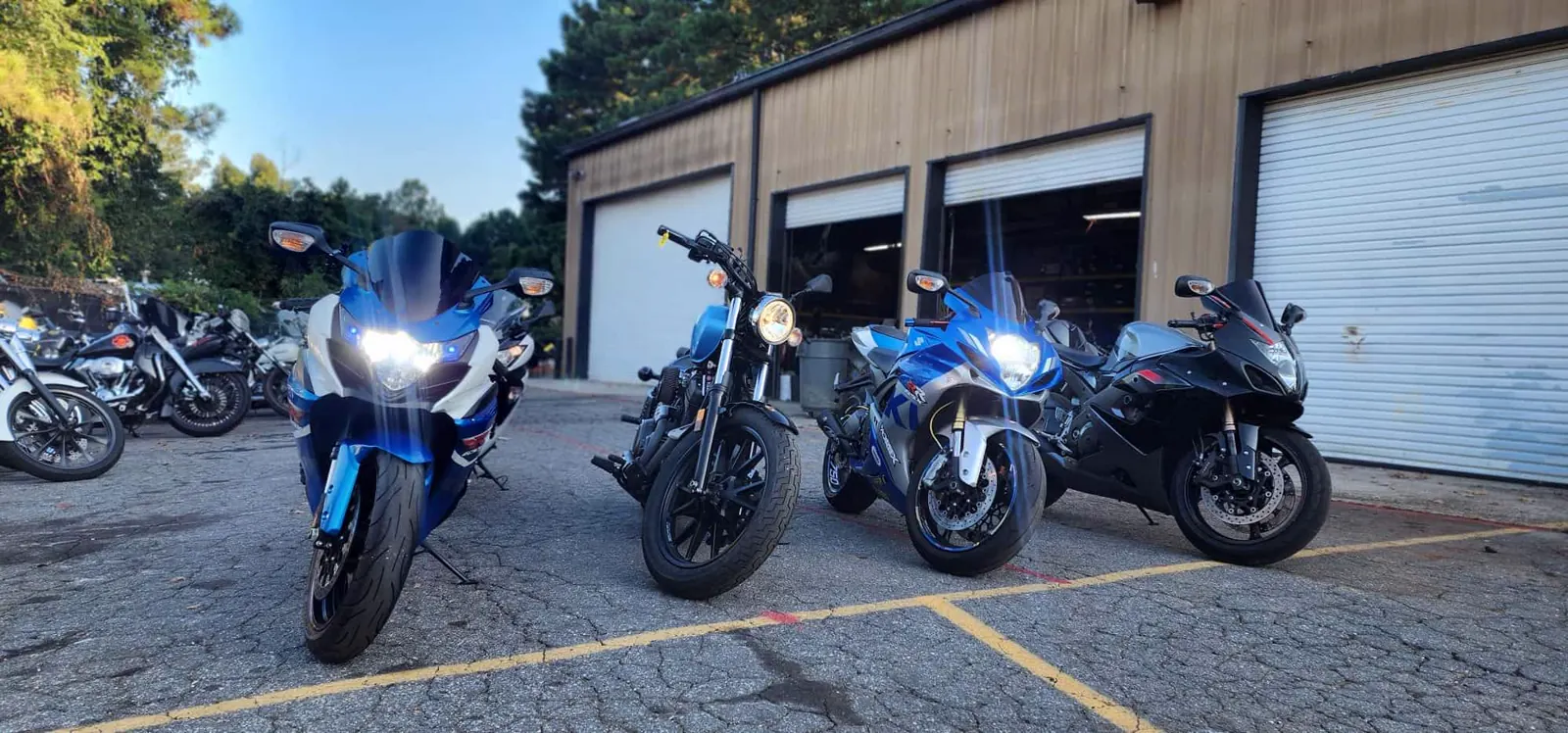
Here’s where it gets interesting — and where most advice online falls apart. Every forum thread will tell you to ‘just check the spark plug’ or ‘clean the carbs.’ That’s fine advice if the bike is already in front of you, on a bench, with tools and a lift. But your bike isn’t on a bench. It’s stuck. And a bike you bought used, with a history you can’t verify, is exactly the bike you don’t want to gamble on by riding it while it’s acting strange.
This is why the pickup matters more than the fix
A shop can diagnose almost anything once the bike is in the bay. The hard part is getting it there. Diaz Motorcycles sits in Marietta, and if you’re in-town — ITP, as everyone here says — that’s a real distance to cover. From Buckhead it’s about 13 miles and 20 to 30 minutes. Of course, From West Midtown, roughly 14 miles. From Midtown near the High Museum of Art on the Woodruff Arts Center campus, figure 16 miles and up to 40 minutes when the Connector is doing its thing. Nobody wants to ride a sick bike that far, and plenty of these bikes can’t be ridden at all.
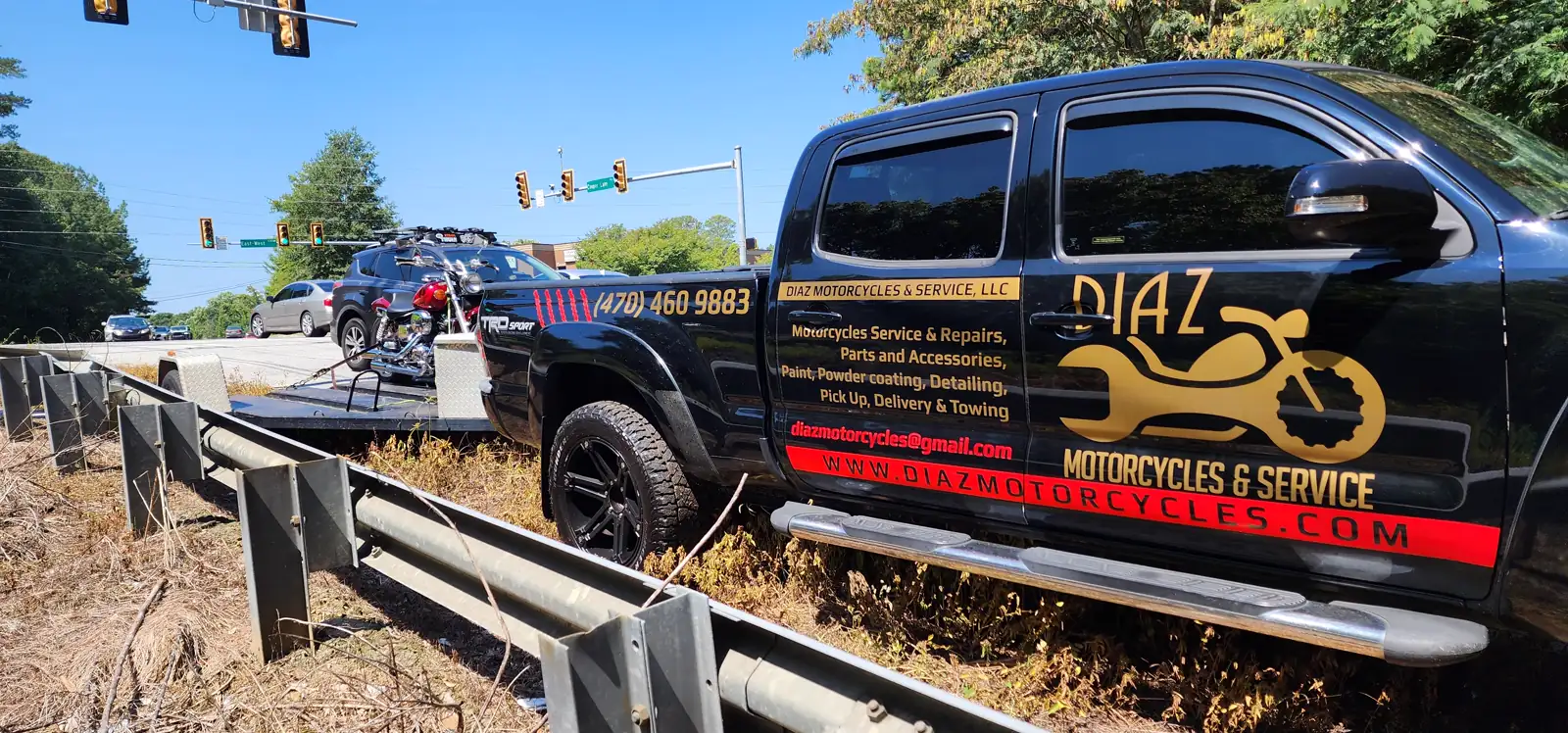
So we come get it. That’s the whole point. A stranded motorcycle pickup Atlanta riders can count on means you don’t push a dead bike up a condo ramp or borrow a truck you don’t own. We load it, we haul it, and you go back to your day. If you want to see what that service actually involves, we’ve laid it out plainly for our friends over in what that service actually involves. And if your symptom turns out to be nothing more than a flat battery, we’ll tell you that too — honesty costs us nothing and earns us the next call.
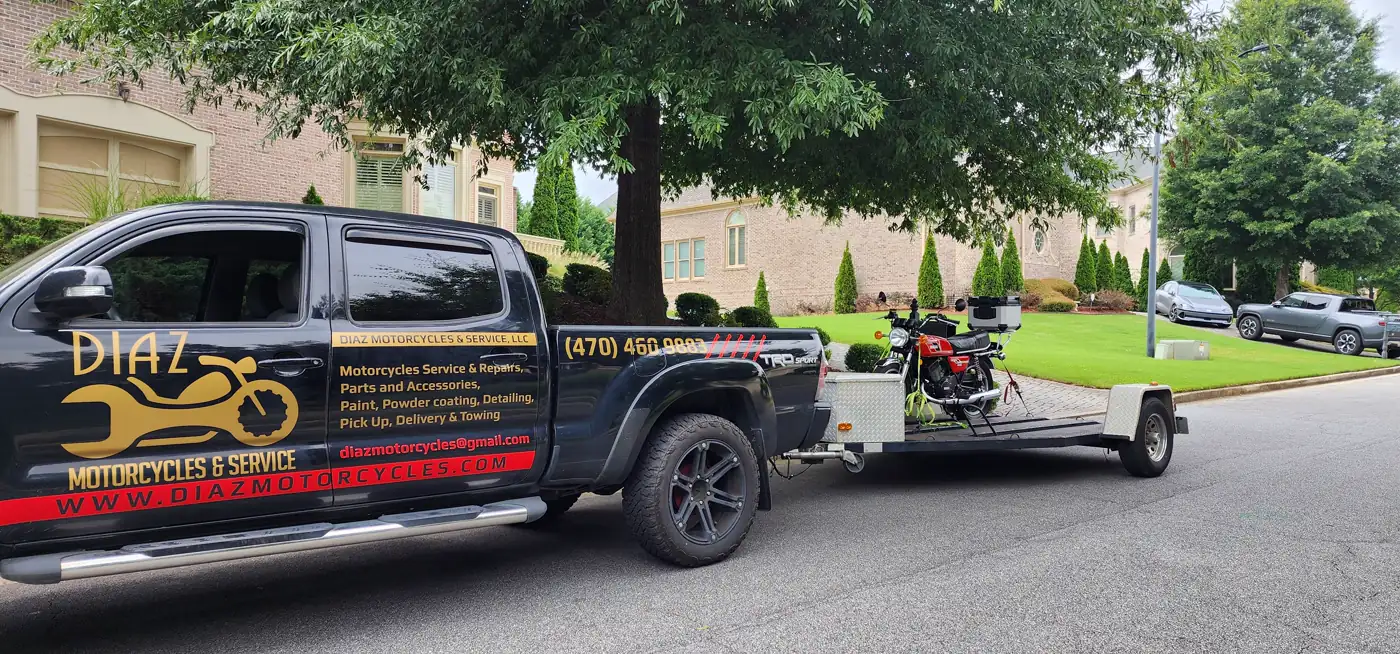
Now the part people worry about most: is my bike safe on a trailer? Fair question, especially with a bike you just spent good money on. Tie-down done right is a real craft. We use soft loops around the triple clamp or bars so nothing scratches, compress the front suspension just enough to keep steady tension, and anchor the rear so the bike can’t walk side to side. A wheel chock holds the front straight. Done properly, your bike rides calmer strapped to our trailer than it ever did in traffic.
Open trailer or enclosed — and why it matters
There are two ways to move a bike: open or enclosed. An open trailer is quick, easy to load, and perfect for a short in-town hop on a dry day. An enclosed trailer costs a bit more time but shields the bike from weather, road grime, and prying eyes — which matters if you’re moving a pristine vintage build out of West Midtown or a premium European bike out of a Tuxedo Park estate garage near the Governor’s Mansion. Both are legitimate choices. We walk you through the tradeoffs between them so you can pick with clear eyes.
For most stranded pickups, open is the right call and nobody blinks. For a concours restoration or a long-distance move across state lines, enclosed earns its keep. The bike you bought used might be either kind of bike. That’s your call in the end, and we’ll give you a straight recommendation instead of upselling you into a trailer you don’t need.
Paperwork is the quiet part that protects you
Nobody buys a used bike dreaming about documentation. But when a bike changes hands with an unknown history, paper becomes your friend fast. Before we load, we note the bike’s condition — existing scratches, dents, mileage, what’s already loose. That way, the bike that comes off our trailer is provably the same bike that went on. For an out-of-state purchase or an inherited bike from an estate, a clean condition report and a simple bill of transport keep everyone honest. It’s boring. It’s also exactly the thing that saves an argument later.
What actually happens once it's at the shop
Once your bike is in the bay, the guesswork ends. We start with the cheap, common stuff — battery, fuel, spark, fuses — because that’s where most no-starts live, and there’s no honor in charging you for a teardown you didn’t need. From there we work outward: fuel system, charging system, ignition. A used bike with a mystery past sometimes hands us a surprise, but even surprises fall into known categories. We’ve seen the varnished carb, the fried regulator, and the previous owner’s ‘quick fix’ held together with the wrong part. None of it is new to us.
- We confirm the exact symptom ourselves — no assumptions carried over from the sale.
- In fact, we check the fast, common causes first, in order of how likely they are.
- We show you what we found before we do any of the work, in writing.
- We fix it, test it, and make sure it starts cold and idles clean.
That written step matters to in-town riders more than almost anything. Buckhead friends especially decide on confidence, not price, and they react badly to being handled. A clean text with a clear explanation reads as normal and right. Nobody here is going to bury you in jargon or vanish for three days. When we say we’ll text, we text — that’s the whole reputation in this town.
How long does all this take?
Timing depends on the symptom, but let’s set real expectations. A pickup itself is usually same-week, often faster, depending on where you are and traffic. Even so, a dead battery or a clogged filter is frequently a same-day or next-day fix once the bike is here. A charging-system or fuel-pump job takes longer, mostly because of parts ordering. A bike that sat for years and needs the full fuel system cleaned is a few days of honest work, not an afternoon miracle. We’d rather quote you long and finish early than the other way around.
Here’s what changes once it’s actually sorted. That used bike you weren’t sure about becomes the bike you hoped you bought — the one that fires on the first press and settles into a clean idle. Suddenly the reverse commute up I-75 to East Cobb, running north mid-morning against the inbound wave, feels like the best twenty minutes of your day instead of a white-knuckle gamble. And how this plays out in how this plays out in East Cobb looks a little different for riders already on that side of town. A sorted bike changes your whole relationship with riding.
None of this requires you to become a mechanic overnight. It just requires getting the bike to people who do this every day. The learning can come later, at your own pace. If you want to build real skill, the MSF Basic RiderCourse is where confident riders start, and Dunlop’s technical resources are a solid rabbit hole for understanding what your tires are telling you. But you don’t need any of that to get unstuck today. You just need the bike on a trailer and pointed toward the bay.
A note on in-town riding and where help actually is
Here’s something worth knowing about Atlanta. Most motorcycle service capacity sits OTP, arrayed around the northern arc and the edges, which leaves in-town riders a little stranded even on a good day. Names can mislead, too — East Atlanta Indian Motorcycle is actually in Covington, not East Atlanta, so a rider counting on a close shop can end up driving far. That gap is exactly why pickup exists. We bring Marietta to you, whether you’re in Home Park near Georgia Tech, over in Blandtown along Huff Road where the old blocks are turning into new construction fast, or downtown near the Fox Theatre on Peachtree Street.
The service area is wide on purpose. Wherever your bike went quiet, there’s a good chance we can reach it and haul it home.
The honest bottom line
A bike bought used with a foggy history isn’t a bad bet. It’s just a bet that hasn’t been settled yet. The symptom you’re staring at — the no-start, the click, the stall — is the bike finally telling you the truth about itself. And the truth is almost always fixable. The service page lays out the work we do in house if you want the full picture. But the first move is simple: stop guessing, stop risking a ride you shouldn’t take, and let a stranded motorcycle pickup Atlanta riders actually rely on bring the bike to us.
Questions Atlanta riders ask us
How do you figure out what's actually wrong?
We start with the exact symptom, then check the cheap, common causes first — battery, fuel, spark, fuses — in order of how often they’re the culprit. Most no-starts get solved before any teardown even begins. We show you what we found in writing before we do the work, so nothing is a surprise.
Could it be something other than what I think?
Often, yes. A used bike hides its history, so a stall you blame on fuel can turn out to be a vacuum leak or a tired battery instead. That’s exactly why we diagnose in the bay rather than guessing over text. The good news is that even the surprises fall into known, fixable categories.
Is it safe to keep riding it like this?
If the bike stalls, cuts out, or won’t hold an idle, treat that as a no. A bike that dies mid-ride in Atlanta traffic is a real hazard, not just an annoyance. When you’re unsure, don’t risk the ride — let us pick it up and check it over first.
What usually causes a used bike to strand its owner?
Stale fuel and a gummed-up fuel system top the list, followed closely by a weak or dead battery from sitting too long. Charging parts, fuses, and fuel pumps round out the usual suspects. Almost all of it is routine, and almost all of it is fixable.
Can I fix any of this myself?
Some of it, sure — a battery or a fuse is beginner territory, and skills grow fast once you start. Deeper fuel or charging work needs tools, space, and a lift that most in-town riders don’t have on a condo deck. There’s no shame in letting us handle the parts that really need a proper bay.
Do you really come pick the bike up in Atlanta?
We do, and that’s the whole idea. Whether you’re in Buckhead, Midtown, or East Atlanta Village, we load your bike, haul it to Marietta, and bring it back running. You never have to push a dead bike or borrow a truck to make it happen.
We roll pickups all across the metro from our Marietta bay, so wherever your bike stalled, we can probably reach it. That includes riders in Buckhead and Midtown, out to Decatur and Brookhaven, up through Sandy Springs and Chamblee, and west into Smyrna, Vinings, and Mableton. We also make the run for friends in East Point and Tucker. If your bike went quiet somewhere in between, just tell us the cross streets and we’ll come get it.
STUCK? WE'LL COME GET IT
If your bike’s sitting silent somewhere in Atlanta, don’t wrestle it up a ramp or gamble on a ride it isn’t ready for. Text us where it is and what it’s doing, and we’ll roll a trailer out from Marietta to bring it home to the bay. A quick message today beats another week of staring at a bike that won’t start.
470-460-9883Diaz Motorcycles and Service, LLC · 847 Barnes Mill Road, Marietta, GA 30062