Stranded Motorcycle Pickup Woodstock — Why It Happens
The bike that quit on you is almost never as broken as it feels on the shoulder. Here's what's really going on.
Fall is when the mountains call. September rolls in, the heat finally breaks, and half of Cherokee County wants to be on I-575 heading north by nine on a Saturday morning. That season is also when we start fielding calls for stranded motorcycle pickup Woodstock riders never expected to make. A bike that napped all summer. At the same time a battery that quit on the first cool morning. As a result an engine that ran fine in July and won’t crank in October.
On the other hand here’s the part worth saying first, because it flips the whole mood: a stranded bike is almost never a dead bike. So most of the time it’s a small thing wearing a scary costume. Still, you just can’t tell which small thing from the side of the road with your helmet still on. So let’s walk through what’s really happening, in plain words, and when it’s safe to ride versus when it’s smarter to let us come get it.
What you're really asking when the bike quits
When a bike leaves you standing on the shoulder, the question in your head isn’t technical. It’s simple and human: is this bad? You turn the key, you hear a click or a slow lazy groan or nothing at all, and your brain jumps straight to the worst number it can imagine. That worry is normal. But the symptom you’re feeling — no start, a stall, a bike that dies at a light — usually points to a short list of ordinary causes. And ordinary causes are good news, because ordinary is cheap to fix and quick to bounce back from.
Riders describe the same handful of scenes to us over and over. So before we talk about why, let’s name the how, because you’ll probably recognize your own bad morning in one of these.
The symptoms riders describe most
- You thumb the starter and hear a fast click-click-click, then nothing. That’s the classic weak-battery voice.
- It cranks but never catches, like it’s trying hard and giving up. Usually fuel or spark.
- It fires, idles for a minute, then dies at the very first stop sign. Often a fuel or air problem.
- It ran, then quit at speed and won’t restart while it’s hot. That can be electrical or a fuel pump.
- It won’t even crank and the dash is dark. Think battery, a blown main fuse, or a loose ground.
Notice something? Every one of those points at a system, not a catastrophe. A motorcycle is really just a few systems shaking hands — battery, fuel, spark, air. When one lets go, the bike stops. Find the loose handshake and it goes again.
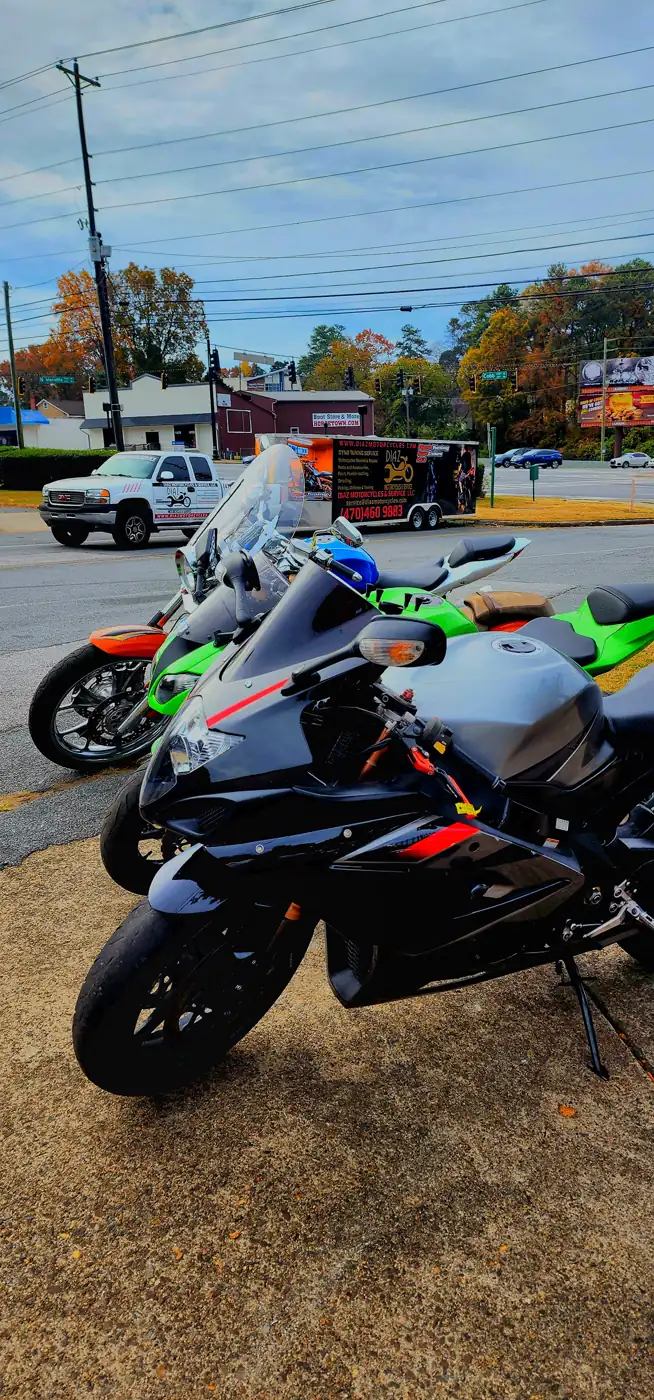
The honest answer, most common first
We’ll be straight with you, the way a buddy would be. Nine times out of ten, the reason a bike strands a Woodstock rider in the fall isn’t dramatic. It’s the calendar. Bikes here don’t commute — Georgia’s helmet law, plus the fact that lane splitting and filtering are illegal, means nobody’s enjoying the I-575 crawl on two wheels. So bikes rack up hard mountain miles in short bursts, then sit for weeks. Sitting is what breaks them. Here’s the pecking order of what we actually find, most common first.
- A tired battery. It slowly bled down over a quiet summer, and the first cold snap finished the job. This is the number-one stranding cause, hands down.
- Stale fuel. Gas that sat for weeks turns to varnish and gums up injectors or a carb. The bike cranks but won’t clear its throat.
- A blown fuse or a loose ground. One corroded connection and the whole bike plays dead, even though nothing serious is wrong.
- A fuel pump or filter that’s had enough. More common on higher-mile touring rigs that see long, hot highway pulls up to the mountains.
- A spark issue — a coil, a plug, a sensor. Less common, but real, and usually why a hot bike quits and won’t restart until it cools.
See how the scary stuff sits at the bottom? A seized engine or a fried stator is rare. Most riders who fear the worst are actually one battery or one cleaned-up fuel system away from riding home. That’s the honest answer, and it’s a hopeful one.
There's a second failure that hides behind the first one
Here’s the twist most riders miss. The dead battery or the gummed-up fuel isn’t always the real story — sometimes it’s the symptom of a slow leak you never saw. A battery that keeps dying might be a lazy charging system quietly starving it every ride. Fuel that keeps gumming up might be a tank breathing damp air all winter in a garage. Fix only the loud problem and the quiet one comes back to bite you next season, usually farther from home.
That’s exactly why guessing on the shoulder is a trap. You can jump a battery in a parking lot and ride off feeling like a hero, then get stranded again two weekends later because the charging system was the culprit all along. A proper diagnosis chases the cause, not just the click. When you want the full picture of a roadside call — from the first phone ring to a bike back on the lift — here’s what the work covers once your bike is safely on our trailer.
When it's safe to ride, and when it isn't
This is the question that actually matters at the roadside, so let’s answer it plainly. Ride it home only if the bike restarts, holds a steady idle, has no warning lights glowing, and nothing’s dripping, dragging, or smoking. A one-time stall that clears up and stays cleared is often fine to limp home carefully. But some symptoms are a hard stop.
- Any fluid on the ground — oil, coolant, or fuel. Don’t ride it. That’s a pickup, every time.
- A bike that dies again the moment you get moving. It’s telling you something; listen.
- Grinding, a hard clunk into gear, or a chain or belt that looks wrong. Stop.
- A charging light that won’t go out. You’ve got minutes of battery, then you’re stuck worse.
- Any crash, tip-over, or bike you’re just not sure about. When in doubt, we come to you.
The honest angle here is simple: for a bike that won’t run or that you’re unsure about, a stranded motorcycle pickup Woodstock riders can trust beats every alternative. There’s no shame in it — it’s the smart, cheap move that keeps a small problem small. Pushing a dead touring bike down the shoulder of a busy road, on the other hand, is how a minor fault turns into a bad afternoon.
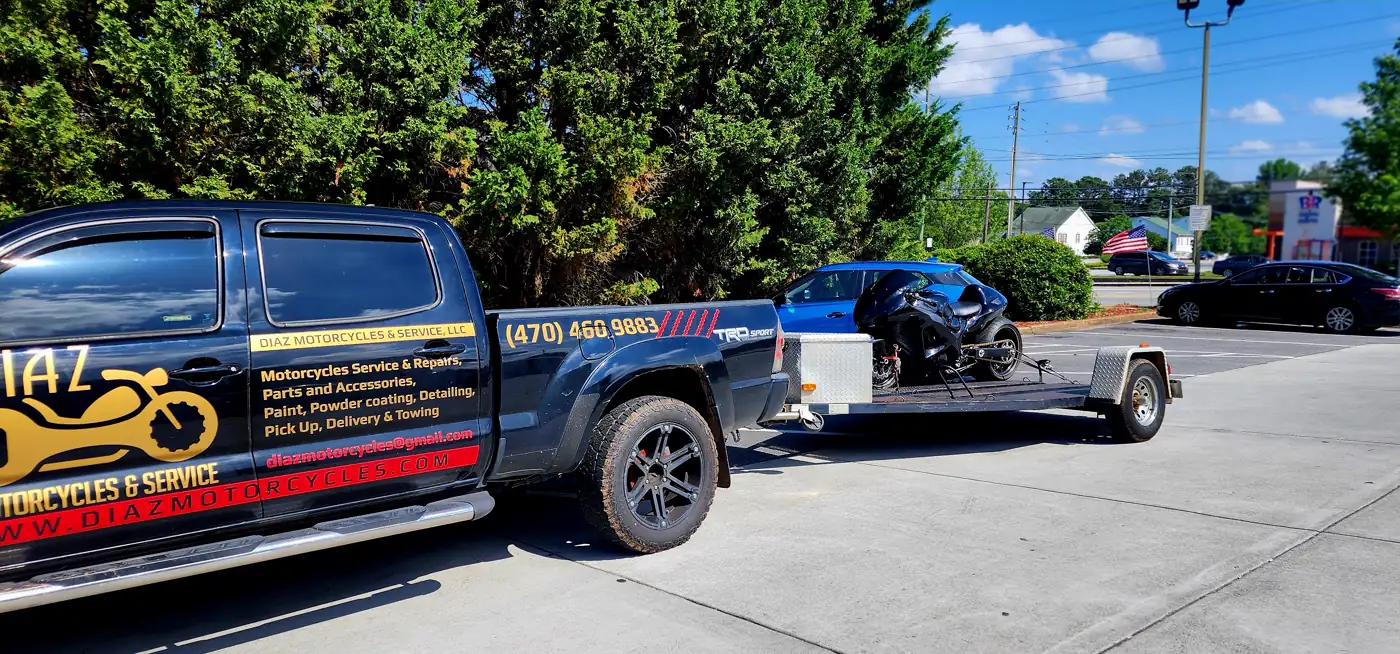
How the pickup actually works
People picture something rough and rushed. The reality is calmer than that. A bike rides on a trailer standing straight up, wheel locked into a chock at the front so it can’t roll or lean. From there it gets strapped down with soft ties looped through solid points — the triple clamp or the frame, never a mirror or a plastic fairing — and the suspension is compressed just enough to keep tension through every bump. Done right, the bike sits like it’s parked in your garage, not swaying an inch. If you want the nuts and bolts of what our team handles on a transport run, it’s all spelled out for you.
Then there’s the open-versus-enclosed question, and the answer depends on the trip. For a short local hop — say a stranded bike over on the Allatoona Downs, Shores, or Woods side of the lake — an open trailer is quick, easy, and perfectly safe. For a long haul, a prized restoration, or a bike heading out of state, an enclosed trailer earns its keep by shielding the machine from weather and road grime the whole way. Both get your bike home in one piece. One just adds a roof.
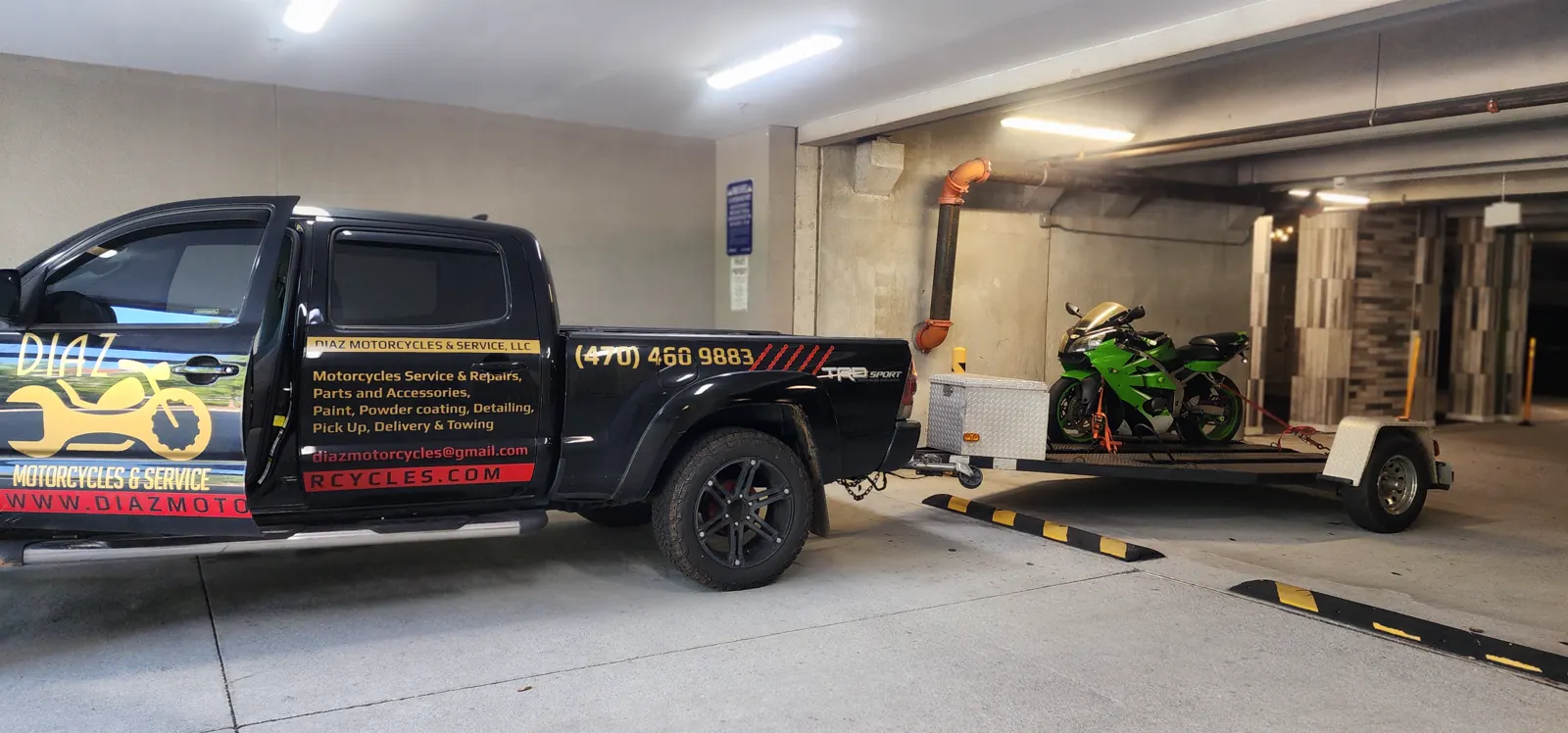
The last piece is paperwork, and it’s the piece that protects you. Before we roll, the bike’s condition gets noted so there’s a clear record of how it looked at pickup — every scuff already there, every ding accounted for. That simple step is what keeps a transport honest for everybody. It’s the difference between a favor from a stranger and a real service you can count on. For a plain-English rundown of what changes the total on a pickup, we broke it down without the runaround.
WON'T RUN? DON'T PUSH IT
A non-running bike is the exact situation transport was built for. One call, a chock, a few soft ties, and your bike is on its way to the lift instead of sitting on the shoulder. That’s the whole pitch, and it’s a good one.
Why Woodstock strands a little differently
Woodstock isn’t a stoplight-to-stoplight town, and that changes how bikes fail here. This is the most riding-serious community in our radius — I-575 is the direct on-ramp to the north Georgia mountains, so a rider can be carving real roads inside of an hour. That means big, hard miles in short seasons, then long idle stretches. Bikes that sit are bikes that strand, and the fall push after a quiet summer is the peak window for it, right as leaf cover and the deer rut make the backroads dicey too.
The gear here is serious as well. Cherokee County skews sport-touring, adventure, and premium touring — BMW GS bikes, Yamaha Ténérés, Triumph Tigers, Road Glides and Gold Wings, the occasional Ducati Multistrada. A lot of that credit goes to Traxxion Dynamics being headquartered right here on Rope Mill Parkway; a respected suspension house in town raises the technical bar for the whole local riding crowd. They own the chassis and suspension side beautifully. We handle the engine, electrical, and get-it-home side, which is a different lane entirely — and when a well-set-up bike still strands, it’s almost always one of those ordinary causes, not the fancy stuff.
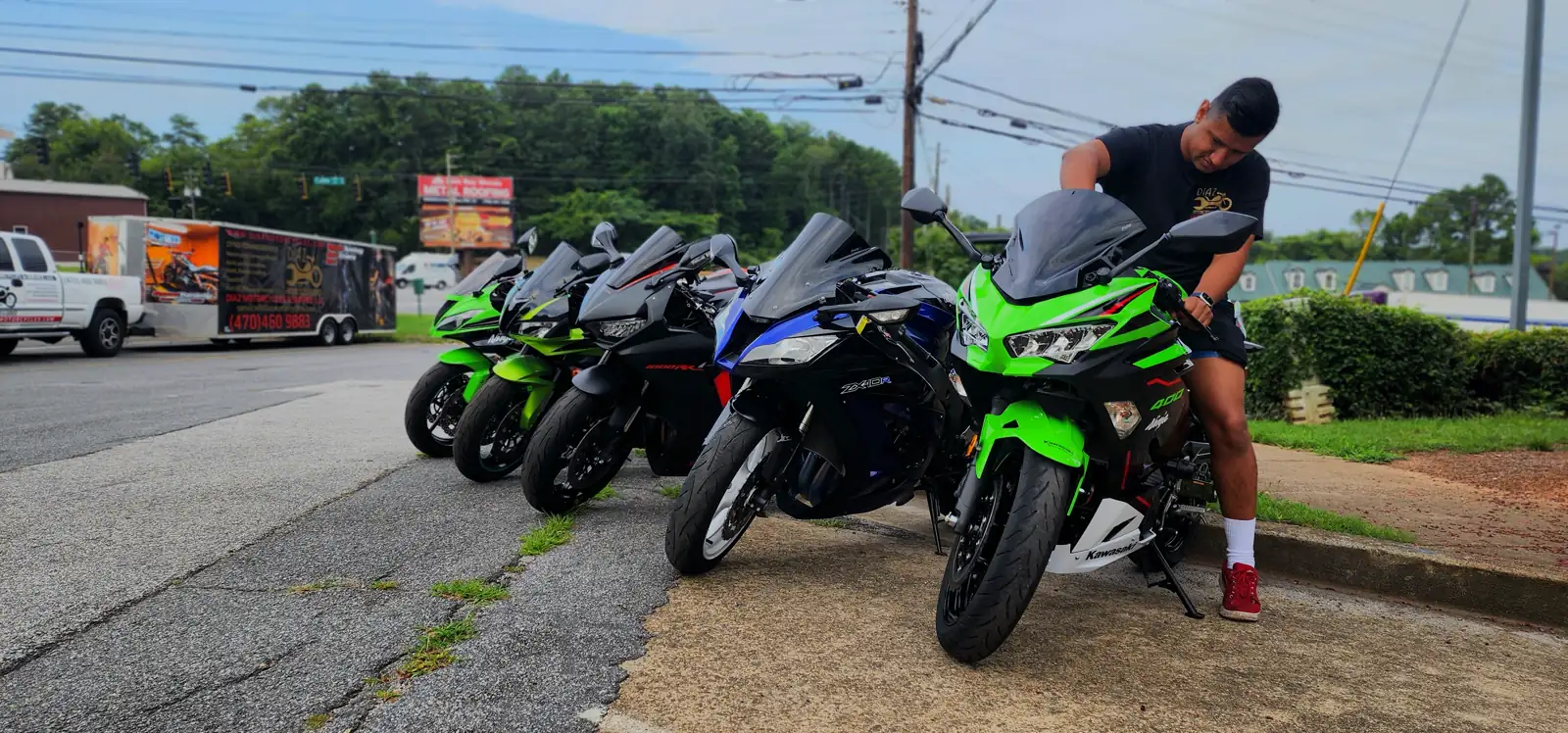
Storage actually helps Woodstock more than most places. The 1990s master-planned subdivisions came with two- and three-car garages as standard, so bikes live indoors on trickle chargers instead of baking in a driveway. Towne Lake alone — nearly 5,700 homes, one of the largest planned communities in the county — is full of well-tended machines and multi-bike households. Even a garage queen strands, though. A battery on a dead charger, stale fuel in a tank that sat since spring, a fuse that let go over the winter: garaged bikes fail quietly and politely, but they still fail.
Geography shapes it too. The main east-west artery, State Route 92 — Alabama Road — carries riders toward Roswell and Alpharetta on one end and Acworth on the other, while feeders like Bells Ferry, Wiley Bridge, Trickum, and Arnold Mill Roads offer the rolling, wooded backroads that make this area worth living in. Those same roads mean a stranded bike can end up a good ways from any shop. Rapid growth adds one more wrinkle: gravel and mud tracked from construction entrances is a routine hazard, and a low-speed slide on someone else’s spilled dirt is a common reason a healthy bike suddenly needs a ride. To keep the rubber side down through all that, Michelin keeps a solid library at Michelin’s motorcycle tire resources.
Picture the version of this where you caught it early
Now imagine the better timeline. It’s late August. You haven’t ridden much since spring, and instead of trusting the bike to fire on the first cold Saturday, you get ahead of it. A quick charge, fresh fuel, a look at the battery and the connections, maybe a real once-over before the leaves start dropping in the shaded corners. Come September, the bike lights right up, and you’re on I-575 north while everyone else is still cussing at a dead starter. That rider — the one who planned instead of panicked — is the one we want you to be.
That’s the whole reason we lead with this. Fall in Woodstock is the single biggest riding season and the prime pre-trip-inspection window, all at once. A little attention before the season beats a shoulder rescue during it every single time. And if a friend down the highway hits the same wall, the causes travel — here’s what Cartersville riders run into, and it rhymes with everything above.
A stranded bike isn't a broken dream. It's a small problem waiting for a ride.
So here’s where you should land, and we hope it’s with your chin up. If your bike strands you this fall, you’re not the rider who neglected it — you’re the rider who caught a small thing before it grew, made the smart call, and got it handled the right way. There’s real pride in that. You know your machine, you know your limits, and you know when to let a trailer do the last mile. The mountains will still be there next Saturday. So will your bike, running, once the loose handshake is fixed.
Whether your bike quit near the Elm Street Event Green downtown where the Noonday Creek Trail ends, out by the mill ruins on the Little River at Olde Rope Mill Park, or tucked in a garage over in Mirramont, the fix is the same friendly phone call. We’ll get it, we’ll find the real cause, and we’ll get you back to the roads you moved out here to ride.
Questions Woodstock riders ask us
Will it get worse if I keep trying to start it?
It can. Cranking a bike that won’t catch drains an already weak battery and, if it’s a fuel or flooding issue, can make the no-start worse. A few tries are fine. If it still won’t go, stop and let it rest rather than grinding the starter down.
How urgent is a bike that stranded me?
It depends on the symptom. A one-time stall that clears up is usually low urgency. Anything leaking, grinding, or dying the second you move is a same-day pickup. When you’re unsure, treat it as urgent — it’s cheaper to be careful than to guess wrong on the shoulder.
What if I just ignore it and keep riding?
Ignoring the loud problem often lets a quiet one grow behind it. A charging fault that keeps killing your battery, for example, will strand you again farther from home. Small faults handled early stay small. Ignored ones tend to pick the worst possible moment to come back.
How do you find the real cause instead of guessing?
We work the systems in order — battery and charging, then fuel, then spark and sensors — and test each one instead of throwing parts at it. That way we catch the hidden second failure, not just the obvious first one, so the bike doesn’t strand you again next month.
Could it be something other than the battery?
Absolutely, and it often is. A weak battery is the most common cause, but stale fuel, a blown fuse, a loose ground, or a tired fuel pump all look similar from the seat. That’s why a real diagnosis beats a parking-lot jump-start every time.
Do I have to ride it to you, or can you come get it?
You never have to ride a bike you don’t trust. For any bike that won’t run or that you’re unsure about, we bring the trailer to you, strap it down safely, and haul it in. That’s exactly what transport is for, and it’s the smart, low-stress move.
We run pickups and transport all over the north metro, so a stranded bike is never really stuck. Beyond Woodstock and the Towne Lake corridor, we help riders in Canton, Holly Springs, and Ball Ground to the north, Acworth and Kennesaw to the west, and Marietta and East Cobb to the south. Cross the county line and we’re still there — Roswell, Alpharetta, and Milton to the east, and Cartersville out toward the northwest. If your bike quit somewhere in between, that counts too.
STUCK IN WOODSTOCK? DON'T PUSH IT
If your bike stranded you anywhere around Woodstock, the smartest move is the easiest one: text us and let a trailer handle the last mile. We’ll come get it, find the real cause instead of guessing, and get you back on I-575 toward the mountains where you belong. No pushing, no panic, no shame in the call.
470-460-9883Diaz Motorcycles and Service, LLC · 847 Barnes Mill Road, Marietta, GA 30062