Tuning Cost Powder Springs — What Really Drives the Price
What a dyno measures, what a tune changes, and why the job is bigger on some bikes than others.
It’s Saturday morning in your garage. So and the door is rolled up, the coffee on the bench went cold an hour ago, and the bike is doing that thing again. It fires. It idles. Then you roll on the throttle to back it out and it stumbles like it forgot the words. Still, you blip it twice and it clears up, sort of. Plus, Right there, standing in flip-flops next to the truck, most riders stop thinking about the bike and start thinking about the bill. Of course, that’s usually the moment someone starts hunting for tuning cost Powder Springs answers before they ever pick up a phone.
So here’s the good news up front. Then again, that stumble almost never means a hurt engine. Even so, it means the bike is being fed wrong. Meanwhile, every motorcycle leaves the factory with instructions living in its computer that say how much fuel to add for a given gulp of air. In fact, that said, Change the air and those instructions stop fitting. A slip-on changes it. A high-flow filter changes it. Georgia’s soupy July air changes it. For example, a tune rewrites them to match the bike you actually own.
The symptoms that bring riders in
After that, Almost nobody walks in and asks for a tune by name. What’s more, Riders walk in describing a feeling, usually with their hands. So and Better yet, here’s the short list we hear most weeks:
- Still, a hesitation or flat spot right off idle, worst in first and second gear
- Plus, Popping and crackling on decel, loud enough that the neighbors have opinions
- Of course, surging at a steady cruise, like someone is tapping the throttle for you
- Then again, Running hot in traffic, with heat coming through your right boot
- Even so, hard starts and a rough idle after new pipes went on
- Meanwhile, Fuel mileage that quietly got worse and never came back
In fact, that said, not one of those is a death sentence. For example, they’re signs of a mismatch between air and fuel, and a mismatch is a fixable thing. Riders get nervous because a bad-running bike feels expensive, but catching it early is the easy version of this story. A bike left running lean is the one that eventually asks for real engine work.
What each symptom is actually telling you
Lean means too much air and not enough fuel. A lean bike runs hot, pops on decel, hesitates when you crack the throttle, and feels sharp but nervous. Rich is the other direction. A rich bike smells strong, fouls plugs, blackens the tailpipe, and feels lazy, like it’s riding with a backpack on. Neither one is exotic. Both are just the fuel map being wrong for the hardware bolted to the bike.
A flat spot is a narrow window where the map is off in one place, usually low rpm and small throttle openings. That’s why it shows up pulling out of your driveway and fades once you’re moving. Surging at a cruise is the same problem, since modern bikes run lean on purpose there to pass emissions rules. Heat is the tell that ties it together, and it’s why riders notice this in August sitting at a light on Powder Springs Road.
What a dyno actually measures
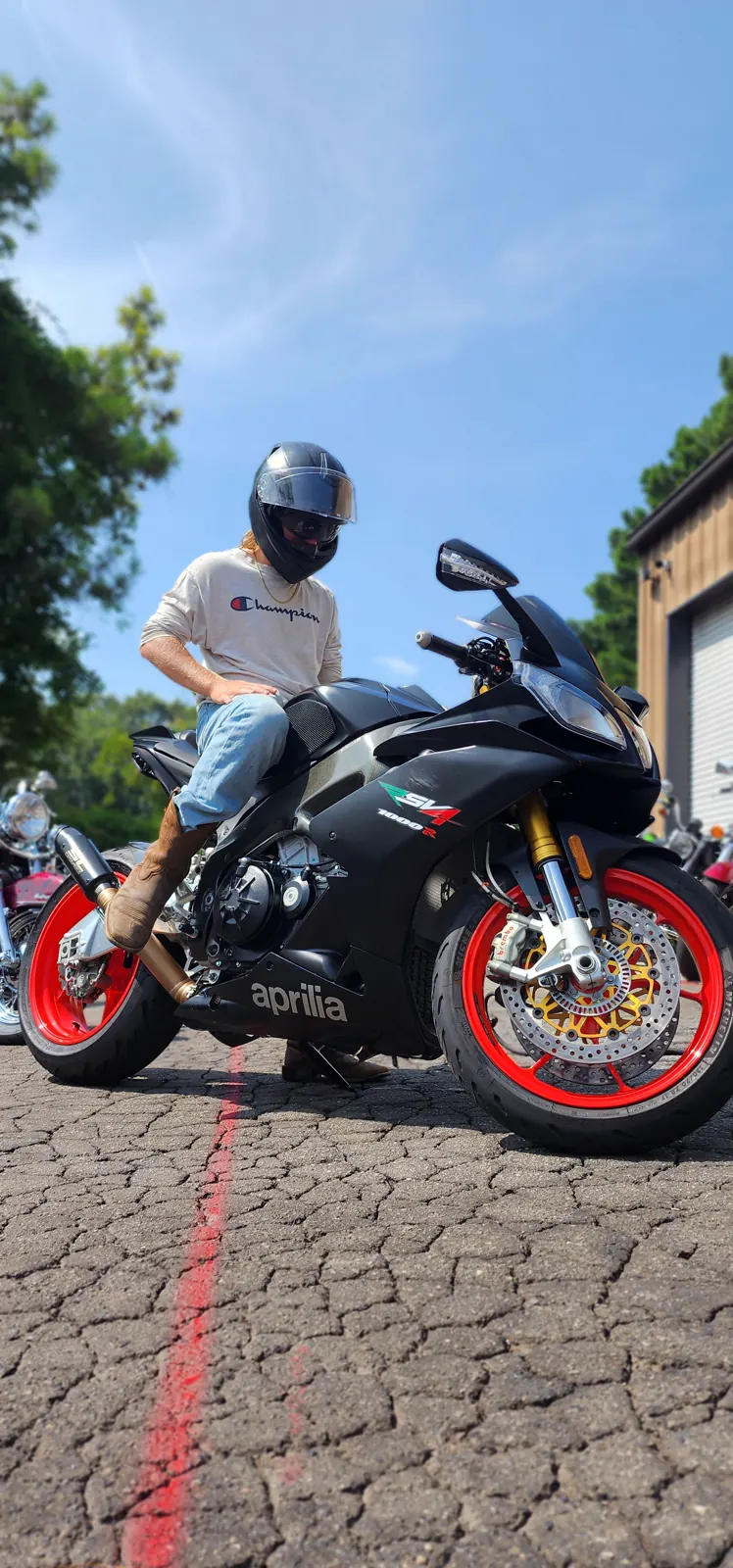
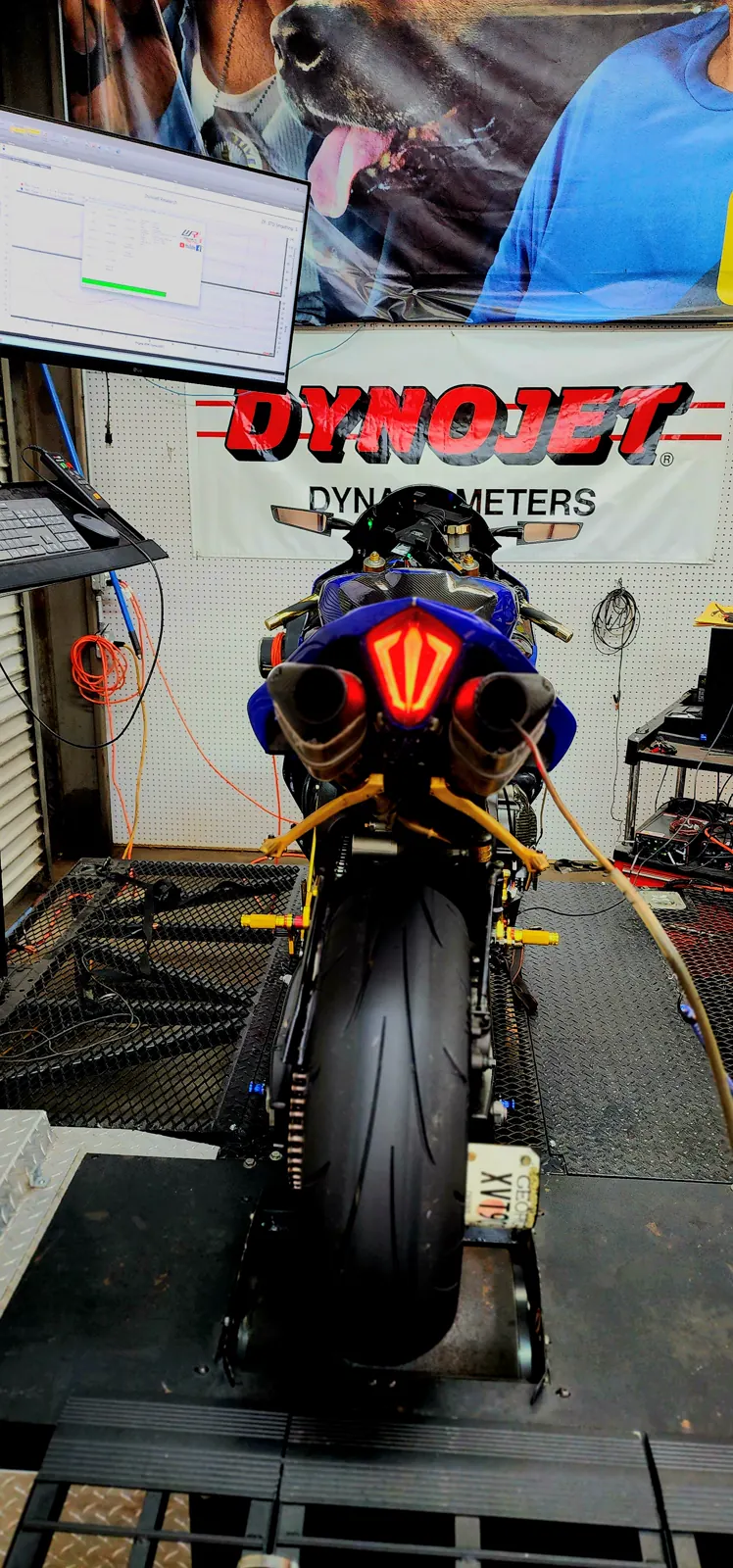
A dyno is a heavy steel drum set into the floor. Your rear wheel sits on it, the bike gets strapped down, and a fan blows air at the front so it breathes and cools like it’s moving. Then we run it through the gears while it stays perfectly still. The drum has a known weight, so the computer watches how fast the bike spins it up and works backward to figure out how much power the engine really makes at every rpm.
Meanwhile a wideband oxygen probe sits in the exhaust and sniffs what’s coming out, reporting the air-fuel ratio hundreds of times per pull. So we end up with two pictures laid over each other: how much power the bike makes, and how much fuel it burned making it. Where those two disagree is where your flat spot lives. It stops being a guess and turns into a line on a screen you can point at.
But here's what most riders get wrong about this
People think a dyno is a bragging machine. Roll on, print a number, tape it to the toolbox. Honestly, peak power is the least useful thing it tells us. You spend maybe two seconds a month at redline, and your whole ride between idle and half throttle, which is exactly the part of the map the factory had to compromise. Fixing that region is what makes a bike feel new again.
That’s also why two tunes on two bikes can look nothing alike in the labor column. One bike needs a fueling module and an afternoon. Another needs the stock computer unlocked and reflashed first, because the manufacturer locked it down. If you want the deeper version of the theory, we wrote the full rundown on it, and it’s worth ten minutes before you book anything.
What happens at the shop, start to finish
There’s no mystery to the process, and knowing it makes the invoice make sense. Here’s the actual order of operations on a normal tuning day:
- We talk first. What did you change, when did the symptom start, what does it feel like and where in the rev range.
- Health check first. Plugs, air filter, valve clearance if it’s due, tires, coolant, exhaust leaks. A sick bike can’t be tuned, only masked.
- Baseline run. We strap it down and record the bike exactly as it sits, so we have honest before-and-after data.
- Read the air-fuel data across the whole range, not just the top.
- Load or unlock the tuning hardware. That’s either an ECU flash on the stock computer or a piggyback module like a Power Commander, depending on the bike.
- Steady-state work. We hold the bike at fixed rpm and throttle positions and correct the fueling point by point. This is the slow part and the part that matters.
- Full pulls to confirm the corrected map holds together under real load.
- Road check. Cold start, stop-and-go, light throttle cruise. The bike has to behave in traffic, not just on the drum.
Access, labor, and parts — where the price actually comes from
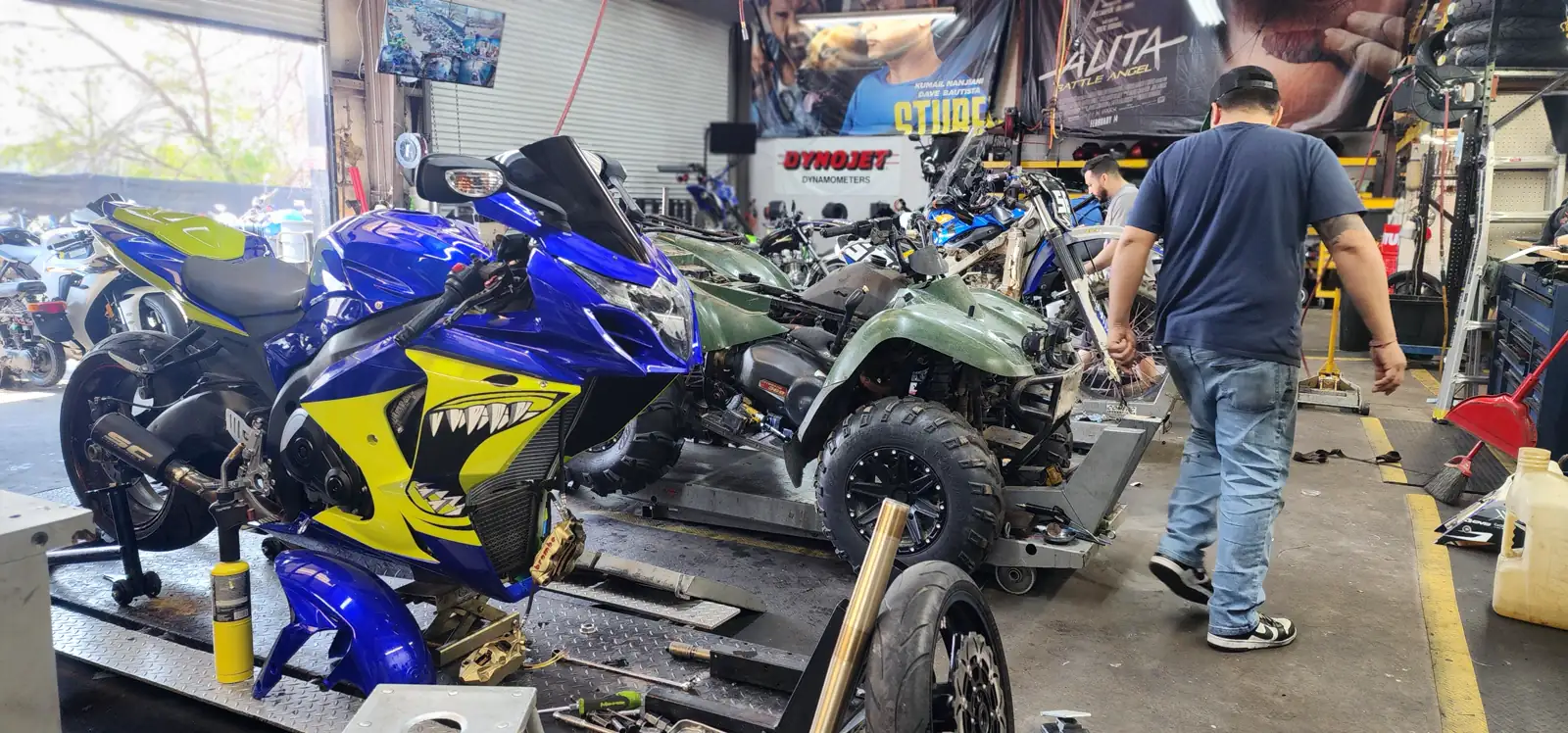
Three things move the number, and only one of them is parts. The first is access. Some bikes hand you the ECU under the seat in four minutes. Others want the tank lifted, the airbox out, and half the fairing off first. A full-dress bagger with hard bags and a stereo harness buries everything, so an hour disappears before tuning even starts. Naked bikes are kind to us. Touring bikes are not.
The second is labor, which is really just time on the drum. A mild bike with a slip-on and a filter needs fewer correction points than one with a full system, a cam swap and bigger injectors. More changes means more of the map is wrong, and every wrong spot gets found and fixed by hand.
The third is parts, and that depends on what your bike accepts. Some need a fueling module bought and installed. Others just need their existing computer unlocked, which shifts the whole job from parts to labor. Sometimes the health check turns up a cracked exhaust gasket or a clogged filter, and those get fixed first, because leaving them means tuning around a fault instead of removing it.
THE HONEST PART
A tune is mostly time and skill, not boxes off a shelf. That’s why the same service can be a short day on one bike and a long one on the next, and why anyone quoting a hard number before seeing your bike is guessing.
How long it takes
Plan on leaving the bike for the day. A simple fueling correction on a lightly modified bike is usually a single-day job, while a locked ECU or a big build can push into a second day. If the health check turns up something that has to be repaired first, we call you before we touch it, because nobody enjoys surprises on a Friday afternoon. Parts on order can add a day, and we’ll say so up front.
What this looks like for West Cobb riders
Powder Springs is West Cobb and it’s OTP, and riding here has its own shape. Most bikes live indoors in a two-car garage next to the truck. They come out on weekends, run a loop out Dallas Highway toward Dallas and Hiram, then go back inside. Georgia bans lane splitting and filtering, so almost nobody commutes on two wheels here. Mileage arrives in bursts, and bikes sit for long stretches between rides.
Sitting is what makes tuning symptoms confusing. A bike parked through winter has stale fuel and a tired battery, and both mimic a fueling problem perfectly. Then pollen season lands from mid-March through late April and quietly loads up an air filter. Change how much air gets in and you’ve changed the mixture without touching a setting. That’s why we check the boring stuff before blaming the map.
There’s no motorcycle dealership inside Powder Springs and no big independent shop in city limits either. The closest brand alternative is Hellbender Harley-Davidson at 993 S Cobb Drive in Marietta, roughly fourteen to sixteen miles northeast, dealer-priced and focused on one brand. We’re independent and work across brands, which matters when your garage holds a metric cruiser, an ADV bike or a sportbike. Getting to us runs about fifteen to eighteen miles, generally half an hour or so, northeast on Powder Springs Road or Macland Road into Marietta and then east toward Barnes Mill Road.
Let us tell you about a rider near Amberton
He’d put a slip-on and a filter on a cruiser over the winter, and by spring it popped hard on decel and ran hot enough that he stopped taking his wife on the back. He was sure he’d cooked something expensive. He hadn’t. The bike was simply lean below half throttle, which is what happens when you let more air in and never tell the computer. A day on the drum, a corrected map, and the popping was gone with the heat right behind it. He said it finally felt like the bike he thought he’d bought.
We hear versions of that all over town. Riders in Peach Plantation with a bike that sat two seasons. Folks in the historic core near Marietta Street and Pine View Drive, where the houses are the oldest in town and the garages the smallest, wrestling a bagger out of a tight bay. Families who spend Saturday at Silver Comet Linear Park while a kid rides the skatepark, then take the long way home. Even riders who walk the Wildhorse Trail connector in the morning and ride in the afternoon. Same complaint, same fix.
Why we won't quote it sight unseen
Because we’d have to make something up. Two riders can call the same afternoon with the same brand and the same complaint, and one bike needs an afternoon while the other needs a locked computer opened, a module wired in, and a leaking exhaust joint fixed first. Quote both the same and somebody gets a phone call later that starts with the word “actually.” That’s the honest answer to the tuning cost Powder Springs question: we look, then we tell you a real number you can plan around.
What we can do on the phone is narrow it down fast. Tell us the bike, what’s been changed, and when the symptom started, and we’ll tell you which path you’re probably on and roughly how long it’ll be here. If you’re comparing towns, riders over in Cartersville ask the same questions and get the same straight answers. And here’s what that service actually involves before you commit to anything.
A tune isn't a bigger number. It's the bike doing what you asked, the first time you ask.
What you actually get at the end
You get a bike that pulls away clean from a stop sign without the hitch. You get less heat at a red light in August, smoother cruising, an idle that settles, and usually better fuel mileage as a bonus. Riders describe it as the bike feeling connected to their right hand again, which is a fair way to put it. Nothing about it is theatrical. It just works, everywhere you ride.
A predictable bike is also a safer bike. Something that surges when you’re merging is something you have to think about instead of ride, and IIHS motorcycle research is a good reminder of why smooth control matters. If you’re newer to riding, Georgia Class M licensing lays out the state’s requirements plainly.
So if your bike is in the garage right now being difficult, take a breath. It’s very likely a fueling issue, and fueling issues are the good kind of problem, because the fix is known and the bike comes back better. Bring it by and we’ll show you the graph while you drink our mediocre coffee. Here’s the work we do in house if you want to see the setup first.
Questions Powder Springs riders ask us
What makes one tuning job bigger than another?
Access and the amount of change. A bike where the computer sits right under the seat is quick to get into, while a full-dress bagger needs bodywork off before anyone plugs in. On top of that, the more you’ve modified, the more of the fuel map is wrong and the longer it takes to correct by hand.
Why can't you just quote it over the phone?
Because we’d be guessing, and a guess helps nobody. Two identical-sounding bikes can need completely different work once we see whether the computer is locked, whether the exhaust is sealed, and what condition the plugs and filter are in. We’ll happily narrow it down on the phone, then give you a firm number after we look at it.
What's included when you tune a bike?
A conversation about what changed, a health check on plugs, filter, leaks and basic service items, a baseline dyno run, the actual fueling corrections point by point, confirmation pulls, and a road check in real traffic. You also get the before-and-after data so you can see exactly what changed.
How long will my bike be with you?
Plan on the day for a straightforward job. A locked ECU that needs flashing or a heavily built bike can stretch into a second day, and parts on order can add a little more. We tell you the timeline up front and call you before we do anything you didn’t approve.
Is it mostly parts or mostly labor?
Mostly labor. Some bikes need a fueling module purchased, but plenty just need their existing computer unlocked, which shifts nearly everything into time on the dyno. The skill is in finding and fixing the wrong spots in the map, and that part is hands and hours, not boxes.
Do I need to be modified to benefit from a tune?
Not at all. Stock bikes are set up to pass emissions rules, which usually means running lean at small throttle openings — the exact place your flat spot and heat live. Cleaning that region up makes a bone-stock bike noticeably nicer to ride around town.
We tune bikes for riders all over West Cobb and the western suburbs, starting with Powder Springs and running out to Austell, Mableton, Clarkdale and Lithia Springs on the south side. Plenty of our regulars come from Hiram, Dallas and Villa Rica out along the Paulding side, and just as many ride in from Douglasville. Closer to the shop we see riders from Marietta, Fair Oaks, Smyrna and Kennesaw every week. If you’re anywhere in that circle, the ride over is an easy one and you’ll get the same straight answers no matter which town you started in.
BRING IT BY. WE'LL SHOW YOU THE GRAPH.
If your bike is stumbling, popping or running hot, don’t let it sit in the Powder Springs garage all season. Text or call us with the bike, the mods and the symptom, and we’ll tell you what you’re likely looking at and how long we’d need it. Then bring it in, and we’ll put it on the dyno and show you exactly what it’s doing before we change a thing.
470-460-9883Diaz Motorcycles and Service, LLC · 847 Barnes Mill Road, Marietta, GA 30062