Independent Motorcycle Shop Roswell — How to Choose
Dealer service department or independent shop? Here's the honest call, plus the one situation where the other choice wins.
Summer has a way of sorting bikes out around here. June through September brings heat, humidity and near-daily thunderstorms in July and August, so cooling systems get stressed, oil breaks down, tire pressures swing, and the painted lines on Canton Street and Alpharetta Highway turn slick. That’s the season when riders start asking whether a dealer service department or an independent motorcycle shop Roswell riders actually recommend is the better home for the bike. Good news? There’s a real answer, and we’re going to give it to you straight instead of shrugging.
We fix bikes for a living, so yes, we have a dog in this fight. Even so, we’d rather be useful than salesy. Because the truth is that both choices are genuinely right for somebody, and the trick is figuring out which somebody you are. So let’s lay it out plainly, name the winner, and then name the case where the other side takes it.
What you're really asking
When somebody calls us in July, they almost never open with “dealer or independent.” Instead they ask something smaller. Who’s going to actually look at my bike this week? Who will tell me what they found before they touch it? And will the person turning the wrench be the person I talked to?
Those three questions are the whole comparison in disguise. You’re not shopping for a building. You’re shopping for access, honesty and continuity. Once you frame it that way, the choice gets a lot less confusing, and a lot less stressful.
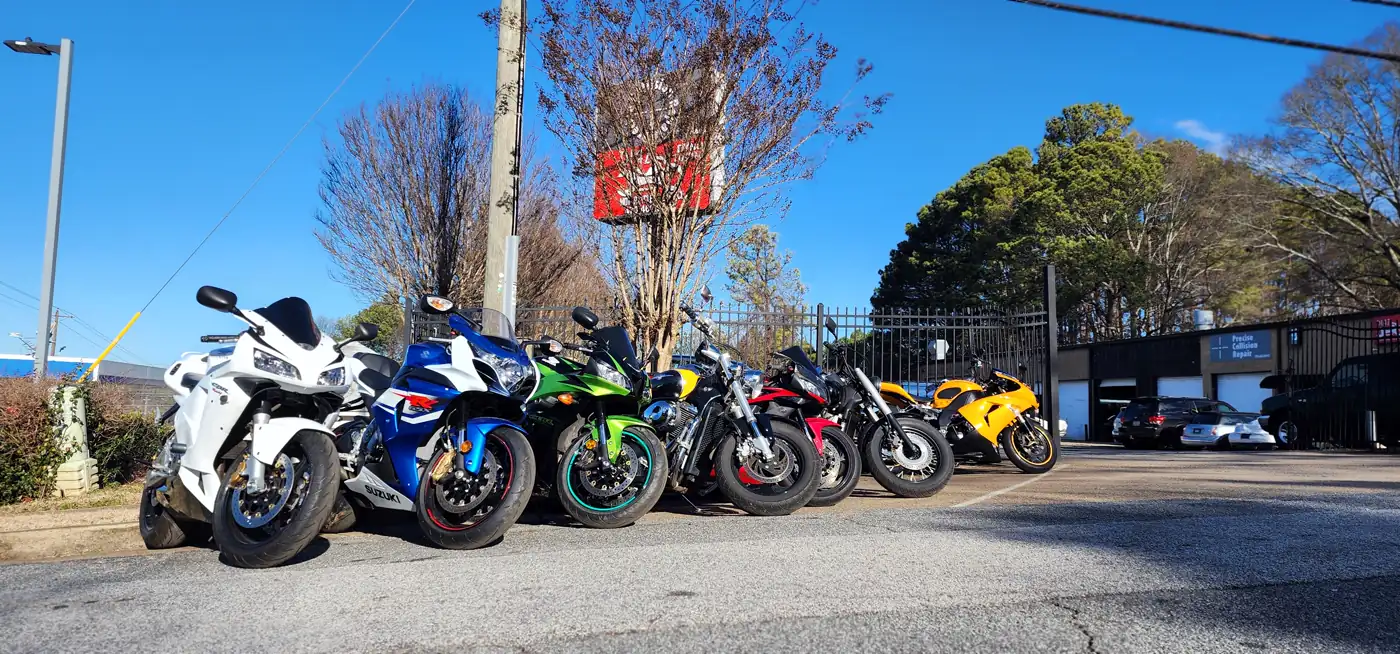
Roswell riders are unusually sharp about this, too. Alpharetta Highway between roughly 10800 and 11500 is North Fulton’s motorcycle row, with Mountain Motorsports, Cycle Gear, BMW Motorcycles of Roswell, G & G Cycles and Killer Creek Harley-Davidson all sitting inside about half a mile. So folks here already know what a flagship service department feels like. They’ve stood at that counter. That means we don’t have to explain the difference — we just have to be honest about it.
The honest answer
For most riders in Roswell, an independent shop is the better long-term home for the bike. Not because dealers are bad — plenty of them are excellent — but because of how the two are built. A dealer service department is designed around new-unit sales, warranty work and brand-specific procedure. An independent is designed around whatever rolls through the door. Those are different jobs, and they produce different habits.
Here’s the thing about habits. A shop that sees one brand all day gets fast at that brand’s common jobs. Meanwhile a shop that sees a 1970s Italian twin on Monday and a GS with hard luggage on Thursday gets fast at diagnosing, which is a broader skill. Both are real. But diagnosing is what you need when the bike does something weird, and weird is most of what actually happens.
| What you need | Dealer service department | Independent shop |
|---|---|---|
| Warranty and recall work | Wins outright | Can't do it |
| Brand-new model, first year | Strong — factory bulletins first | Catching up |
| Older bike, out of warranty | Often declined or deprioritized | Normal Tuesday |
| Mixed garage, several brands | One shop per brand | One shop, all of them |
| Talking to the actual tech | Rare by design | Expected |
| Custom paint, restoration, performance | Usually sublet out | Done in house |
Notice that the dealer column isn’t empty. It’s genuinely better in a few spots, and we’ll say so out loud in a minute. Still, look at how many rows describe a bike that’s been on the road a few years. That’s most bikes in this city.
You're not choosing a building. You're choosing who picks up the phone when your bike does something strange.
Roswell also has a real market shape worth knowing. It’s dealer-saturated but independent-thin — five motorcycle businesses on one highway, and only one other true independent general shop, G & G Cycles of Roswell at 11235 Alpharetta Hwy, opened in 2017 by Shawn Guinther as a dealership alternative for American V-twin and metric bikes. They’re good folks doing honest work, and we’ll say that plainly. What the city still doesn’t have locally is one roof that covers custom paint, restoration, dyno and ECU work, and general service together. That’s the gap we fill.
There's a second failure hiding behind the first one
Real talk: most riders don’t switch shops because of a bad repair. They switch because of a bad second visit. The first job goes fine. Then the bike comes back three weeks later with a related symptom, and nobody remembers the bike, the notes are thin, and the whole conversation starts from zero. That’s the failure behind the failure.
We see this all the time, and it’s usually not anybody being careless. It’s volume. High-throughput service departments rotate techs and log by ticket, not by bike. So the history lives in a file instead of in somebody’s head. Don’t worry — this one’s an easy fix, and it’s the main reason continuity matters more than brand certification for a bike you plan to keep.
For example, a slow-cranking bike in August might be a battery, or it might be charging output, or it might be a ground that corroded after a wet week. If the same person saw it last time, they skip two of those. If not, you pay for the tour. We wrote a whole piece on what usually causes it if you want the short version.
What changes the answer
Now here’s where we stop being one-sided. Three things flip the recommendation toward the dealer, and they’re not close calls.
- Your bike is under factory warranty. Warranty and recall work has to go through an authorized dealer, full stop. So ride it there, get it covered, and enjoy it.
- Your bike is a brand-new model in its first year or two. Factory service bulletins land at dealers first, plus early-run quirks get documented there before anybody else sees them.
- You need a brand-specific software or security procedure that the factory locks down. Some systems simply won’t open outside the network, and no amount of skill changes that.
Outside those three, the independent case gets strong fast. Because once a bike is out of warranty, dealer service departments naturally prioritize the units they sold, and older bikes drift to the back of the queue. Meanwhile older bikes are exactly what we like. Ducati and other European machines, high-mile touring rigs, that Honda with a mystery wiring splice from a previous owner — those are good days for us.
Your riding changes the answer too. A rider who commutes GA 400 southbound to Perimeter and Buckhead year-round needs different things than a weekend rider. Georgia doesn’t permit lane filtering, so commuting here is about parking and range rather than splitting traffic, though motorcycles can legally use the GA 400 HOV lanes — which is a genuine reason people around here commute on two wheels. Year-round miles mean chains, brakes and tires wear on a schedule, so a shop that knows your interval beats a shop that’s fast at one brand.
How we actually work
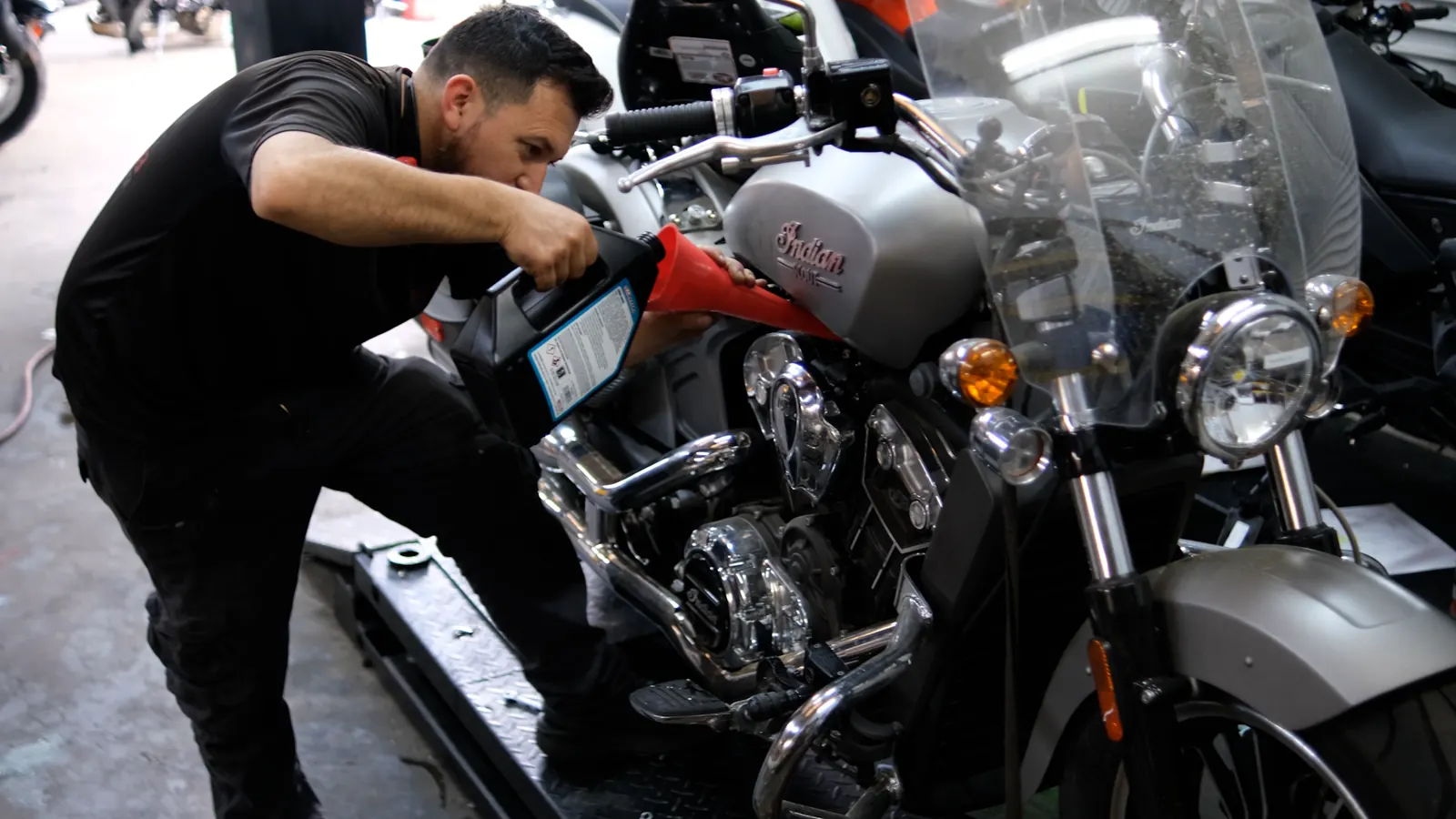
Our approach is simple, and honestly a little old-fashioned. We look at the bike before we quote the work. Then we call you, tell you what we found, and separate “this needs doing now” from “watch this and we’ll revisit.” Nothing gets done that you didn’t say yes to. Of course that takes an extra phone call, but it’s the call that keeps people coming back for a decade.
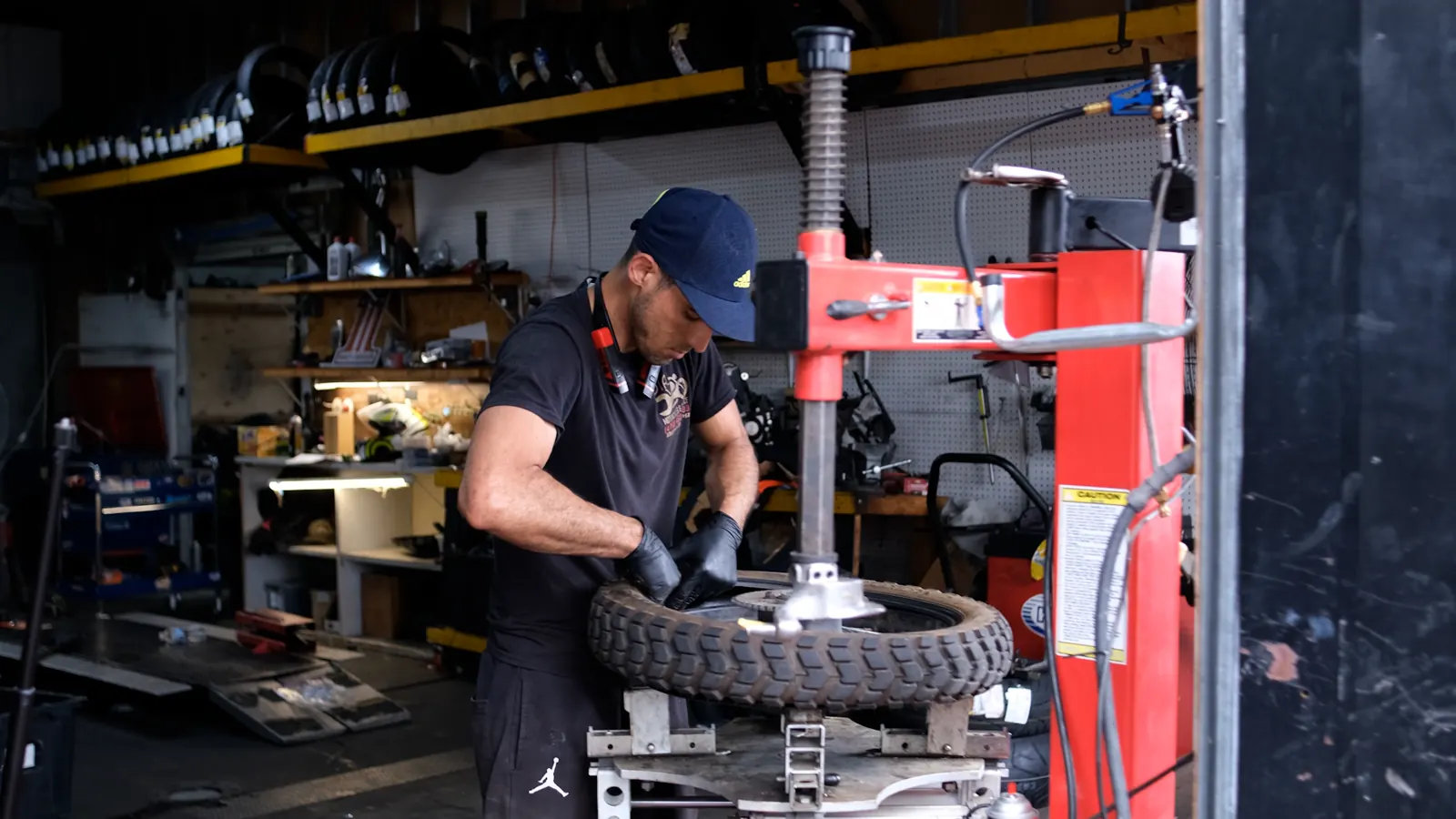
We also keep the whole job under one roof — general service, tires, brakes, suspension, dyno and ECU tuning, custom paint, full restoration and transport. That matters because sublet work is where timelines go sideways. If you’re curious about the bigger builds, here’s what the work covers, and here’s what our team handles day to day.
HOW WE TALK TO YOU
Plain words, no lecture, no upsell theater. If a part has life left in it, we say so. If we’d ride it as-is this weekend, we’ll tell you that too.
The Roswell part of this
Where you live in town actually shifts what your bike needs. Around Historic Roswell and the Canton Street district — that 1840s mill-town core of Craftsman bungalows and newer infill townhomes — a lot of bikes live under covers on driveways or in shared lots, so they take more weather. Over in Horseshoe Bend, with the larger lots around the country club, and in established spots like Lake Charles and Lake Charles Estates, bikes almost always sit in a garage.
That garage is good news, mostly. Roswell has high homeownership and mostly detached single-family housing, so bikes get stored properly. But the median home here was built in 1989, which means two-car garages shared with actual cars — limited lift room, low ceilings, no compressor. So riders here store beautifully and wrench rarely. Nothing wrong with that. It just means the shop relationship does the heavy lifting.
Pavement matters too. The city has budgeted for citywide resurfacing and reconstruction in 2026 covering roughly 14 miles, with help from GDOT’s Local Maintenance and Improvement Grant, and Bulloch Avenue, Canton Street, Riverside Road and Old Roswell Road are among the named targets. Great long-term. Short-term, though, it means construction plates, utility-cut seams and potholes in the historic district and along the river roads — the exact stuff that bends rims and kills tires. Roswell runs a pothole reporting app plus SeeClickFix, so reporting one takes about a minute.
And then there’s the fun part. Willeo Road past the Chattahoochee Nature Center is the tight, tree-lined river run locals use for evening rides, and it’s our favorite post-service shakedown loop. Old Mill Park and the Roswell Manufacturing Company ruins on Vickery Creek sit right there, and the Vickery Creek, Island Ford and Gold Branch units of the Chattahoochee River National Recreation Area all touch the city. Riding home past all that beats a parking-lot test any day.
Getting to us is easy, roughly speaking. From Historic Roswell it’s about 7 to 9 miles straight west on Roswell Road, GA 120, across the Chattahoochee into East Cobb — call it 15 to 20 minutes, traffic depending. From the Holcomb Bridge and GA 400 side it’s closer to 12 to 14 miles and 25 to 30 minutes. Plenty of riders make that run on the bike and turn it into a ride, which we fully endorse.
Picture the version where you caught it early
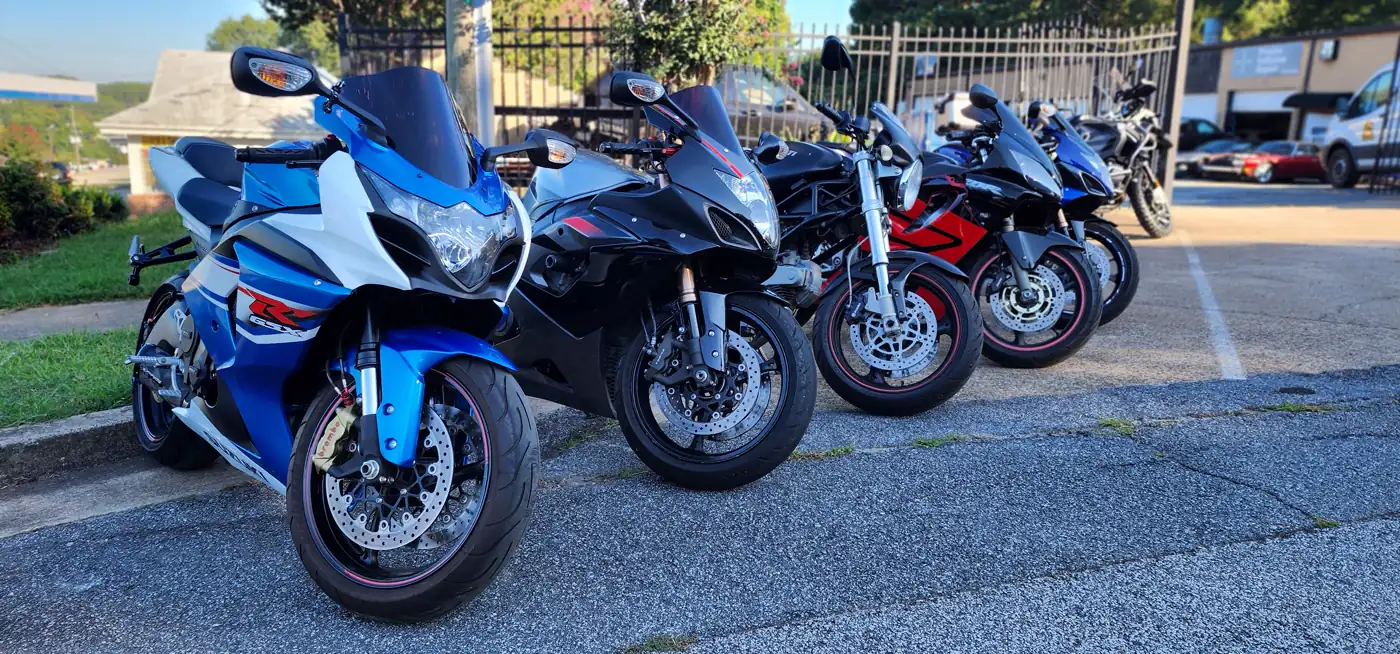
Now picture the other timeline. It’s mid-August, storms roll through most afternoons, and your chain is a little dry and your rear tire is at the wear bars. In the version where nobody looks, that becomes a wet-line surprise on Alpharetta Highway and a much bigger repair. In the version where you caught it early, it’s a Thursday morning, a tire, a chain adjust, a brake check — and you’re back on Willeo Road by evening.
Same bike, same rider, totally different month. That’s the whole argument for having a shop that knows you, honestly. Not fear, just timing. Because a shop that remembers your last visit sees the pattern one visit sooner, and one visit sooner is usually the difference between routine and expensive.
If you like reading up on this stuff, the Georgia Motorcycle Safety Program is a solid starting point, and Dunlop’s technical resources explain tire pressure and wear better than most of us can over a counter. We also wrote up what Atlanta riders run into, since the ITP experience is genuinely different from OTP life.
So what should you actually do
Here’s the recommendation, stated once and clearly. If your bike is under warranty or brand new, use the dealer and use it happily — that’s what it’s for. For everything else, build a relationship with an independent shop and keep it. Then, when the bike gets older and more interesting, you’re not starting from scratch with a stranger in the middle of a problem.
You can absolutely switch later, too. Nobody’s locked in. Plenty of friends we’ve helped ran dealer service through the warranty period, then came to us afterward with the records in hand. That’s the smart play, and it’s the one we’d make ourselves.
Roswell money is quiet and referral-driven. People here respond to craftsmanship and to being talked to like an adult, which makes sense in a preservation-obsessed city where folks have real opinions about restoration. So we don’t do pressure. We do good work, explain it, hand you the keys, and let the bike make the argument on the ride home. That feeling — pulling out of the lot on a bike that finally feels right and knowing exactly what was done to it — is the point of all of this.
You should feel a little proud of that bike. Whether it’s a touring rig from the Killer Creek H.O.G. crowd, a GS that’s seen real dirt, a GA 400 commuter sportbike, or an old Italian machine that other shops keep passing on, it deserves somebody who’s glad to see it roll in. That part we can promise.
Dealer while it's new. Independent for the long haul. That's the whole answer.
Questions Roswell riders ask us
Which is right for my kind of riding?
If you commute GA 400 year-round or ride hard on mountain roads, an independent is usually the better fit, because your wear items move fast and you want one shop tracking them. Weekend-only riders can go either way. But if your bike is still under factory warranty, ride it to the dealer first.
Can I switch shops later if I change my mind?
Of course. Nothing about this is permanent, and plenty of riders run dealer service through the warranty window and then move to us. Just bring whatever service records you have, or a rough timeline if you don’t. We’ll build the history from there.
Which one do you actually recommend?
For most Roswell bikes, an independent shop for the long haul. The dealer wins clearly for warranty work, recalls, first-year models and locked-down factory software. Outside those, breadth and continuity beat brand specialization, and that’s where we live.
Does the bike I own change the answer?
It does. Newer bikes under warranty belong at the dealer. Older bikes, European machines, high-mile tourers and anything modified tend to do better with an independent, because dealers often deprioritize or decline them. So the older and more interesting the bike, the stronger the independent case.
Is upgrading parts or tuning actually worth doing?
It depends on what bugs you about the bike. If suspension or brakes feel wrong for your weight and roads, that upgrade changes every ride and is easy to recommend. Big power work is worth it when you’ll actually use it, and we’ll tell you honestly if you won’t.
How long does a normal service visit take?
Routine work like oil, tires, brakes or a chain is usually quick, and we aim to get you back on the road fast. Diagnostic jobs take longer because we look before we quote. Either way, you’ll hear from us with findings before anybody touches a wrench.
We take care of riders all over the north metro, and Roswell folks make the run to us constantly. Alpharetta, Milton, Crabapple and Johns Creek riders come down through North Fulton, while East Cobb and Marietta are practically next door. Sandy Springs and Dunwoody riders head up when they want something more than a quick dealer ticket, and Mountain Park, its own small city, sends us bikes too. Woodstock and Kennesaw riders come our way for tires, tuning and paint, and plenty of Atlanta riders make the trip out of the Perimeter because the work is worth the ride.
BRING THE BIKE BY
If you’re weighing a dealer against an independent motorcycle shop, Roswell rider, just text us and describe your bike and how you ride it. We’ll tell you straight which one makes sense — even when the answer is the dealer. And when it’s us, you’ll get a look before a quote, a real conversation, and a bike that feels right on the ride home down Willeo Road.
470-460-9883Diaz Motorcycles and Service, LLC · 847 Barnes Mill Road, Marietta, GA 30062