Motorcycle Running Lean Woodstock — Why It Happens
A chalky white spark plug, a flat spot off idle, extra heat at the light. Here's what your bike is telling you, and what we do about it.
Meanwhile, it’s a Tuesday morning on our shop floor, and there’s a bike up on the lift with the tank off and four spark plugs lined up on a clean shop towel. The tips are chalky white. Almost pretty, and exactly wrong. In fact, that said, the owner rode down from Cherokee County that morning and said his bike felt hesitant, like it thinks about it before it goes. For example, Nearly every motorcycle running lean Woodstock sends our way starts with a sentence just like that one. After that, the plugs only confirm what the rider already felt in his right wrist.
So here’s the direct answer first, before anything else. What’s more, Lean means your engine is pulling in more air than the fuel it’s being given can keep up with. So and Better yet, the mix in the cylinder is too thin. It still burns, but it burns hot and fast and a little rough, and your bike will tell on itself in a dozen small ways long before anything actually breaks.
What running lean really means, in plain words
Still, Think of your engine as a very fast, very picky eater. Plus, every single breath it takes, it wants air and fuel in a set ratio. Of course, too much fuel is rich, and the bike runs sooty, lazy and smelly. Too little fuel for the air coming in is lean, and the bike runs hot, sharp and twitchy. Neither one is your fault. It’s a recipe that drifted, and recipes can be rewritten.
Recipes drift for ordinary reasons. Maybe you added a slip-on exhaust that breathes better than stock. Maybe your air filter is cleaner or dirtier than the factory ever planned for. Georgia heat and thick summer air change the math too. A rubber intake boot may have aged and started letting extra air sneak in behind the throttle body. Your bike’s computer is doing its honest best with a map written in a lab years ago, and your bike doesn’t live in a lab.
Here’s how that shows up on the road. Riders describe it to us almost word for word, over and over:
- Popping and crackling on deceleration, loudest coming down a long hill
- A flat spot right off idle, where the bike pauses a beat before it pulls
- More heat than usual on your inner thighs while you sit at a light
- Surging at steady cruise, where the bike lightly hunts up and down on its own
- Hard hot starts, or an idle that hangs high for a few seconds before settling
- Fuel mileage that quietly got worse with no good explanation
None of that means your engine is doomed. The large majority of bikes we see with these symptoms ride in under their own power and ride back out running better. Your bike being noisy about a problem is a gift. Most machines just quit and leave you guessing.
What drives the work on a lean-running bike
The size of the job depends on why the mix went thin, not on how loud the popping is. A bike that’s lean because somebody bolted on a full exhaust and never touched the fuel map needs a tune. A bike that’s lean because a vacuum line cracked needs a piece of rubber and ten minutes. Those two bikes sound identical in the parking lot, and they are nothing alike underneath. That’s the biggest single thing that separates a quick visit from a real project, and it’s also most of what changes the total.
Because of that, we always chase the cause before we chase the fix. Rewriting a fuel map to hide a hidden air leak is like turning up the radio to cover a wheel bearing. It works for a week. Then you’re back, annoyed, and out a day of good riding weather.
The usual causes, most common first
- Aftermarket exhaust or intake with no matching fuel change. The bike breathes more, but nobody told the computer to feed it more.
- Air leaks. Cracked vacuum lines, dry intake boots, a tired throttle body gasket, or an exhaust gasket letting air in near the head.
- Fuel delivery falling behind. A weak pump, a clogged filter, or injectors with years of varnish built up in them.
- Dirty or wrong air filter. Both too restrictive and too free-flowing cause trouble in opposite directions.
- Sensors telling small lies. An oxygen sensor or air temperature sensor that’s drifted off will skew everything downstream of it.
- Old fuel and long sit times, which matter more here than most people think.
- A previous tune that never fit the bike, loaded off a laptop by somebody who never watched this engine actually run.
That last one is more common than you’d guess, especially on bikes bought used. A generic map is a guess dressed up as a solution. Your engine has its own personality, right down to how it was assembled and how many miles are on it.
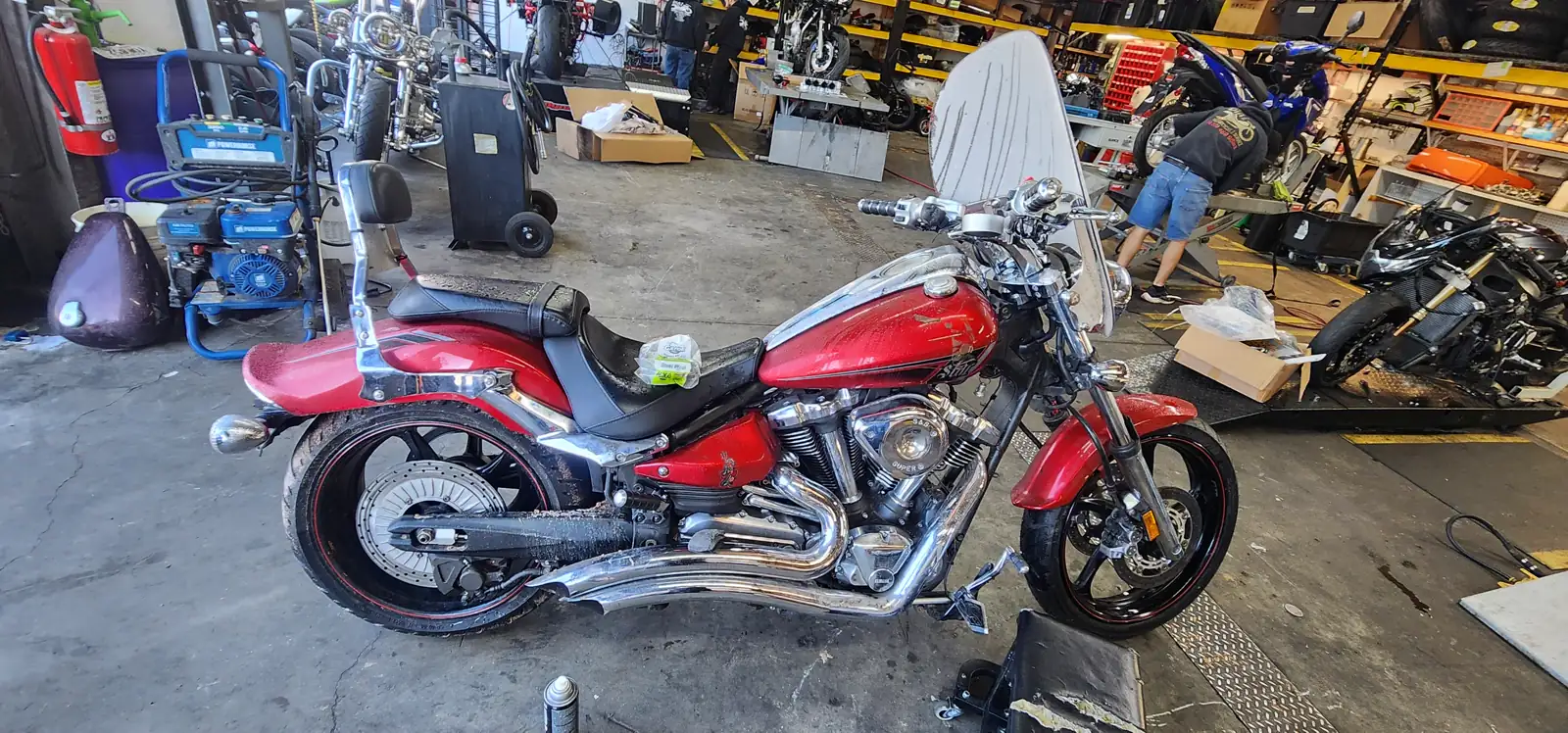
Two bikes with the same symptom can need completely different work.
We had two bikes in the same week that both popped on decel and both ran hot in traffic. One needed a fuel map written from scratch after an exhaust swap. The other needed a cracked hose the size of your pinky. Same complaint, wildly different day. If a shop quotes you a fix over the phone from a description alone, they’re guessing, and you’re paying for the guess.
What we check, and what a dyno actually measures
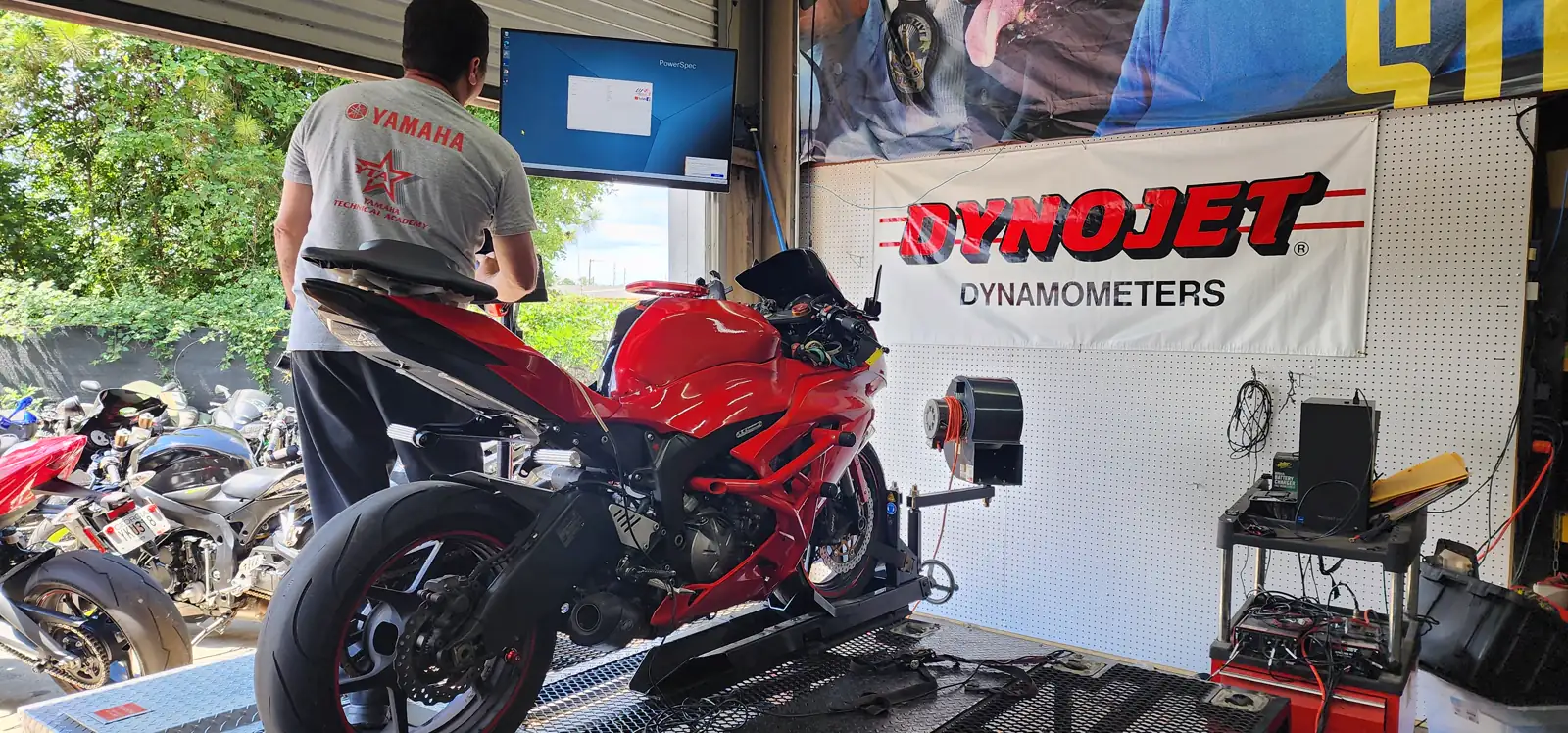
A dyno is a big roller your rear wheel sits on. The bike runs while it stays put, and we can hold it at any speed and load we want while we watch. Meanwhile, a probe in the exhaust reads exactly how much oxygen is left over after the burn. Leftover oxygen tells us the mix was thin. Almost none means it was rich. We see that at every throttle position, in real time, instead of guessing from a plug color.
That’s the whole trick. Your bike is honest on the dyno in a way it can’t be on Arnold Mill Road, where you’re busy watching traffic and can’t hold a steady quarter throttle for thirty seconds. So we hold it there for you. Then we adjust the fuel and the timing, run it again, and keep going until the numbers are clean everywhere you actually ride, not just at full throttle. It’s slow, careful, repetitive work, and it’s the work we do in house rather than shipping it out.
Depending on your bike, that adjustment happens through an ECU flash on the factory computer, or through a Power Commander style module that sits between the computer and the injectors. Both get you to the same place. Which one we reach for depends on your year, brand and what’s already installed. If you want the longer version of what the work covers, we wrote that out too.
When it's safe to ride, and when it isn't
Let’s make this part simple, because it’s the question everyone actually came for. A mild lean condition, meaning some decel popping and a small flat spot, is generally fine to ride on gently for a little while. Keep it out of long high-load pulls, don’t sit in traffic longer than you have to, and get it looked at within a few weeks. Your engine isn’t melting on a Sunday coffee run.
STOP RIDING IF
You see a temperature warning, you smell hot metal or a sweet coolant smell, the bike pings or rattles under load, it stalls repeatedly at idle, or it suddenly loses power. Any of those, park it and call us. A tow is cheaper than a top end, and we’d much rather talk you through it than meet the pistons.
The honest risk with a badly lean engine is heat. Heat is what cooks valves, scuffs pistons and turns a tune into an engine job. But that takes sustained abuse, not one careful ride home. So the right move is calm and quick, not panicked. Ride easy, get it on the schedule, and go back to enjoying the bike.
Mistakes we'd love to help you skip
- Buying a downloaded map for your exact model and assuming it fits. Your bike is not the internet’s bike.
- Turning the fuel up everywhere to chase the popping. That fixes the sound and hides the leak.
- Swapping the spark plugs and calling it solved. New plugs read clean for a while no matter what’s wrong.
- Adding an intake and exhaust on the same weekend with no tune, then wondering why it feels worse than stock.
- Ignoring a hanging idle for a whole season, which is usually an air leak politely raising its hand.
- Letting a bike sit for months with old fuel and then blaming the tune in the spring.
That last one hits hard around here, since our riding is seasonal and bikes sit between mountain trips. It’s the same pattern as what Acworth riders run into, and the fix is usually easier than people fear.
One more thing, and it’s the part riders thank us for later. When we’re done, we hand you the sheet. You get to see the before and after curves, where the mix was thin, and where it sits now. Most shops never show you that, so you’re asked to take the improvement on faith. We’d rather you see it, understand it, and be able to explain it to the guy who asks about your bike at the brewery.
Because you will get asked. Riders here are sharp, and they ask real questions. That sheet is yours to keep, and it also becomes the baseline for whatever you bolt on next year.
Why this comes up so often in Woodstock
Cherokee County riders ride differently, and their bikes show it. I-575 north to GA 515, the Appalachian Highway, puts you in real mountain country in about an hour. That means hard, sustained, high-load miles in concentrated bursts, then quiet weeks in the garage. A motorcycle running lean Woodstock style, invisible on short errand rides, gets loud fast on a long climb toward Ellijay with the throttle open.
The bikes themselves lean premium, too. Towne Lake alone covers close to 5,700 homes, and Deer Run adds another 848 built mostly in the late nineties, nearly all with two- and three-car garages. Down toward the water, Allatoona Downs, Shores and Woods keep the same pattern. Garages full of tools and trickle chargers make for well-kept bikes and owners who do their own basics and hire out the specialist work. Those garages also hold a lot of sport-touring rigs, adventure bikes, baggers and European twins, which is exactly the crowd that adds pipes and then needs a real map.
Getting to us is easy enough. Most Woodstock riders run I-575 south to I-75, then east on Roswell Road to Barnes Mill Road, about fifteen to nineteen miles and half an hour on a normal day. Bells Ferry Road south is the surface route if the interstate is ugly. You’ll pass plenty of shops on the way, including a big pre-owned powersports lot on Cobb Parkway with hundreds of units, but volume sellers aren’t tuning shops. Very few places between the Outlet Shoppes at Atlanta and downtown Marietta will strap your bike down and map it themselves.
That’s the gap we fill. Woodstock has motorcycle businesses, but they’re narrow ones: suspension only, or newer Japanese only, or Harley and custom only. If your bike is a fifteen-year-old European twin with a popping habit, you shouldn’t have to call four places. And if you’d rather spend that Saturday walking to Reformation Brewery from downtown instead of chasing a diagnosis, we get it completely.
What the finished bike feels like
Riders always describe it the same way: the bike stops arguing. Throttle response gets crisp off idle, the surge at cruise disappears, and heat at stoplights drops noticeably. Roll-on power arrives right when you ask instead of a half beat later. It feels like the bike finally agrees with you, and honestly, it’s a little addictive.
You’ll notice it most on the stuff that matters here. Blind crests on the rural roads north of town, off-camber curves, damp shaded pavement in the fall. Predictable throttle is a safety feature, not just a fun one, which is also why we point newer riders toward the MSF Basic RiderCourse and remind everyone to check tires before mountain season. Dunlop’s technical resources are a solid place to start on pressures and wear.
Mostly, though, you get to be the rider who knows what their bike is doing. You’ll know why it was lean, what changed, and what the numbers say. That’s a good feeling to carry into a season, and it’s the one we’re really after.
Questions Woodstock riders ask us
Will a lean condition get worse on its own?
Usually, yes, but slowly. Air leaks grow as rubber ages, and filters and injectors only get dirtier. The symptoms tend to creep rather than jump, which is why riders often don’t notice until a friend points it out. Catching it early keeps it a tuning job instead of an engine job.
How urgent is this, really?
Mild symptoms mean weeks, not minutes. Ride gently, skip the long high-load pulls, and get on the schedule. But pinging under load, a heat warning, or sudden power loss means park it and call us that day.
What happens if I just ignore it for a season?
Most likely you lose some fuel mileage, run hotter than you should, and wear valves and rings faster than normal. The worst case is heat damage to the top end after sustained hard riding. It’s rarely dramatic, but it’s never free.
How do you find the actual cause?
We start with the cheap, fast checks: plug reading, a smoke or spray test for air leaks, filter condition, and fuel pressure. Then the bike goes on the dyno, where a probe in the exhaust shows us the mix at every throttle position. The data usually names the culprit quickly.
Could my symptoms be something other than running lean?
Absolutely, and we check for it. Decel popping can come from an exhaust leak. A flat spot can be a failing sensor or a clutch issue. Hard starting can be battery or valve clearance. That’s exactly why we diagnose before we tune.
Do I need a tune if I only added a slip-on muffler?
Often not, since a single slip-on changes airflow less than people expect. A full system or an intake change is a different story. If you’re unsure, bring it by and we’ll tell you straight, even when the answer is that your bike is fine.
We take care of riders across Cherokee and Cobb and well beyond, so Woodstock and Towne Lake folks are in good company here. Canton and Ball Ground riders come down the same I-575 corridor, while Holly Springs, Acworth and Kennesaw sit just a short hop west. Marietta is home base for us, and East Cobb riders are practically neighbors. From the east side, Roswell, Alpharetta and Milton riders make the run over regularly, and Cartersville riders come in from the northwest. If you’re within an easy morning ride, we’re happy to see you.
LET'S FIND OUT WHY
If your bike pops, surges or runs hot, don’t guess at it and don’t let it eat your riding season. Text us a quick description and we’ll tell you honestly whether it sounds like a ten-minute hose or a real tuning job. Woodstock riders are a half hour away, and we’ll strap your bike down, read the numbers, and hand you the sheet when we’re done.
470-460-9883Diaz Motorcycles and Service, LLC · 847 Barnes Mill Road, Marietta, GA 30062