Motorcycle Running Lean Acworth — How to Fix It
A stumble off idle, a pop on decel, more heat than you remember. Here's what your bike is trying to tell you.
After that, the bike looked perfect sitting in that driveway. What’s more, Low miles for the year, tires with plenty of tread, and a slip-on exhaust the seller waved off as “just a little breathing room.” You paid, you rode it home, and for about a week you were the happiest person in the Lake City. Then the little things started. A stumble when you cracked the throttle. So and Better yet, that said, a pop on the way down off GA-92. Still, Heat off the header that soaked through your jeans at every light. So you started searching motorcycle running lean Acworth at eleven at night, and here you are. Plus, you’re not imagining it, and you’re definitely not the first friend to land on this page.
Good news first, because there’s plenty of it. What you’re describing is one of the most common things we see roll through the shop, and it’s almost always fixable. Not “replace the engine” fixable. More like “the bike is breathing differently than the factory expected, and nobody ever told the computer” fixable. Let’s walk through it together.
What "lean" actually means, minus the jargon
Your engine drinks two things: air and fuel. It wants them mixed in a pretty specific ratio, the way a recipe wants a certain amount of flour per egg. When there’s too much air for the fuel being delivered, that’s lean. Too much fuel for the air, that’s rich. Neither one is a moral failing on your bike’s part. It’s just a recipe that drifted.
Lean burns hotter. That’s why the symptoms cluster the way they do: extra heat, snappy little pops, a hesitation right where the engine has the least to work with. A slightly lean bike will still start, still ride, still get you to Logan Farm Park on a Friday morning. It just does everything with a small clenched jaw. Over enough miles, that heat is hard on valves, pistons and exhaust parts, which is why we don’t shrug it off.
The symptoms riders describe to us
Nobody walks in saying “my air-fuel ratio is off.” They say it the way it feels. Here’s the list we hear, almost word for word:
- Popping, crackling or backfiring when you roll off the throttle
- A flat spot or stumble just off idle, especially in first and second
- The bike surges at a steady cruise, like it can’t pick a speed
- It runs hotter than it used to, and the fan kicks on constantly in traffic
- Hard cold starts, or an idle that hunts up and down before it settles
- Spark plugs that come out chalky white instead of light tan
- Throttle response that feels abrupt and jerky instead of smooth
You may have two of those. You may have all seven. Either way, write them down before you call anybody. A rider who can say “it stumbles between two and three thousand RPM in second gear when the engine is warm” has already done half the diagnostic work, and we’ll love you for it.
What each symptom usually means
Popping and crackling on decel
When you shut the throttle, the engine stops asking for fuel but air keeps moving through. Unburned fuel meets hot exhaust and lights off in the pipe. A tiny bit of this is normal on some bikes. In fact, a constant machine-gun rattle every time you slow for the light near the depot is your bike telling you the mixture is thin down low.
A flat spot right off idle
Small throttle openings are the hardest part of the map to get right, and they’re the first thing an exhaust or intake change ruins. You crack the throttle, the engine gulps more air than the fuel map planned for, and it hesitates before it catches up. In stop-and-go on Cherokee Street, that hesitation is genuinely annoying.
Extra heat
Fuel doesn’t just make power, it cools the combustion chamber on its way through. Thin the fuel out and you lose some of that cooling. Riders notice it first in summer, sitting still, when the fan runs and runs. Georgia in August will find every weakness a cooling system has.
Hunting idle and cold-start drama
A cold engine needs extra fuel. If the mixture is already thin, cold mornings expose it. The bike fires, wanders around looking for an idle, and dies unless you feed it throttle. Riders who store a bike all winter and wake it up in March see this most, and stale fuel from sitting makes it worse.
White spark plugs
This one’s free to check. Pull a plug and look at the tip. Light tan or grey means the mixture is in a healthy range. Chalky white points lean, black and sooty points rich. It’s a rough measure, not a verdict, but it’s honest information you can gather in your own garage.
Here’s where it gets interesting — and where most advice online falls apart. Forum posts will tell you to swap plugs, clean the injectors or buy a specific brand of fuel. Sometimes that helps a little. But the real question isn’t “what part is bad.” It’s “what changed, and does the bike’s computer know about it?” On a modern fuel-injected bike, nothing is broken at all in most lean cases. The hardware is fine. The instructions are stale.
Why used bikes are the usual suspect
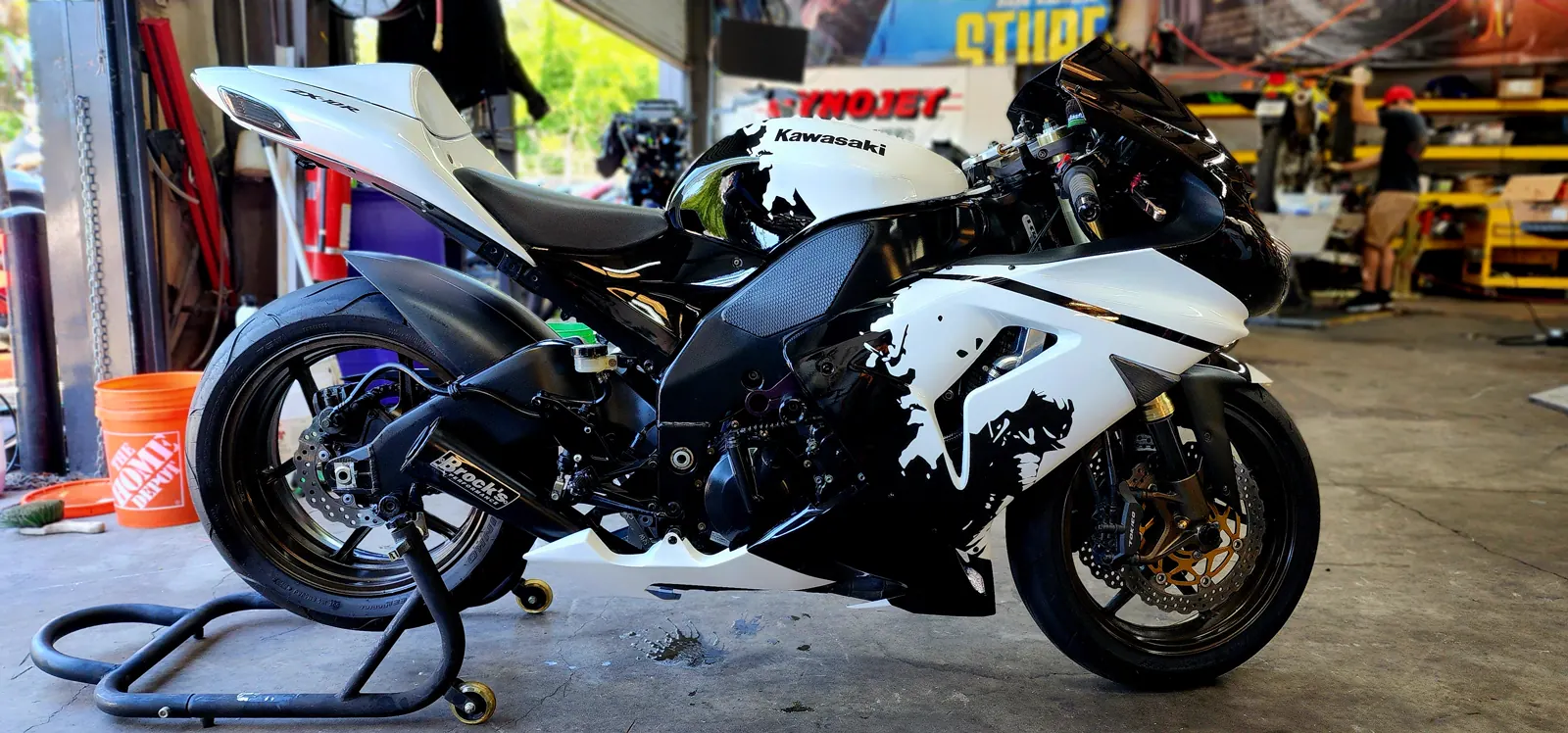
Buy a bike secondhand and you inherit somebody else’s decisions. Maybe an exhaust went on and the fuel was never touched. For example, Maybe an air filter came out and something “high flow” went in. Maybe there’s an old flash on the ECU from a shop three owners ago that nobody documented. Each change moves air through the engine differently, and stock fuel maps are built around stock airflow. If you’re weighing whether to modify at all, we broke down the tradeoffs between them in a separate post, because there’s a real case for leaving a bike alone.
There are also plain mechanical causes worth ruling out before anyone touches a map: a cracked intake boot, a loose clamp, a leaking exhaust gasket, a vacuum line that went brittle from age, a lazy oxygen sensor, or gummed-up carbs on an older bike that spent three winters parked. Those let unmetered air sneak in, and no amount of tuning fixes a leak. It’s the same story we see across the metro, and you can read how this plays out in Roswell too. Different city, same physics.
What a dyno actually measures
A dyno is a heavy drum in the floor. Your bike sits on it, strapped down, rear wheel spinning the drum instead of the pavement. The machine measures how hard your engine can accelerate that known weight, which is where power and torque numbers come from. But the numbers aren’t the point for a lean bike. The important part is the sniffer in the exhaust, reading the actual air-fuel ratio at every RPM and every throttle position, in real time.
That’s the difference between guessing and knowing. Instead of “it feels lean around three grand,” we get a chart showing exactly where and how much. Diagnosing a motorcycle running lean Acworth riders bought secondhand comes down to that data, then adjusting the map with an ECU flash or a Power Commander and running it again. If you’re curious how many passes that takes, here’s what that service actually involves. Short answer: more than one, and less than you’d fear.
What happens when you bring it to us
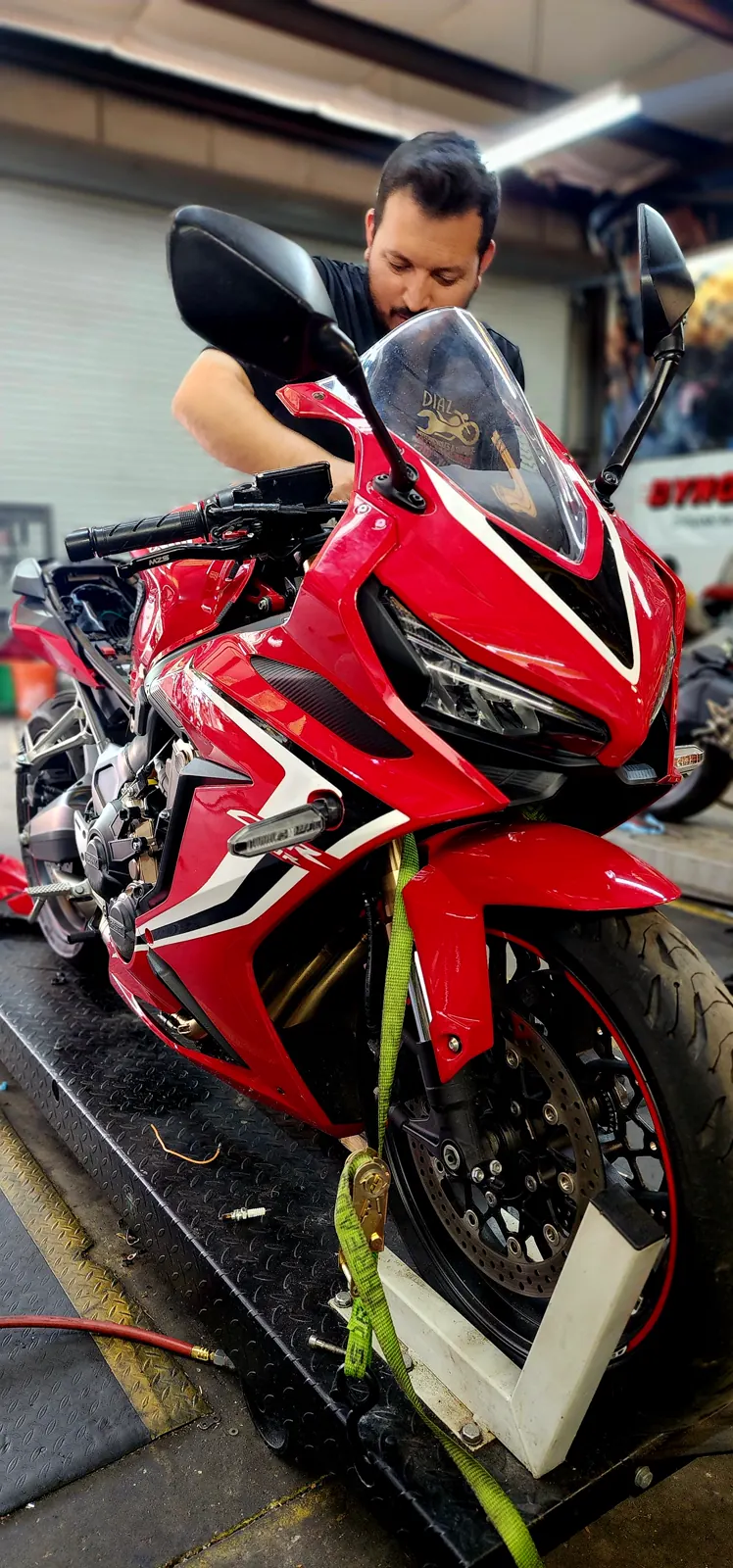
- We listen. Your symptom list, when it started, what the previous owner said, and what you’ve already tried.
- We inspect. Intake boots, clamps, gaskets, vacuum lines, filter, plugs and sensors, before any tuning talk.
- We fix what’s mechanically wrong first. Tuning around a leak just hides it.
- The bike goes on the dyno and we take baseline pulls to see the real air-fuel ratio across the range.
- We build the map, adjusting fuel and timing where the data says it’s needed, then verify with more pulls.
- You get the chart, in plain English, and a bike that behaves the way you expected on the test ride.
That’s the short version. If you want the whole menu, including ECU work and Power Commander setups, here’s the full list of what we do. And if any of it sounds like a fight, it isn’t. Most of it is just paying attention in the right order.
Is it safe to ride like this?
Straight answer, because you deserve one. A mildly lean bike with an occasional pop on decel is generally fine to ride short distances while you get it scheduled. Plenty of riders live with it for a season without drama. What you shouldn’t do is put long, hot, wide-open miles on it, and that’s exactly the kind of riding Acworth encourages: sustained highway pulls, long back-road runs, no lane splitting to break up the heat because Georgia doesn’t allow it.
STOP RIDING IF
You hear pinging or a metallic rattle under load, the temperature climbs past its normal range, the bike loses power as it heats up, or it stalls in traffic. Those aren’t annoyances anymore. Call us and let us come get it instead.
While the bike’s parked, check the boring stuff nobody enjoys checking. Tire pressure and tread age matter more than most riders think, and Dunlop’s technical resources explain the wear patterns better than we can in one paragraph. A bike that’s been sitting in a garage since November usually needs more than a map.
When to get it in
Around here the calendar does the deciding. Riding is basically year-round, but the real season runs March through November and it tracks lake rhythms more than anything else. When the boats come out, the bikes come out. That means late winter is the smartest window: the shop is calmer, and you’d rather sort a stumble in February than discover it on the first warm Saturday when everyone in the county is headed toward the water. If you already know something’s off, don’t wait for the weather to remind you.
Distance isn’t much of an obstacle either, since nobody in this town blinks at a drive. From downtown it’s roughly 20 miles and a 32 to 40 minute run down I-75 to Roswell Road. From the Paulding side near Bentwater and Cedarcrest Road, figure 24 to 26 miles and 40 to 50 minutes. CayloR-Made Motorsports over on Rosewood Circle is about the same drive, so you’ve got options either way. The difference is we’ll come to your garage and pick the bike up, which beats trailering it yourself on a Saturday.
Here’s what changes once it’s actually sorted. Riders always describe it the same way, and it’s never the horsepower they mention first.
How a properly tuned bike feels
The stumble disappears, so rolling on from a light stops feeling like a negotiation. Throttle response smooths out, which matters most in the low-speed stuff where jerkiness makes you look like a beginner in front of your neighbors. Heat drops back to normal. The decel popping fades to whatever your exhaust naturally does. Cold starts settle down. And yes, there’s usually more usable power, but it shows up as a wider, flatter pull rather than a headline number. Your bike stops fighting itself. That’s the whole prize.
Riding the Lake City with a bike that behaves
This is the most powersports-heavy town we serve, and it isn’t close. Garages around Brookstone and out at Governors Towne Club don’t hold a motorcycle so much as a small fleet: a boat, a side-by-side, a dirt bike for the kid, and something with two wheels for the owner. A sorted bike fits that life better. Old US-41 north through Emerson toward Cartersville is still the honest alternative to the interstate, all easy sweepers and light traffic. Weekends fill up fast between the trail network at Allatoona Creek Park and the Victorian streets of Historic Downtown Acworth, where the farmers market takes over Logan Farm Park on Friday mornings from April into late October.
A lean bike doesn't fail dramatically. It just quietly stops being fun.
Watch your surfaces out there too, since Acworth addresses spread across three counties and three different maintenance budgets. The Cherokee and Paulding edges are rougher, with gravel at driveway aprons and tar snakes that go greasy in July heat. Add boat-ramp sand near the lakes and wet leaves in the fall, and smooth throttle control earns its keep. If it’s been a while since anyone taught you those habits, the MSF Basic RiderCourse is a genuinely good day.
So if you bought somebody else’s project and it’s been nagging at you ever since, you’re in good company. We’ve helped a lot of friends in exactly your spot, and almost none of them needed the scary repair they were bracing for. They needed a bike whose computer finally understood what it was breathing.
Questions Acworth riders ask us
How do you figure out what's actually causing it?
We start with your description and a hands-on inspection of the intake, exhaust, filter, plugs and sensors. Then the bike goes on the dyno with a sniffer in the pipe, which reads the real air-fuel ratio at every RPM and throttle position. That turns a hunch into a chart. From there we know whether it’s a leak, a sensor or a map that never got updated.
Could my symptoms be something other than a lean condition?
Absolutely, and we check. Popping and hesitation can also come from a weak fuel pump, a clogged filter, tired ignition coils, a dragging clutch or old fuel that’s been sitting since last season. On carbureted bikes, varnished jets from months of storage cause almost identical behavior. That’s why we inspect before we tune.
Is it safe to keep riding until my appointment?
Short local rides are usually fine if the symptoms are mild and the temperature stays in its normal range. Skip the long highway runs and hard wide-open pulls until it’s sorted, because heat is the real risk. If you hear pinging under load, see the temperature climb, or the bike loses power as it warms up, park it and call us.
What causes a bike to run lean in the first place?
Most often an airflow change without a matching fuel change, like an aftermarket exhaust or air filter on a stock map. Air leaks are the other big one: cracked intake boots, loose clamps, brittle vacuum lines or a leaking exhaust gasket. Aging oxygen sensors and undocumented ECU flashes from previous owners round out the list.
Can I fix this myself in my garage?
Some of it, yes, and plenty of Acworth riders do. You can read plugs, check clamps and vacuum lines, spot a cracked boot and replace a filter with basic tools. What you can’t do at home is measure the actual air-fuel ratio under load, which is the part that tells you whether the map is right. That’s the equipment piece, and it’s usually why folks call.
Do I have to trailer the bike down there myself?
Nope. We offer pickup and delivery, local and out of state, so the bike can leave your garage on our trailer instead of your Saturday. Riders near the lakes take us up on it constantly. Just text us and we’ll set a time.
We take care of riders all over the northwest metro, starting with Acworth and the surrounding lake communities and reaching out from there. That includes Kennesaw and Marietta just down the interstate, Woodstock and Canton over on the Cherokee side, Dallas and Powder Springs to the southwest, and Cartersville, Emerson, Adairsville, Euharlee, Taylorsville and White up toward the north end of Lake Allatoona. If you’re somewhere in that stretch and your bike is acting up, the drive isn’t the hard part, and it doesn’t have to be your drive at all.
LET'S GET YOUR BIKE BREATHING RIGHT
Text us what your bike is doing and when it started, and we’ll tell you straight whether it sounds like a map issue or a mechanical one. We’ll come get it from your garage in Acworth, sort it on our dyno, and hand it back feeling the way it should have felt the day you bought it. No pressure, no upsell, just a bike you’re excited to ride again.
470-460-9883Diaz Motorcycles and Service, LLC · 847 Barnes Mill Road, Marietta, GA 30062