Dyno Tuning Cost Douglasville — Full Breakdown
The small stuff a dyno sees, the honest way we quote a tune, and what really drives the work on your bike.
It started so small he almost let it go. A little hitch just off idle. At the same time a flat spot right where the throttle should have pulled hardest, there and gone before he could point to it. As a result one rider felt it pulling away from a gas stop and blamed bad fuel. It wasn’t the fuel. On the other hand that tiny stumble is usually the first sign a bike is asking for a tune, and it’s why the whole question of dyno tuning cost Douglasville riders bring us tends to start with a shrug. So let’s clear it up, plain and simple.
The honest answer, up front
Here’s the truth. So there’s no single price that fits every bike. Still, a tune on a lightly modified cruiser is not the same job as a tune on a built-up sportbike, and pretending otherwise would only set you up for a surprise down the road. Plus, what we can do is show you exactly what drives the work. Once you see the moving parts, the whole thing stops feeling like a mystery. That’s the goal of this breakdown.
Think of it in three buckets. Meanwhile, a dyno tune is part measurement, part labor, and part parts. Of course, the measurement barely changes from bike to bike. The labor and the parts are where two jobs split apart. Get those three clear in your head, and you’ll be able to size up your own bike before you ever pick up the phone.
What a dyno actually measures
A dyno is a machine that lets your bike run hard while it stays still. We strap the rear wheel down to a heavy roller, and the bike spins that roller instead of the road. Sensors read how much force the engine makes across the whole rev range. That gives us a clean picture of power, and just as important, of the air-and-fuel mix the engine is breathing while it works.
That mix is the heart of the whole thing. Every engine wants a certain balance of air and fuel to burn clean. Too much air and not enough fuel, and the bike runs lean. Too much fuel and not enough air, and it runs rich. A dyno with a wideband sensor reads that mix in real time, so we stop guessing and start seeing what your engine is really doing.
Here’s why that matters to you and not just to us. The mix isn’t the same everywhere. A bike can be perfect at cruise and lean under a hard pull, or rich down low and fine up top. The road never asks for just one throttle position, so a good tune has to be right across all of them. That’s what the dyno lets us see, foot by foot through the rev range.
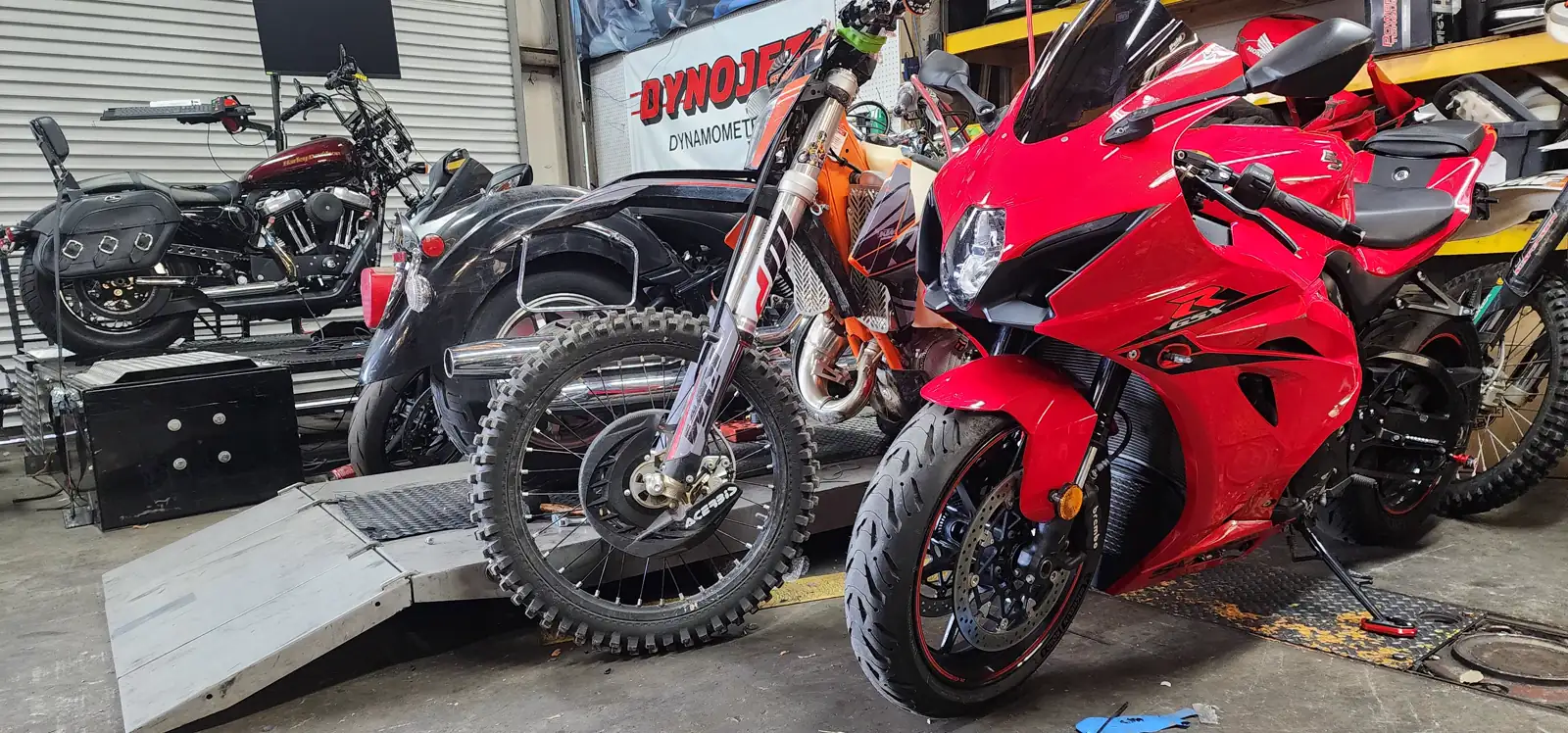
Lean, rich, and why your bike feels off
A lean bike often runs hot and feels flat. It can pop on decel, surge at steady throttle, and feel like it’s holding its breath down low. Plenty of riders live with it because it creeps in slowly. If you want the deeper story on that, we wrote a whole post on what usually causes it. The short version is simple: lean is fixable, and a tune is the tool that fixes it.
A rich bike has the opposite problem. It wastes fuel, feels a little lazy, smells strong at the pipe, and can leave soot on the tip. Neither one is a disaster. Both are exactly what a tune is built to correct. That’s the fix hiding inside a bad-feeling bike, and it’s genuinely good news.
So what does a tune actually change? It reshapes the map, which is the set of instructions your bike’s brain follows for fuel and timing at every throttle position and every rpm. We adjust that map until the mix is right everywhere, not just in one lucky spot. The bike comes out smoother off idle, cleaner through the midrange, and honest when you finally crack it wide open.
Flash or Power Commander?
People ask which one they need, and the honest answer is that it depends on the bike. A flash rewrites the factory brain directly, which is clean and tidy when your model supports it. A Power Commander sits alongside the stock unit and trims the fuel, which is a great path when a flash isn’t available or when you’re still changing parts. Neither is automatically better. We match the method to your bike, your mods, and the way you actually ride.
How a tune goes, start to finish
- We talk first. Actually we ask how you ride, what you’ve changed on the bike, and what feels wrong. Your seat-of-the-pants report tells us where to look.
- We inspect. Before the bike ever touches the roller, we check plugs, the air filter, the throttle bodies, and the intake and exhaust for leaks. A tune can’t paper over a mechanical problem hiding underneath.
- We take a baseline pull. That’s why we run the bike exactly as it sits and record where it stands. That’s our starting map and our proof of what changes.
- We read and adjust. Either way we watch the air-and-fuel mix across the range and reshape the map, whether that’s an ECU flash or a Power Commander.
- We confirm. In short we pull again to make sure the new map holds under real load, then check it at the throttle openings you actually use every day.
- We hand it back with notes. You leave with a clear picture of what we found and what we did.
NO BLIND QUOTES
We won’t throw a number at a bike we haven’t seen. We look, we inspect, and then we tell you what your tune actually needs. No padding, no surprises when you swing by to pick it up.
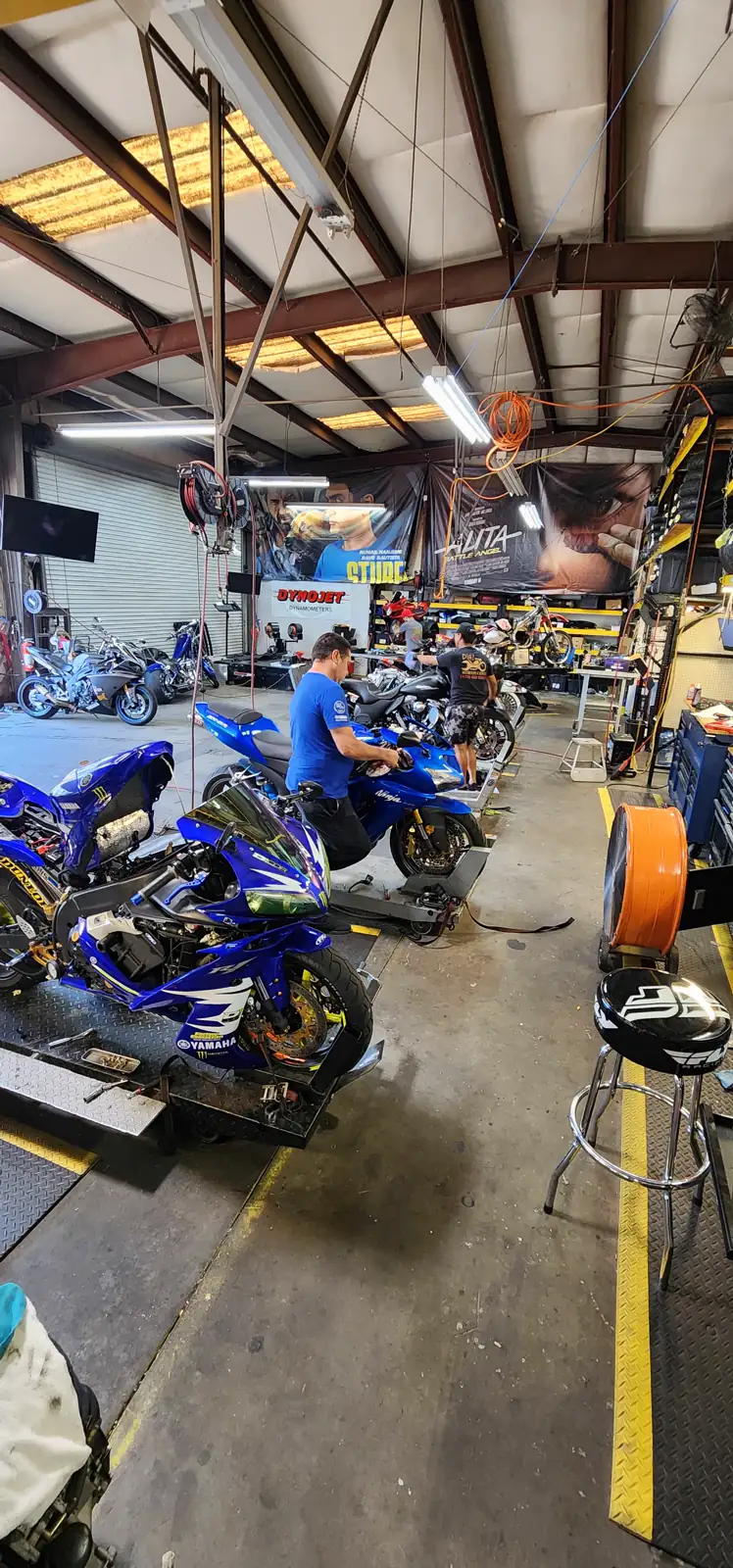
Now, the part nobody mentions until you’re already paying for it.
Access. Some bikes make the job easy. The tuning port sits right there, the fairings pop off in minutes, and the strap clears the exhaust. Other bikes bury everything. Full fairings, tucked-away connectors, and tight tanks all add time, and time is labor. Two bikes can need the very same map change, yet one takes far longer to reach. That, more than anything, is why two tunes on the same street can land at different totals.
Parts are the other lever. A flash reuses the brain already living in your bike. A Power Commander is a piggyback unit that adds a piece of hardware. If your setup needs a new sensor, a bung welded in for a wideband, or a fuel or air part to hit the target, that’s real material stacked on top of the labor. None of it is a trick. It’s just the gap between a bike that needs its map redrawn and one that needs a small part added first.
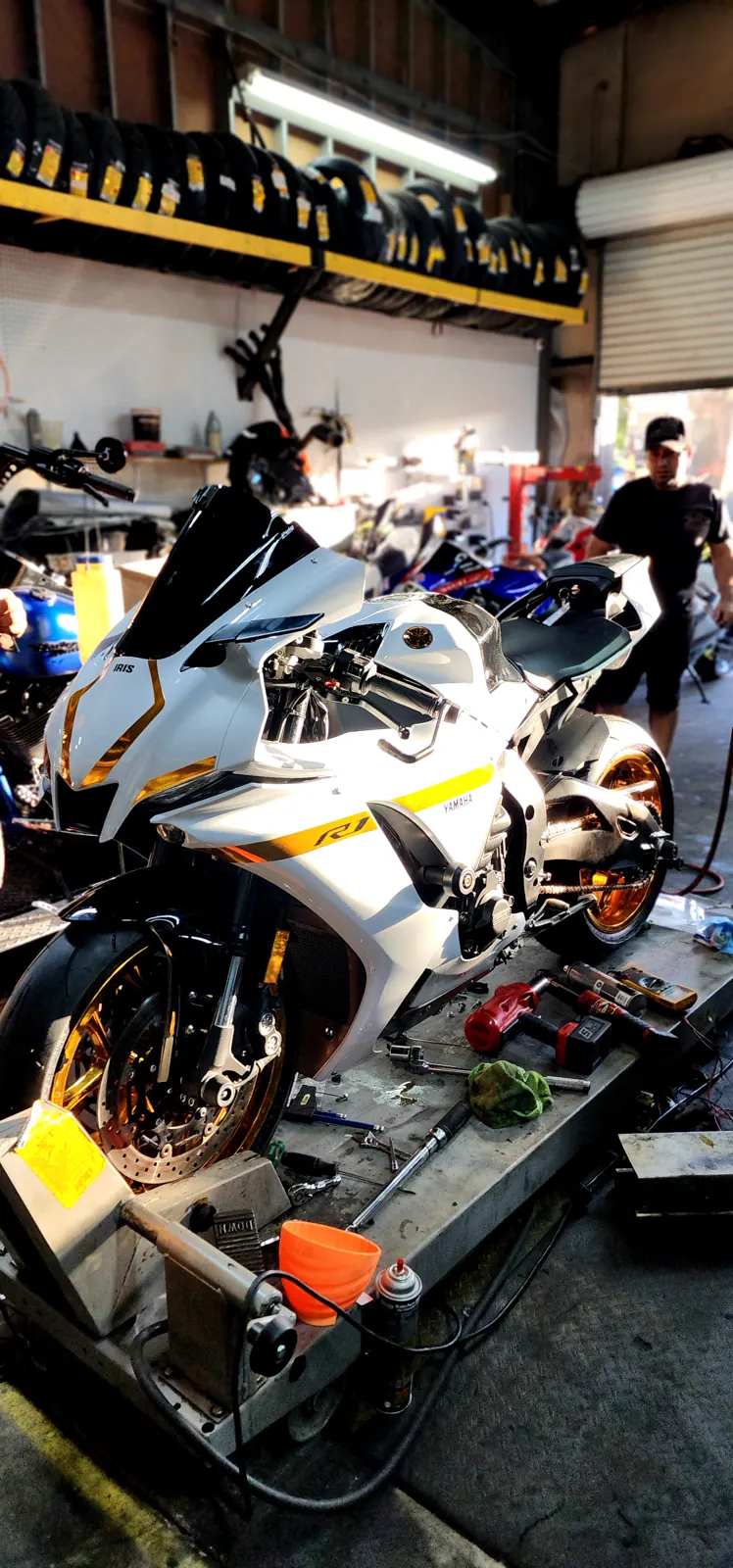
Mistakes that cost riders more
The most common one is chasing a canned map off the internet. A tune pulled from a forum was built for someone else’s bike, someone else’s exhaust, someone else’s altitude. It might feel okay. It might also run lean in the exact spot where you ride most. A real tune is measured on your bike, not copied onto it from a stranger’s.
A dyno doesn't guess. It shows you exactly what your engine is doing.
- Skipping the inspection and tuning around a vacuum leak, so the map fights a battle it can’t win.
- Bolting on a loud exhaust and never retuning, then wondering why the bike stumbles.
- Chasing one big peak number instead of the smooth, honest power you actually feel on the road.
- Waiting until a small flat spot grows into a hard-starting, hot-running headache.
You can compare notes with what Kennesaw riders run into, because the same traps show up a county over. And if you’re curious how deep a proper job really goes, here’s what the work covers when a tune is done right the first time.
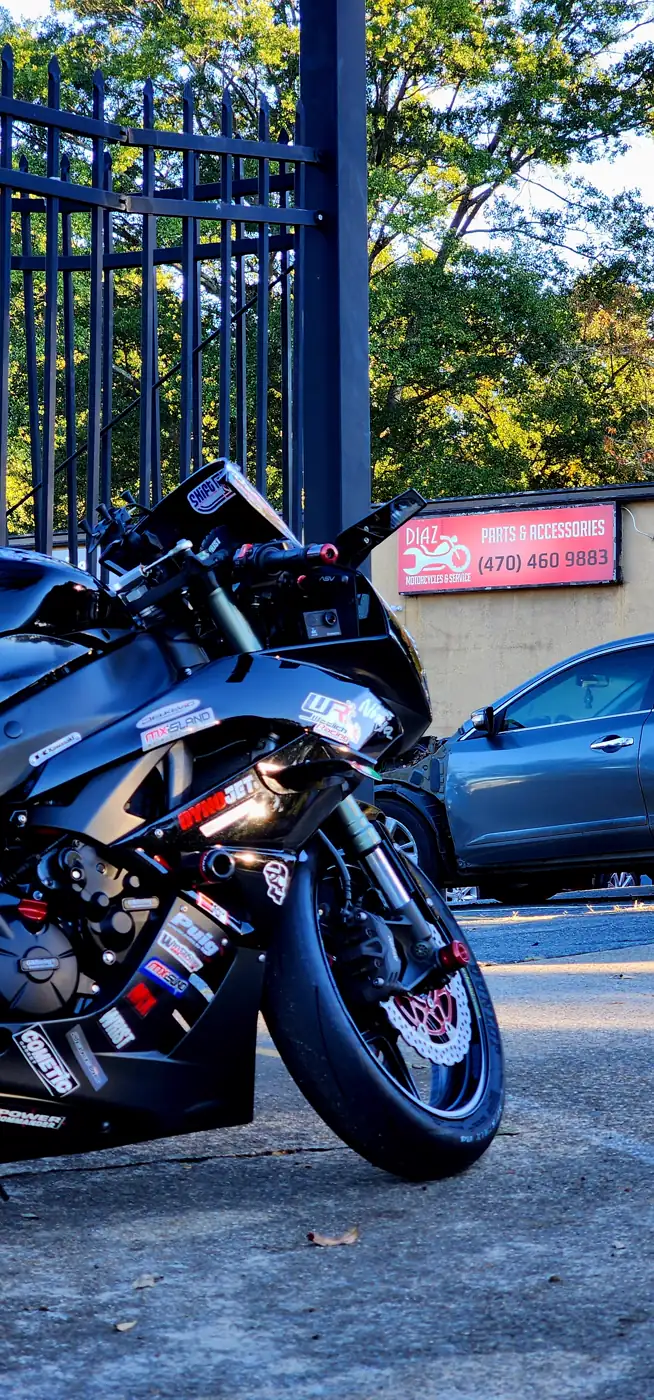
Why we won't quote it over the phone
We know a phone quote is easier to hear. But an honest shop can’t hand you a real figure for a bike it has never seen. The access might be simple or a puzzle. The bike might need nothing but a map, or it might need a part first. Quoting blind would mean padding it to stay safe or lowballing it to sound good, and both roads end at a surprise. That’s what keeps any real talk about dyno tuning cost Douglasville honest instead of guesswork. We’d rather look first, tell you what it needs, and let you decide with the full picture. You can see the work we do in house before you ever roll a bike in.
And then there’s the part that’s just about riding again.
Because in the end, that’s why any of this matters. A well-tuned bike is a steadier friend on a rough road and a pure joy on a good one. Around here, both kinds sit close together, which is a lucky thing for a rider.
Take an easy Saturday roll out of Brookmont, past the newer homes and the pool, and the streets are smooth and forgiving. Head a little south, though, and roads like Dorsett Shoals, Post Road and Basket Creek turn chip-sealed and rough, with gravel wash and shoulder drop-offs that punish a bike that hesitates at the wrong second. A tune won’t fix the pavement, but it does make your bike predictable when the road refuses to be.
Riders roll in to us from every corner of the county. Some live over in Anneewakee Trails, where the clubhouse, pools and tennis courts keep families close to home. Others are up in long-established Anneewakee, tucked in among the woodlands, lakefront and creek beds. Plenty more pass through downtown near O’Neal Plaza on an event night, or pull long shifts at Wellstar Douglas Hospital and just want a bike that runs right when they finally get to ride.
And when you want the real reward, you point the bars north. The run from Johns Mountain to Cloudland Canyon is about 72 miles of GA-136, Armuchee Road, Pocket Road and Floyd Springs Road, stitched together by the Lookout Mountain Scenic Highway and reached through Villanow. It’s tight hairpins that peak in autumn color, and it is not the place to discover a flat spot mid-corner. A bike that pulls clean everywhere turns that road from a test into a treat.
We sit in Marietta, roughly 28 to 32 miles out, which usually runs 40 to 60 minutes depending on how the day’s traffic behaves. The smart route dodges the worst of it: take Thornton Road and GA-6 north to the East-West Connector into Marietta instead of grinding up I-20 east to I-285 north, since that interchange is one of the ugliest in the state. You’ve got closer options too, and Fusion Powersports up in Dallas, about 40 minutes north on Dallas Acworth Highway, is one of them. But if you want a real in-house dyno paired with ECU flashing and Power Commander work, the ride to us pays off.
What you walk away with
So here’s the whole thing in one breath. A dyno measures what your engine is truly doing. Lean or rich is just the mix being off in one direction or the other. A tune redraws the map until the bike feels right everywhere. What you pay comes down to access and parts, which is the very reason an honest shop looks first and quotes second.
That’s the point of a plain breakdown of dyno tuning cost Douglasville riders can actually use. Not a number pulled from thin air, but a clear map of what drives it. Ride safe out there, keep that DOT helmet buckled, and if you ever want the bigger safety picture, the IIHS motorcycle research is worth a read. When you’re ready, we’ll have the roller warmed up and waiting.
Questions Douglasville riders ask us
How do I avoid surprises with a tune?
Bring the bike in and let us look before anyone talks numbers. We inspect it, take a baseline pull, and tell you what it actually needs. That way the plan is set before the work starts, and nothing sneaks up on you at pickup.
What makes one tune bigger than another?
Two things, mostly: access and parts. A bike with full fairings and buried connectors takes longer to reach than an open one, and that time is labor. On top of that, some bikes need a sensor, a wideband bung, or a fuel or air part before the map can hit its target.
Why can't you quote it over the phone?
Because we haven’t seen the bike yet. The access could be simple or a real puzzle, and the bike might need only a map or a small part first. An honest figure comes after we look, not before. Quoting blind would just mean guessing, and you deserve better than a guess.
What's included in the work?
You get the talk-through, a full inspection, a baseline pull, the actual mapping by ECU flash or Power Commander, confirmation pulls under real load, and notes on what we found. In short, the whole job from first look to final check.
How long does it take?
It depends on the bike and what it needs. A straightforward tune can wrap in a day, while a bike that needs a part added or a leak fixed first takes longer. We’ll give you a real timeline once we’ve had a look, so you can plan around it.
Is a flash or a Power Commander right for me?
That comes down to your bike and your mods. A flash rewrites the factory brain when your model supports it, and a Power Commander adds a unit that trims fuel alongside the stock one. We pick the method that fits how you ride, not a one-size answer.
We tune bikes for riders all across Douglas County and the west metro. Folks roll in from Lithia Springs and Villa Rica, from Austell and Hiram, and from Powder Springs and Mableton. We see plenty of bikes out of Dallas and Winston, along with Smyrna and Temple, and riders as far as Fairplay make the trip. And of course we’re right here in Marietta, roller warm and ready when you are.
READY WHEN YOU ARE, DOUGLASVILLE
If your bike’s got a flat spot, a stumble, or you just want it running its honest best, let’s take a look. Text us and tell us what you ride and what feels off, and we’ll get you a real plan for your Douglasville tune. No blind quotes, no surprises, just a bike that pulls clean everywhere.
470-460-9883Diaz Motorcycles and Service, LLC · 847 Barnes Mill Road, Marietta, GA 30062