Dyno Shop East Cobb — A Rider's Guide To Picking The Right One
How to tell a real tuning shop from a shop with a dyno in the corner, and why waiting one more month costs you.
Then again, Right now the bike runs a little hot at the long light on Roswell Road. It stumbles when you crack the throttle leaving the neighborhood. Even so, you tell yourself you’ll deal with it next month. Meanwhile, Next month it’s a fouled plug, a popping exhaust and a motor that feels tired by the time you get home. In fact, that said, that’s how small stuff turns into parts stuff. Which is exactly why riders start hunting for a dyno shop East Cobb can reach without burning a whole Saturday. Waiting is almost always the expensive option, and the fix is smaller than you think.
One more month of waiting, and what it turns into
Here’s the thing about a bike that runs wrong. It doesn’t hold still. A motor running lean runs hot, and heat is what turns a short job into a long one. A motor running rich washes the oil film off the cylinder walls and dumps raw fuel where it doesn’t belong. Both get worse on a schedule you didn’t pick. The good news is that this is one of the most fixable things on a motorcycle. Fuel and spark are adjustable, and once they’re right, the bike feels new again.
Start with the symptom list
Ride your bike this week and pay attention to it. If any of the following show up, your engine and its fuel map are having a disagreement. None of these mean the bike is ruined. They mean the bike is talking.
- It hesitates or flat-out stumbles right off idle, usually in the first quarter turn of throttle.
- What’s more, it pops and crackles on deceleration, especially rolling down Johnson Ferry Road toward the river.
- It runs hotter than it used to, and you feel that heat through the tank and your right boot in stop-and-go traffic.
- It surges at a steady cruise, like somebody invisible keeps tapping your throttle.
- The fuel light shows up earlier than it used to on the same familiar loop.
- Still, the plugs come out black and sooty, or they foul out completely.
- You added a slip-on, a full exhaust or a high-flow filter, and the bike honestly felt worse afterward.
What each of those is telling you, in plain words
Lean means too much air for the amount of fuel. Combustion gets hot and fast, so the bike surges at cruise, feels flat at low throttle and pops on the overrun as unburned mixture lights off in a hot pipe. Riders often describe it as the bike feeling nervous. Over time that extra heat is hard on valves, pistons and the oil itself. Nothing dramatic happens in one ride. It’s the slow version that gets people, which is why lean is the condition we’d rather catch in spring than in August.
Rich is the opposite problem, too much fuel for the air. It sooties the plugs, dulls throttle response and quietly eats your fuel range. A rich bike feels lazy rather than nervous. It will also make your riding jacket smell like a gas station, which is a great conversation starter and a terrible cologne.
Then there’s the aftermarket part story, which is the most common one we hear. A free-flowing exhaust or filter changes how much air moves through the engine. The factory fuel map has no idea you did that. So the computer keeps delivering the fuel it was told to deliver for a stock bike, and the mixture drifts. That’s why bikes so often get louder and no faster. The part wasn’t wrong. Plus, the map just never got the memo, and that’s the piece a tune fixes.
So what does a dyno actually measure?
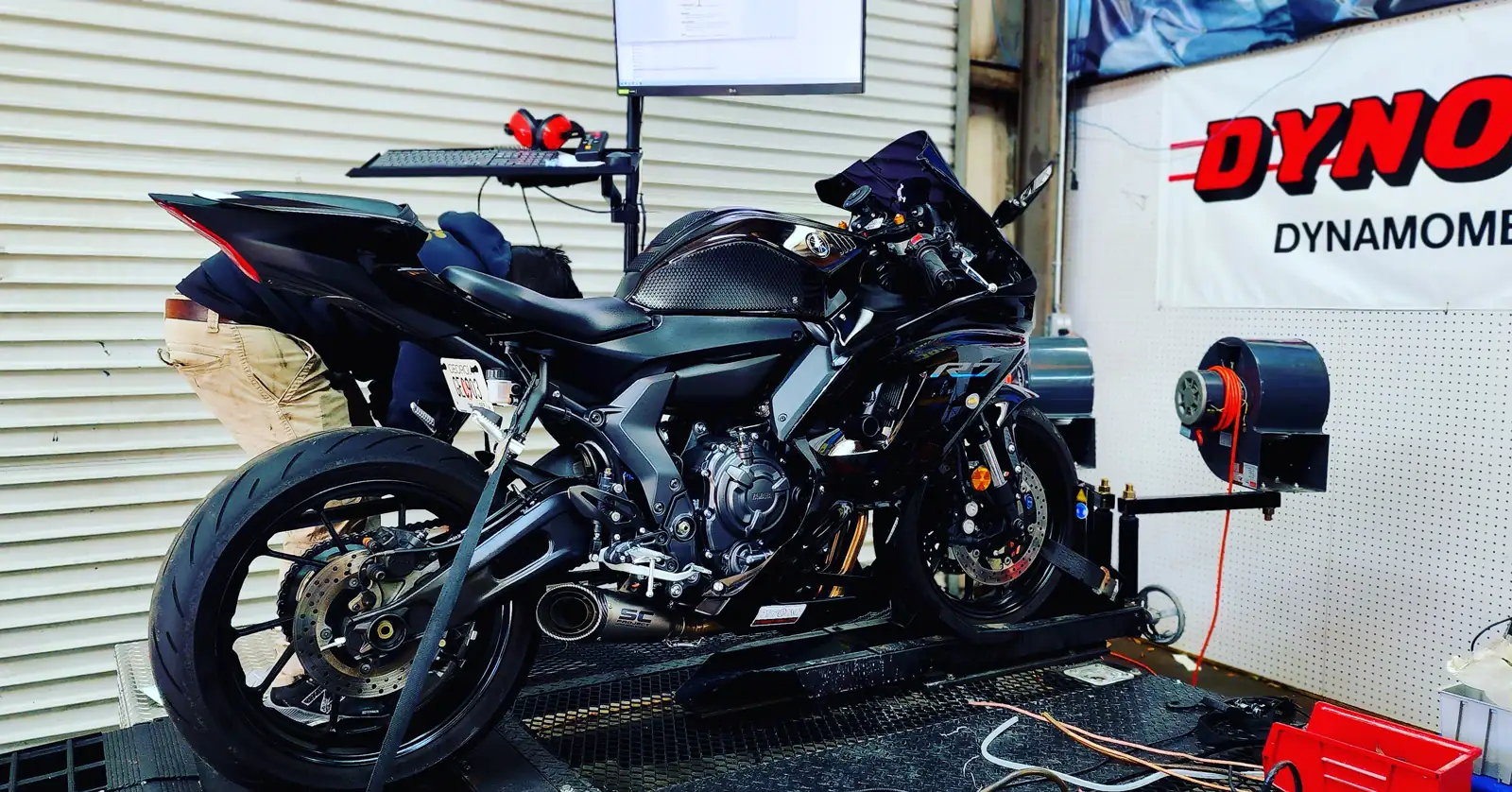
A dyno is a big drum that your rear wheel spins against. The drum resists, the computer measures how hard your bike has to work to accelerate that known weight, and from that it calculates power and torque across the whole rev range. That’s the part everybody pictures. The more useful part is the sniffer in your exhaust reading the air-fuel ratio at every single throttle position and every engine speed, hundreds of data points, all while the bike is under real load in a controlled room instead of out on public roads.
That distinction matters more than the peak number on the chart. Peak power is one dot. What you feel every day is the shape of the curve between the dots, plus a mixture that’s correct where you actually spend your time. That’s the philosophy behind the work we do in house, and it’s why we tune for the whole range instead of one bragging number.
Most people stop reading here. That's the expensive mistake.
Because this next part is what separates a real tuning shop from a shop that owns a dyno. Anybody can strap a bike down and print a graph. The graph is the easy part. Now, the skill is knowing what to change, and knowing when the right answer is to change nothing at all and go fix a vacuum leak first.
What actually happens when your bike is on the dyno
There’s no mystery to it, and you’re welcome to stand there and watch. Here’s the order of operations on a normal day.
- We talk first. What bike, what parts, what fuel you run, and most importantly how and where you ride it.
- We check the health of the engine before we tune it. Plugs, filter, valve clearance history, leaks. A tune cannot fix a mechanical problem, and we’re not going to pretend it can.
- We strap the bike down, get the fan and the exhaust sniffer set, and make a baseline pull to see where it sits today.
- Better yet, we read the air-fuel ratio across the range and find the spots that are off, which is usually low throttle and midrange rather than the top end.
- We adjust the map, whether that’s an ECU flash or a Power Commander, then pull again and compare.
- We repeat until the numbers and the feel agree, then hand you the before-and-after sheet so you can see exactly what changed.
Real criteria for judging a shop
You’re comparing options, so let’s give you something better than a gut feeling. These are the things we’d want a friend to ask, including asking us.
- Ask who does the tuning, by name, and how long they’ve been doing it. Tuning is a person, not a machine.
- Ask whether they flash the factory ECU, run a piggyback like a Power Commander, or both, and why they’d pick one for your bike.
- And ask if you get the before-and-after chart to keep. The answer should be an immediate yes.
- Ask what they do if the bike turns out to have a mechanical fault mid-session, and listen for whether they stop and call you.
- So ask how many pulls are included and whether a follow-up check is part of the deal after you’ve ridden it.
- Ask what they will not do. A shop with real standards has a list, and hearing it is reassuring.
Notice that not one of those questions is about the number on the wall. Ask about process instead, and the answers sort themselves out quickly. If you want to think through the planning side too, here’s how the work adds up when a bike needs more than one thing done at once.
Being straight with you about the other shops
East Cobb has good options, and we’re not going to pretend otherwise. Wooly’s Cycles of Atlanta over on Cobb Parkway South is Georgia’s number one volume BMW and KTM Group dealer, and there’s a reason people go there. If you own a new bike under factory warranty and you want the dealer network behind it, that’s a completely sensible choice. It’s about twenty to twenty-five minutes from most of East Cobb, which is a fine trade for the right job.
What we’d point out is simply this. There’s no motorcycle dealership inside East Cobb at all, so every option means crossing the county toward Cobb Parkway or South Cobb Drive, and several of those bays are closed both Sunday and Monday. We’re at 847 Barnes Mill Road off Roswell Road, which puts most of the community inside a fifteen minute ride and nothing farther than about twenty. Pick whoever fits your bike best. Just make sure convenience is on the list of things you’re weighing, because your Saturday is worth something too. Groups like the American Motorcyclist Association have been telling riders to ask questions for decades, and that’s still the best advice going.
Timing, and why February is the smart month
March and April are when everybody wakes up. The first genuinely warm weekend arrives, half of East Cobb walks into the garage, and every shop in the county gets the same phone call on the same Tuesday. If you’d like your bike sorted before that wave, book in February. Winter is the calm stretch, the schedule is open and you get more attention, not less.
There’s a mechanical reason too. A bike that sat since November has old fuel in it, and old fuel doesn’t burn the way fresh fuel does. Tuning a bike on varnished gas is like taking a test after somebody swapped your notes. Fresh fuel first, then the dyno, then the good weather. That order saves you a repeat visit.
Why East Cobb riders run into this more than most
Bikes here live indoors. Two- and three-car garages came standard on these lots, so whether you’re in Indian Hills with its wooded acreage and golf course frontage, or over in Northampton or Windsor Oaks in the Lassiter district, the bike is almost certainly parked on concrete under a roof. That’s wonderful for paint and terrible for everything with a chemical clock. Batteries drain, fuel varnishes, tires flat-spot and rubber dries out. A garage-kept bike isn’t a preserved bike. It’s a bike on pause, and paused engines develop their own set of habits.
The riding here doesn’t help the fuel map either. This is a weekend market, not a commuting one. You take Johnson Ferry Road south toward the Chattahoochee and swing over to Paper Mill for the Saturday coffee run, then park it. Low speeds, heavy tree canopy, short heat cycles, plenty of idling. Add the rough patched sections and creek-bottom dips near Sewell Mill, where the old eighty-acre mill ruins still sit on Sewell Mill Road, or the stop-and-go by the trailhead parking at Johnson Ferry North, and you’ve got a bike that almost never gets to run in the range the factory tuned it for. Roswell Road, GA-120, is the east-west spine that carries all of it from Marietta Square to the Fulton line. Resurfacing work through the county is tracked publicly, and Georgia DOT keeps state route information current if you’re curious about your regular route.
The last piece is the one people underestimate.
It’s not the dyno. It’s the conversation. The best tune in the world is worthless if nobody asked how you ride, and the honest truth is that two identical bikes with two different owners should not leave with identical maps. A rider doing north Georgia mountain trips wants a different midrange than a rider making short hops to the Square for dinner. That takes about ten minutes of talking, and it’s the ten minutes that makes the difference you’ll actually feel on Saturday.
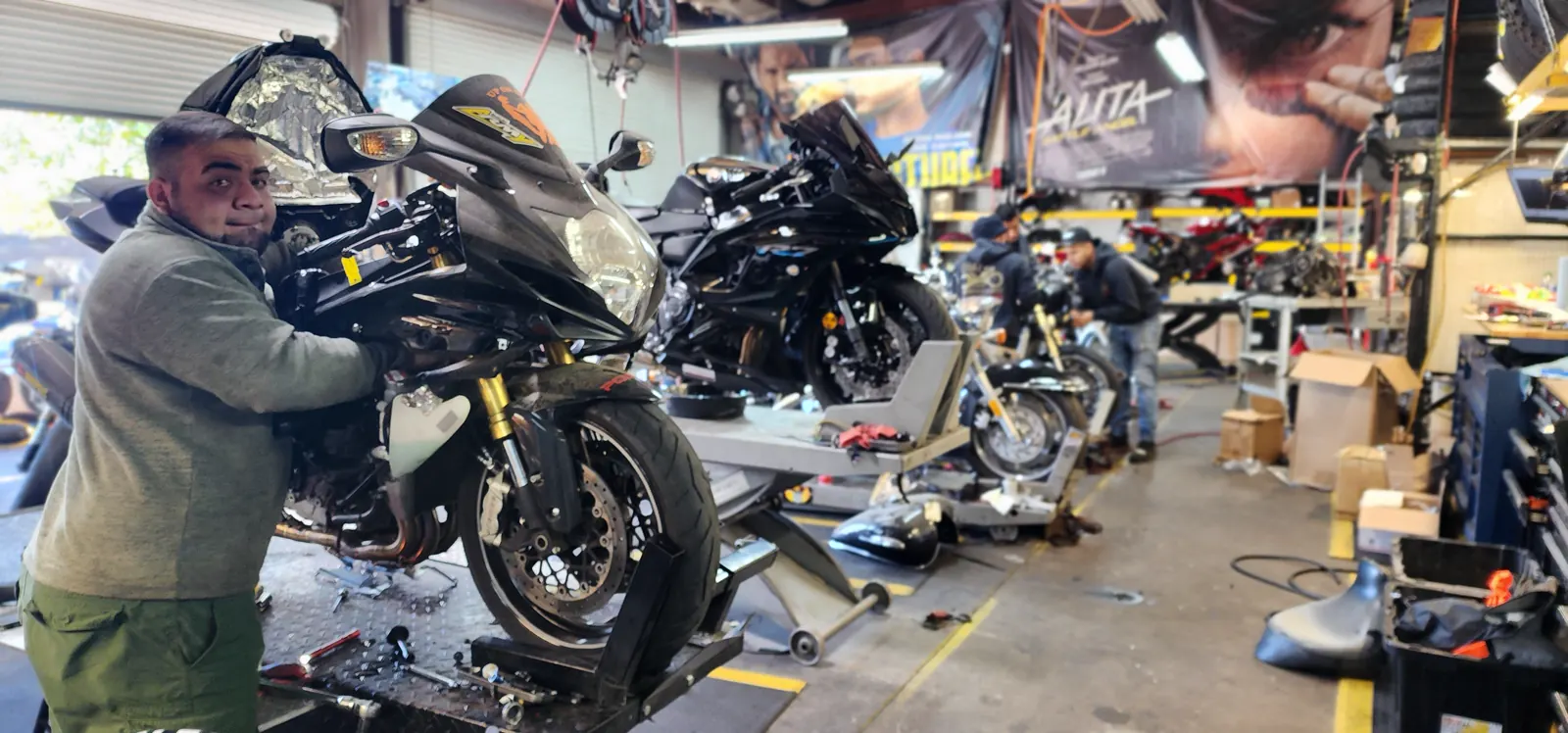
You should also expect the shop to explain what it did in words you can repeat to somebody else. If you can’t describe the change, you can’t judge whether it worked. We walk through the chart with you before you leave. If you want to see the same thinking applied somewhere else, here’s how this plays out in Gainesville with a different set of roads and a different kind of rider.
What you actually walk away with
A properly tuned bike feels calmer, not wilder. The throttle does what your wrist asked the moment you asked it. Of course, the surge at cruise goes away. The heat drops. It idles evenly at the light instead of hunting. And yes, the power comes up, but the thing riders always mention first is how much smoother it got. You’ll find yourself using more of the throttle range because the bike finally rewards it. That’s the whole point of a good dyno shop East Cobb riders keep coming back to, and here’s what that service actually involves from start to finish.
THE SHORT VERSION
Ride it this week and note what it does. Write down the symptoms. Ask any shop who tunes, what method they use, and whether you keep the chart. Book before the spring rush. You now know more than most riders walking in the door, and that’s exactly the position you want to be in.
Questions East Cobb riders ask us
What should I ask a shop before I let them tune my bike?
Ask who is doing the tuning and how long they’ve done it. Ask whether they flash the factory ECU or use a piggyback unit, and why that’s the right pick for your bike. Ask whether you get the before-and-after chart to keep. A shop that answers all three easily is a shop that does this regularly.
Do you work on all brands, or just a few?
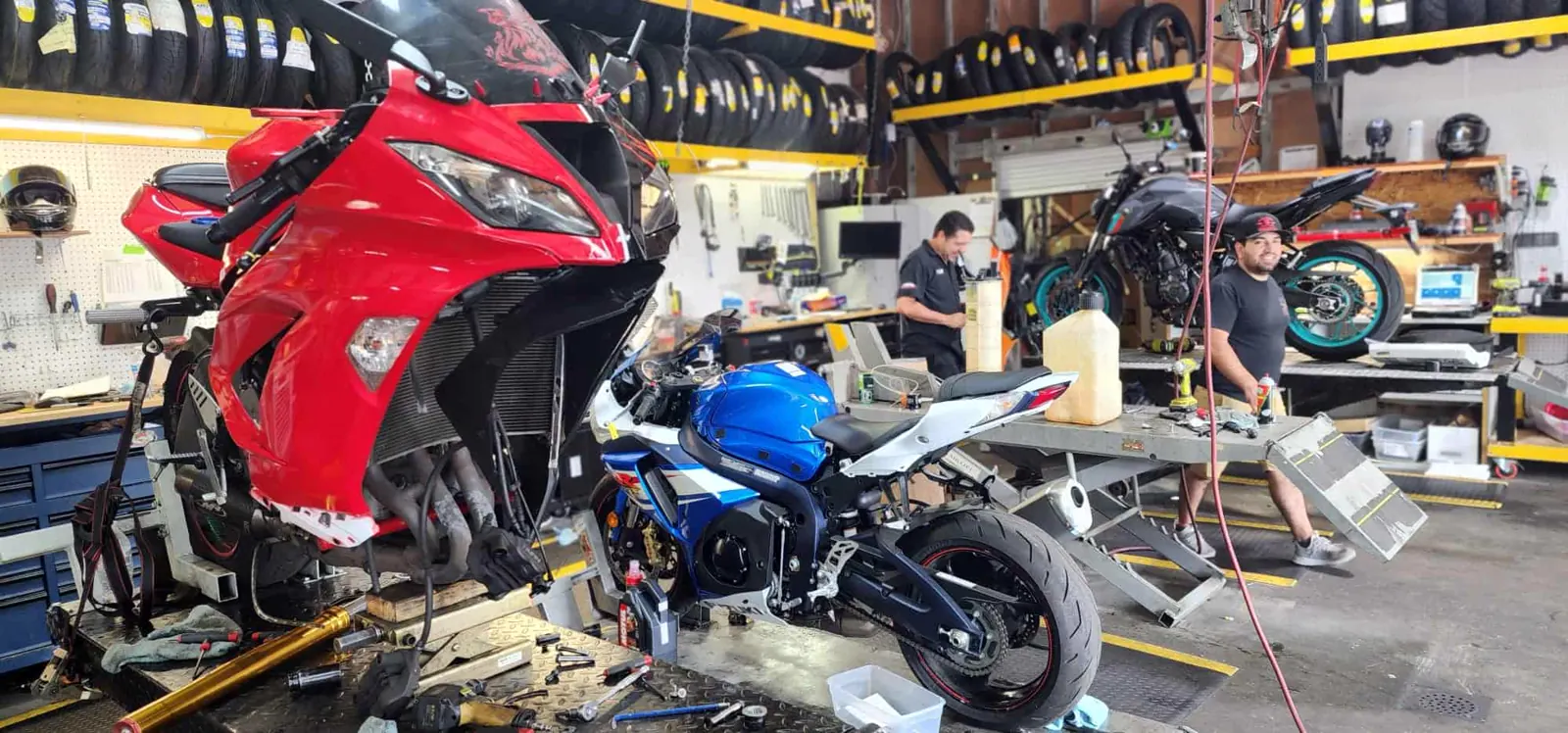
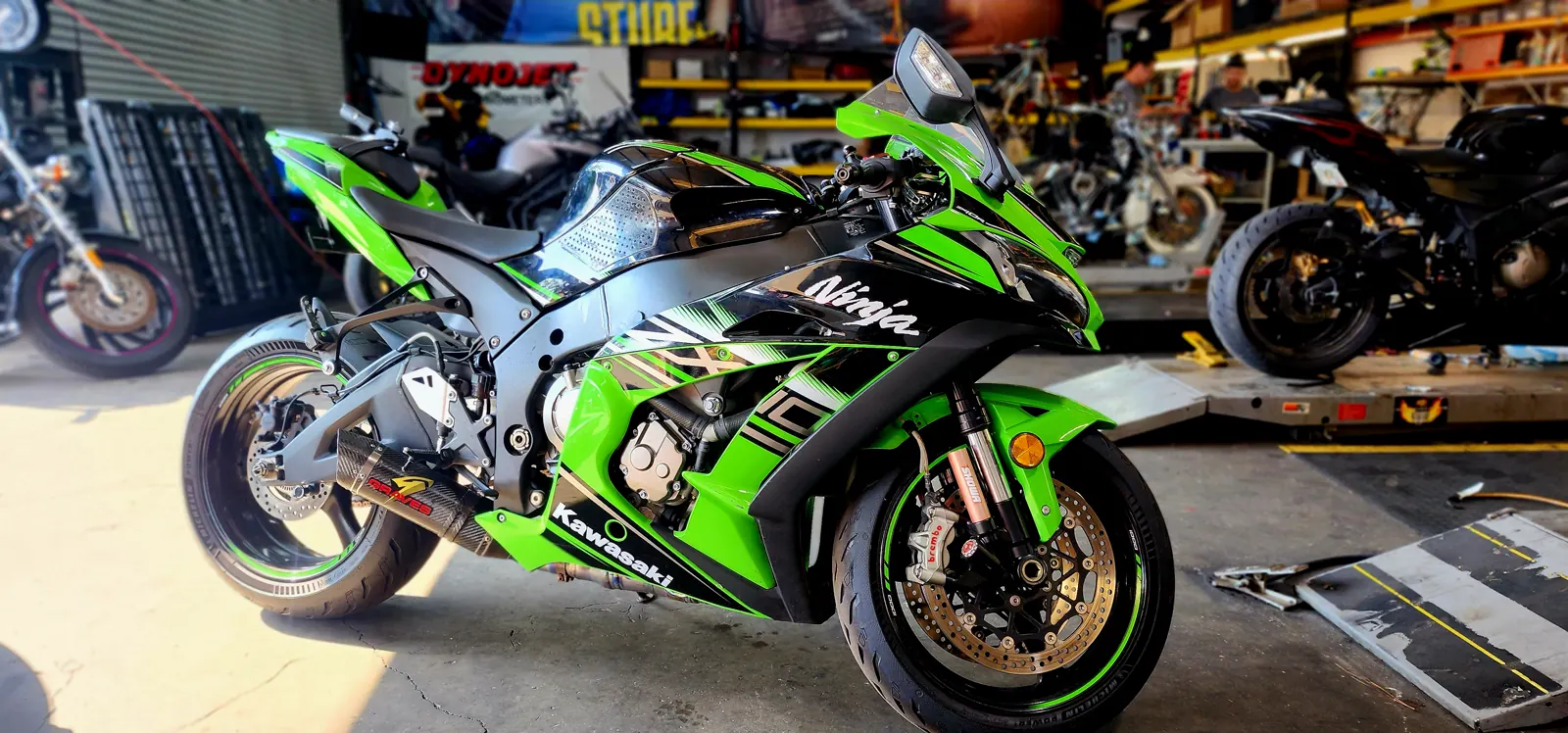
All of them. Japanese, American and European, plus older air-cooled machines that predate any computer at all. Harley baggers, Gold Wings, BMW GS and RT, Ducati, KTM, and sportbikes of every flavor come through our bays. If it has an engine and two wheels, bring it in and we’ll tell you honestly what it needs.
How far do you serve?
We’re in East Cobb at 847 Barnes Mill Road off Roswell Road, so most of the community is a short ride away. Beyond that we regularly see riders from Marietta, Roswell, Sandy Springs, Kennesaw and Woodstock, and plenty come further than that. Distance has never been the deciding factor for people who want the work done right.
Can you pick up my bike?
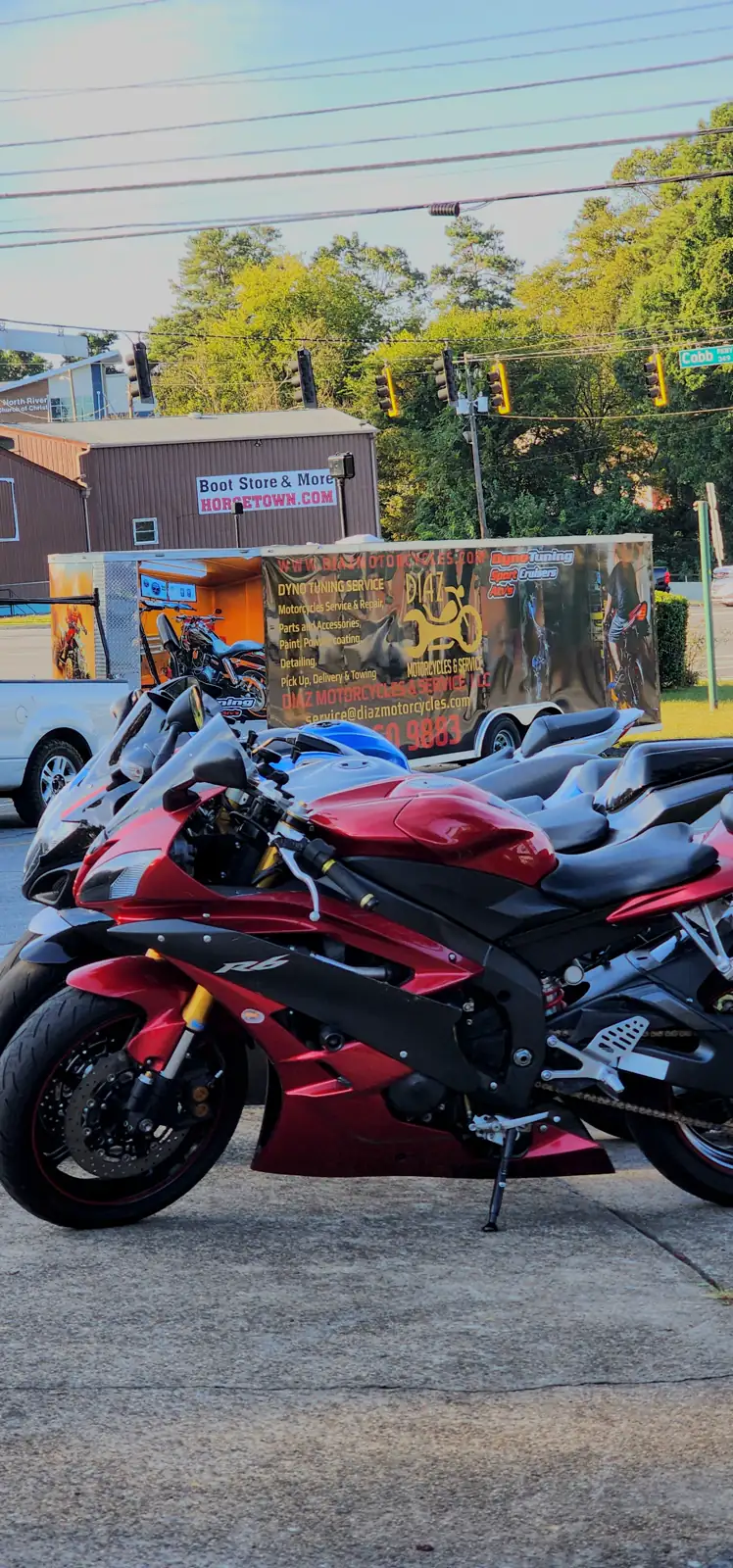
Yes. We run an enclosed trailer, so if the bike won’t start, hasn’t run since 1994, or you’d simply rather not ride it in its current mood, we’ll come get it. Just call and tell us where it’s parked. That’s a common request in a market where bikes sit in garages for months at a time.
How do I know the diagnosis is right?
Because we show you. The dyno produces real data on air-fuel ratio across the entire rev range, and you get to see the numbers before and after. If we find something mechanical during the session, we stop and call you rather than tuning around it. You should never have to take a shop’s word alone.
Is dyno tuning only worth it if I've added an exhaust?
That’s the most common trigger, but no. Stock bikes often ship with maps set conservatively for emissions and for fuel that varies by region. Older bikes drift as they age. Plenty of friends we’ve helped had completely stock machines and still felt a clear difference in throttle response and running temperature.
We’re based in East Cobb and ride the same roads you do, so most of our friends and customers come from right around the corner. We also see riders from all over Marietta, plus Roswell and Sandy Springs just across the line, and Kennesaw, Woodstock and Acworth from the north end of the county. Smyrna and Vinings riders make the short trip down, and folks come over from Alpharetta, Dunwoody and Canton on the weekends. We’ve had bikes trailered in from all over Atlanta too. If you’re within a reasonable ride and you want your bike tuned by someone who’ll explain what changed, come see us.
LET'S GET YOUR BIKE RUNNING RIGHT
Text or call us and tell us what your bike is doing. We’re right here in East Cobb off Roswell Road, so there’s no county to cross and no Saturday to sacrifice. Bring it by, or let us come get it with the trailer. We’ll put it on the dyno, read what’s really happening, show you the chart and explain every bit of it in plain English before you decide anything.
470-460-9883Diaz Motorcycles and Service, LLC · 847 Barnes Mill Road, Marietta, GA 30062