Dyno Tuning Cost Canton — What You Pay For And Why
What a dyno really measures, what makes one tune bigger than another, and why an honest shop won't quote it blind.
Still, Morning on 575 southbound is a grind. Plus, you roll the bike out of the garage before the sun clears the trees, merge in with the trucks, and spend the next half hour rolling on and off the throttle in second and third gear. Heat soaks up through the tank. The fan cycles at every light. Of course, that stop-and-go slog is the riding your engine actually spends its life doing, which is why so many riders start asking about dyno tuning cost Canton shops quote long before they ever chase a horsepower number.
Here’s the good news. Then again, a tune isn’t a mystery box, and it isn’t a luxury reserved for track bikes. Even so, it’s a measurement job followed by a correction job. Once you understand what’s being measured and what’s being corrected, the price stops feeling random and starts making plain sense. Meanwhile, that’s the whole point of this post.
The straight answer first
In fact, that said, a tune is priced by time on the machine and time at the keyboard, not by parts. For example, the parts side is usually small or zero. After that, you’re paying for a technician strapping your bike down, running it under load, reading real data, changing the fuel and spark instructions, and running it again until the numbers and the feel line up. Some bikes get there fast. Others fight back.
So the honest range depends on which one you’re bringing us. What’s more, a stock bike with a slip-on and an intake is a short conversation. A bike with a big-bore kit, a cam swap and a wiring harness somebody already poked at is a longer one. We’d rather see it and tell you the truth than guess and be wrong. If you want the full rundown of what you get when you bring it in, that page walks through the whole service.
WHY NO NUMBER OVER THE PHONE
Two bikes of the same year and model can need very different work depending on what’s been bolted on, what’s been flashed before, and how healthy the engine is. A number given blind is a guess wearing a suit.
What a dyno actually measures
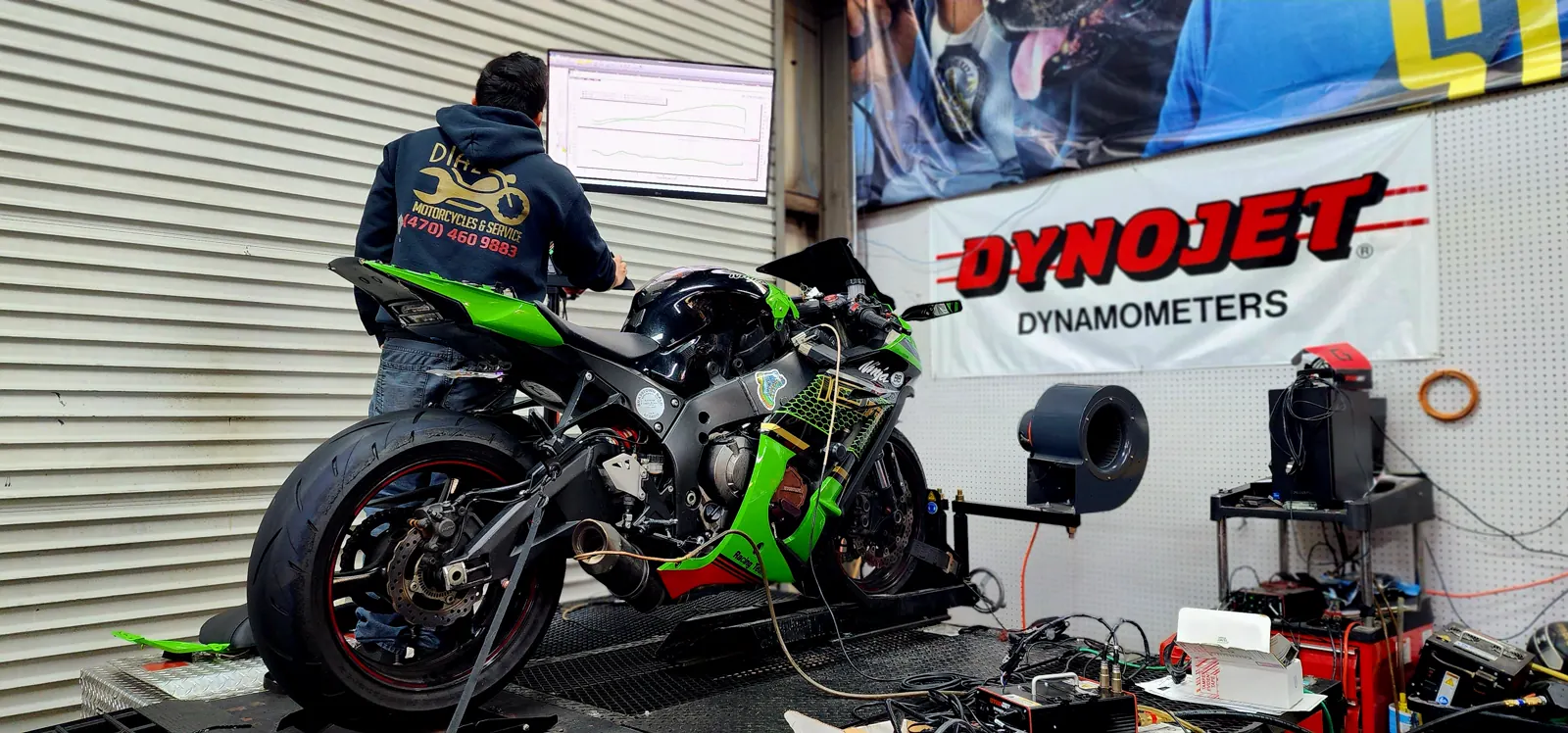
Strip away the jargon and a dyno is a very heavy roller your rear tire spins. The bike is strapped down, then it works against that roller exactly like it works against the road. The machine watches how hard the engine pushes to spin that weight up, and calculates power at every point in the rev range. It also sniffs the exhaust to see what the engine is burning.
That exhaust reading is the important half. An engine wants a certain mix of air and fuel. Too little fuel for the air coming in and it’s running lean. Too much and it’s running rich. Lean makes heat, popping on decel and a bike that feels snatchy. Rich makes soot, fouled plugs and a lazy feel off the bottom. Both are fixable.
A tune changes the instructions the computer follows. It tells the injectors to squirt a little more here, a little less there, and it adjusts when the spark fires. You don’t feel a graph. Better yet, you feel the throttle stop hesitating when you crack it open at 3,000 rpm. You feel the surge disappear at a steady 60. You feel the bike pull clean instead of stumbling. That’s what people are really buying.
What makes one tune bigger than another
How your bike is fueled
The fueling system sets the ceiling on how much can be changed and how it’s changed. A modern fuel-injected bike can often be handled with an ECU flash, where we rewrite the factory map directly. Others do better with a piggyback module like a Power Commander, which sits between the computer and the injectors. Older carbureted bikes are a different animal, because the tune is mechanical. Jets, needles, slides. Same goal, more wrenching.
What's bolted to it
Every change to how air gets in or out changes what the engine needs. A slip-on exhaust is a small nudge. A full system, a high-flow air filter, a cam, higher compression pistons or a big-bore kit each move the target further from stock. More modifications means more of the map is wrong, so more of the map has to be rebuilt. That’s not a penalty. It’s just arithmetic.
Access and labor
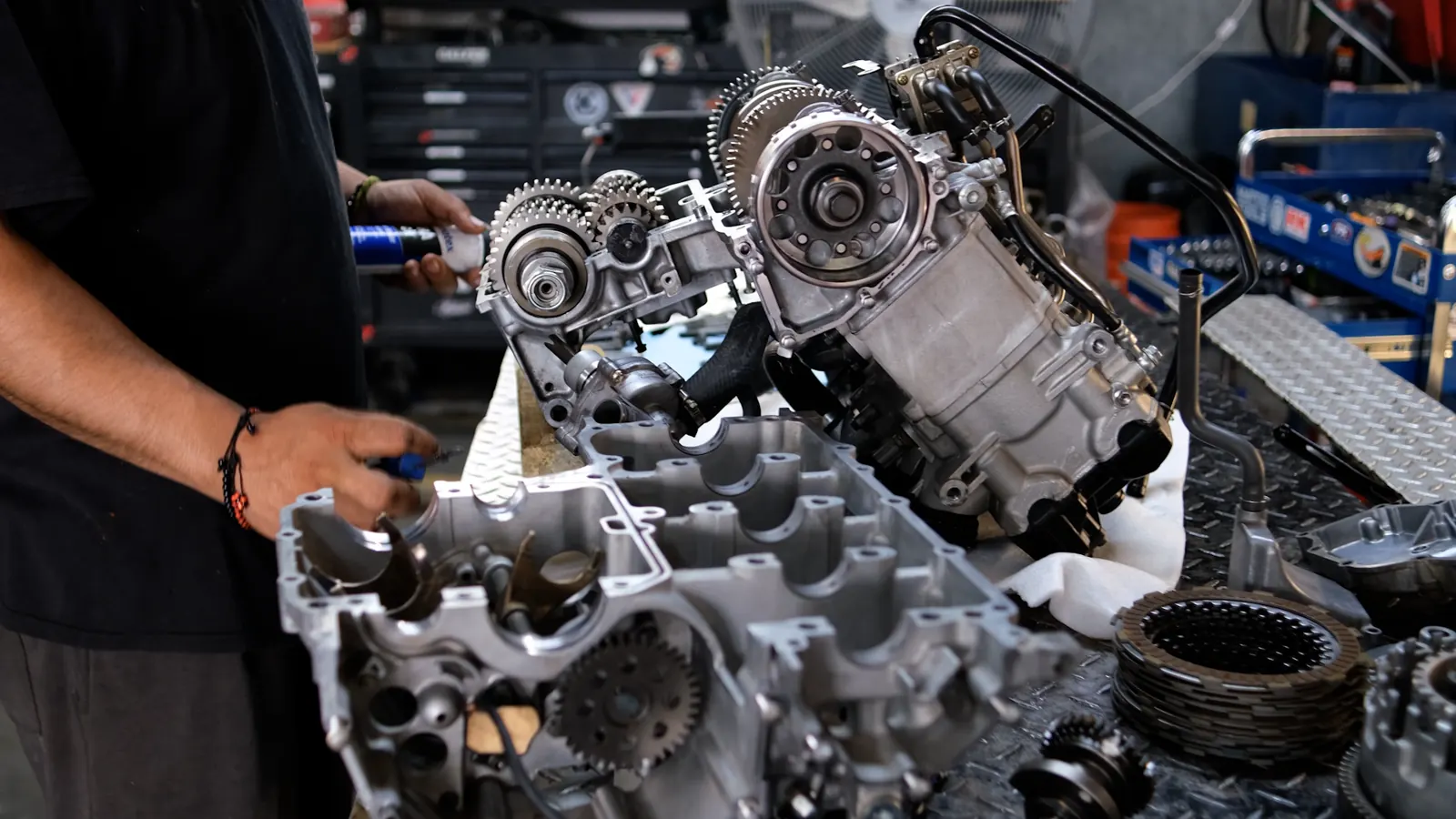
This is the part riders never see coming, and it’s usually the biggest swing. On some bikes the ECU sits right under the seat. And On others it lives behind the airbox or beneath a fairing held on by two dozen fasteners. On a full-dress bagger, reaching a sensor can mean pulling bodywork, saddlebags and a fuel tank before a single line of the map gets touched. The tuning time might be identical. The wrench time isn’t.
Then there’s the bonus round. A bike that’s been sitting, which describes plenty of garage-kept bikes here every spring, may need the fueling side cleaned up before it can hold a steady reading. Varnished injectors, a tired pump, a clogged filter. None of that is tuning, but all of it has to be right first.
- Fueling type: ECU flash, piggyback module, or carbs
- How far the bike sits from stock: intake, exhaust, cams, displacement
- Physical access to the ECU, sensors and injectors
- Whether a previous tune has to be undone before we start
- Engine health, because a dyno can’t fix a mechanical problem
Something changes once you know what to look for
Riders come in expecting to be handed a single number. They leave realizing the number was never the product. The product is a bike that behaves the same on a cold morning as it does on a hot afternoon, and a printout that shows exactly what changed. Once you can read the sheet, you stop being a passenger in the conversation. Our post on how we handle that job breaks the graph down line by line.
What we check before the first pull
- A real conversation about how you ride: commuting, mountain runs, two-up touring, or all three.
- A health check. Compression, plugs, air filter, chain or belt, tire condition and pressure, brakes and any active fault codes.
- A look for existing tunes or modules, because stacked corrections fight each other.
- Fuel system sanity: pump pressure, filter, injector spray, and no vacuum leaks.
- A baseline run so we have an honest before picture, not a marketing one.
- The tuning passes themselves, adjusted and repeated until the fuel mix is right across the range.
- A final run, a printed sheet, and a road check so the feel matches the data.
That health check is not padding. A dyno is a truth machine, and it will happily show a pretty graph on an engine with a slipping clutch. We’d rather find that in the first twenty minutes than at the end. That pre-check is a big part of what separates a good shop from a place that just loads a generic file and hands you the keys.
Mistakes worth dodging
The most common one is buying a map off the internet for a bike that isn’t yours. A downloaded file was built for someone else’s exhaust, filter, altitude and fuel. It might run fine. It might also run lean at exactly the throttle position you use most. Free maps are the only kind that get expensive without ever charging you.
The second one is tuning around a problem instead of fixing it. If a bike has an intake leak, a tune can mask it for a while by dumping in fuel. Then the leak grows and you’re back where you started, only now the map is wrong too. Fix the mechanical thing, then tune. Always that order.
- Skipping the baseline run, so nobody can prove what improved
- Stacking a piggyback on top of an already-flashed ECU
- Chasing a peak number instead of the midrange you actually ride in
- Tuning on a bike with a worn chain, tired tires or a slipping clutch
- Leaving without a printed sheet you can keep
Now for the part that has nothing to do with parts at all
The biggest input to a good tune is how you use the bike, and around here that varies a lot. Somebody in Ashton Farms who rides to work on 575 needs clean, predictable throttle down low, because that’s where the whole commute lives. Their bike never sees redline on a Tuesday. Meanwhile a rider running the Cartersville-Fairmount-Jasper-Canton loop on a Saturday, out US-411 to Fairmount, across GA-53 to Jasper and back down GA-5, is spending real time in the upper half of the tach with a hot engine and a hot day.
Same model. Same modifications. Two different right answers. That’s why we ask about your riding before we ask about your parts list, and it’s why a tune built for you feels different from a file built for nobody.
We're not tuning a model. We're tuning your bike, for your roads.
How this plays out around Canton
Canton sits right at the doorstep of the North Georgia mountains, and that shapes everything about how bikes get used here. It’s the last real services town before the highway turns north toward Jasper, Ellijay and Blue Ridge. On a good April or October Saturday, GA-5 through town is a rolling parade of bikes, and Riverstone Parkway is where most of them stop for fuel, food and a stretch before heading up.
That creates two very different riders in the same zip codes. There’s the mountain crowd who moved here because the good roads start half an hour north, including the run past Lake Arrowhead that plenty of riders treat as a warm-up. Then there’s the garage-kept crowd. A bagger in a three-car garage in BridgeMill, a cruiser in Laurel Canyon with a view of the ridgeline, both immaculate, both putting on modest miles a year. Bikes that sit develop fueling problems that look exactly like tuning problems.
Weather adds its own flavor. Late March into April is pollen season, when everything turns yellow, the road film gets slick and air filters load up fast. A clogged filter changes the air side of the equation, which changes the mix. Riders are often surprised how much a fresh filter alone wakes a bike up.
Pavement matters too. Southbound 575 is grooved, patched and stitched with tar snakes, and the two-lanes out west see chip seal and gravel off the shoulders. That’s part of why we road check a bike after the pulls instead of waving from the door. If you’re newer to riding, the state’s own Georgia Class M licensing page is a solid place to start, and the IIHS motorcycle research is worth a browse on gear.
The drive down is not the hurdle people assume. You already drive to Woodstock, Kennesaw and Alpharetta for everything else, and the run down 575 toward Barrett Parkway or GA-92 and east through East Cobb is roughly a half hour on a normal day. Southern Devil Harley-Davidson sits about half an hour west in Cartersville on US-411, and their events calendar, including the Frosty Bells Toy Run and the Turkey Bowl, is a good excuse to put miles on whatever we just tuned.
Etowah River Park on Brown Industrial Parkway gives you 58 acres, an amphitheater, a canoe launch and trail connections, and it’s a natural spot for a group to gather before a run north. Ride there, then decide whether the bike feels right. That’s the real test.
What you walk out with
A finished tune should leave you with three things. A bike that responds the same way every time you touch the throttle. A printed sheet showing where you started and where you ended. And a clear explanation of what was changed and why, in words you can repeat to a friend. If a shop can’t give you all three, the price was never the problem.
You should also leave knowing what to watch for next season. Filters load up. Fuel goes stale in a bike that sits through winter. Adding an exhaust later means the map needs another look. That’s just maintenance with a different name. For riders coming from the other direction, the Sandy Springs side of things covers the same work.
The goal was never to hand you a number. It was to hand you the questions. Ask what the baseline run showed. So ask whether it’s a flash or a module. Ask what they found during the health check. Anyone quoting a dyno tuning cost Canton riders can trust will answer all three without flinching, and you’ll know exactly what you’re paying for before a strap ever goes over your rear wheel.
Questions Canton riders ask us
Does the type of bike change the work?
A lot, yes. A fuel-injected sportbike we can flash directly is a different job from a carbureted classic that needs jetting, and both differ from a full-dress bagger where bodywork has to come off first. The tuning itself may take similar time. The access and setup around it is where bikes separate.
What happens if you find something else wrong?
We stop and call you before doing anything extra. A dyno shows problems clearly, so things like a weak coil, an intake leak or a tired fuel pump tend to surface early. You decide whether we fix it now, tune around a smaller issue, or reschedule. We never add work without your okay.
How do I avoid surprises?
Tell us everything that’s been done to the bike, including anything a previous owner did. Bring any modules or tuning hardware that came with it. Then let us do the pre-check before we start, since twenty minutes of looking up front prevents almost every unpleasant surprise later.
What makes one tune bigger than another?
Three things mostly. How far the bike sits from stock, how hard it is to physically reach the ECU and sensors, and whether an old tune has to be removed first. A lightly modified bike with easy access is a short job. A heavily built bike with buried electronics is not.
Why can't you quote it over the phone?
Because two identical model years can need completely different work. We can tell you how the process runs, what we check and roughly how long the machine time takes. Putting a firm figure on a bike we haven’t seen would just be a guess, and guesses have a habit of being wrong in the direction nobody likes.
My bike sat all winter. Should I tune it now?
Get it running healthy first, then tune. Bikes stored in an unheated garage often come out with varnished injectors, a tired battery and stale fuel, and none of that gives a dyno a steady reading. Clean that up and the tune will actually hold.
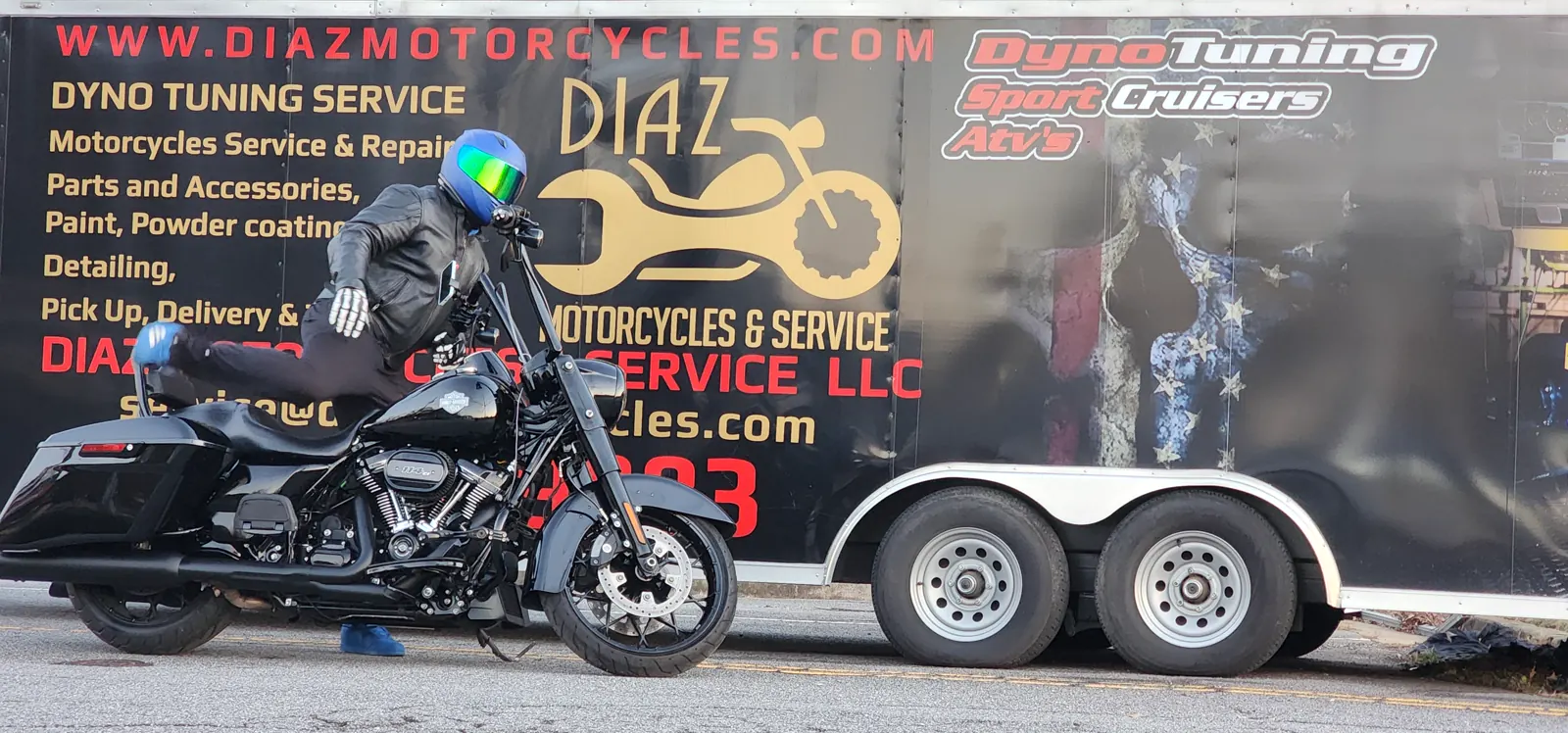
We work with riders across Cherokee County and the whole northwest side of metro Atlanta. That includes Canton, Woodstock, Holly Springs and Ball Ground, plus Waleska, Free Home and Nelson out toward the county line. Riders come down from Jasper on their way south, over from Cartersville and Acworth on the west side, and up from Kennesaw, Marietta and Alpharetta. If you’re somewhere in that stretch and the ride down doesn’t work for you, ask us about the trailer.
TEXT US ABOUT YOUR BIKE
If you’re in Canton and your bike feels flat, snatchy or just not like it should, send us a text with the year, model and what’s been done to it. We’ll tell you straight whether a tune is the right call, what the process looks like for your bike, and what we’d want to check first. No pressure, no mystery.
470-460-9883Diaz Motorcycles and Service, LLC · 847 Barnes Mill Road, Marietta, GA 30062