Motorcycle Repair Cost Woodstock: What Actually Drives the Work
A plain-English look at what a repair really involves, why one job is bigger than another, and why a straight answer needs eyes on the bike.
Give that little noise one more month and it usually stops being little. That’s the honest heart of the motorcycle repair cost Woodstock riders ask us about, because a bike never heals itself while it sits. The chain that’s dry today is chewing a sprocket by fall, and the seal that’s weeping now is soaking a brake pad next ride. Good news? Almost every one of these jobs starts small, so catching it early keeps the work small too.
So let’s talk about what actually drives the work. Instead of guessing, we’ll walk the real path a bike takes from a Towne Lake garage to a lift and back again. You’ll leave knowing what to look for and why one job is a morning while another is a week.
Here’s the thing about waiting. A bike doesn’t send a bill for the delay, but it does keep score. A weeping fork seal is a seal. However, three months later it’s a seal, a fork oil flush, a fresh brake pad set and a rotor clean, because the oil found the brakes. That’s why the same repair can be a small job or a big one depending on nothing but the calendar.
The symptoms Woodstock riders bring us most
Riders in Cherokee County put on hard mountain miles in bursts, then park the bike for weeks. As a result, the symptom list here has its own flavor. See if any of these sound like your bike.
- It cranks fine but won’t catch, especially after a few idle weeks
- The front end dives or feels greasy, and there’s shiny wetness on a fork tube
- A clunk or a chirp shows up right when you roll off the throttle
- The brake lever pulls closer to the bar than it used to
- Chain noise changes pitch as you accelerate, then settles
- The bike runs hot in stop-and-go and starts to feel lazy
- A warning light glows and stays glowing, even though the bike still moves
- It rides fine to the store but stumbles halfway up a mountain pull
None of that is a disaster. In fact, most of it is normal wear talking out loud. Still, each symptom points somewhere specific, and knowing where saves real time on the lift.
What each of those symptoms usually means
A no-start after idle weeks is usually fuel and battery, not engine. Fuel goes stale, a battery sags below what a modern bike wants, and the bike protests. Because so many local garages already keep a trickle charger on the bench, this one often turns out to be a tank of tired gas. Don’t worry — that’s an easy fix, and you’ll feel silly in the best way when it fires on the first button.
A greasy front end is fork seals or fork oil, and sometimes both. Gravel and grit tracked onto pavement from construction entrances along Ridgewalk and Towne Lake Parkway does a number on fork tubes. So does mountain dust. Once a seal lets go, the fix is straightforward, but the access is what makes the job what it is.
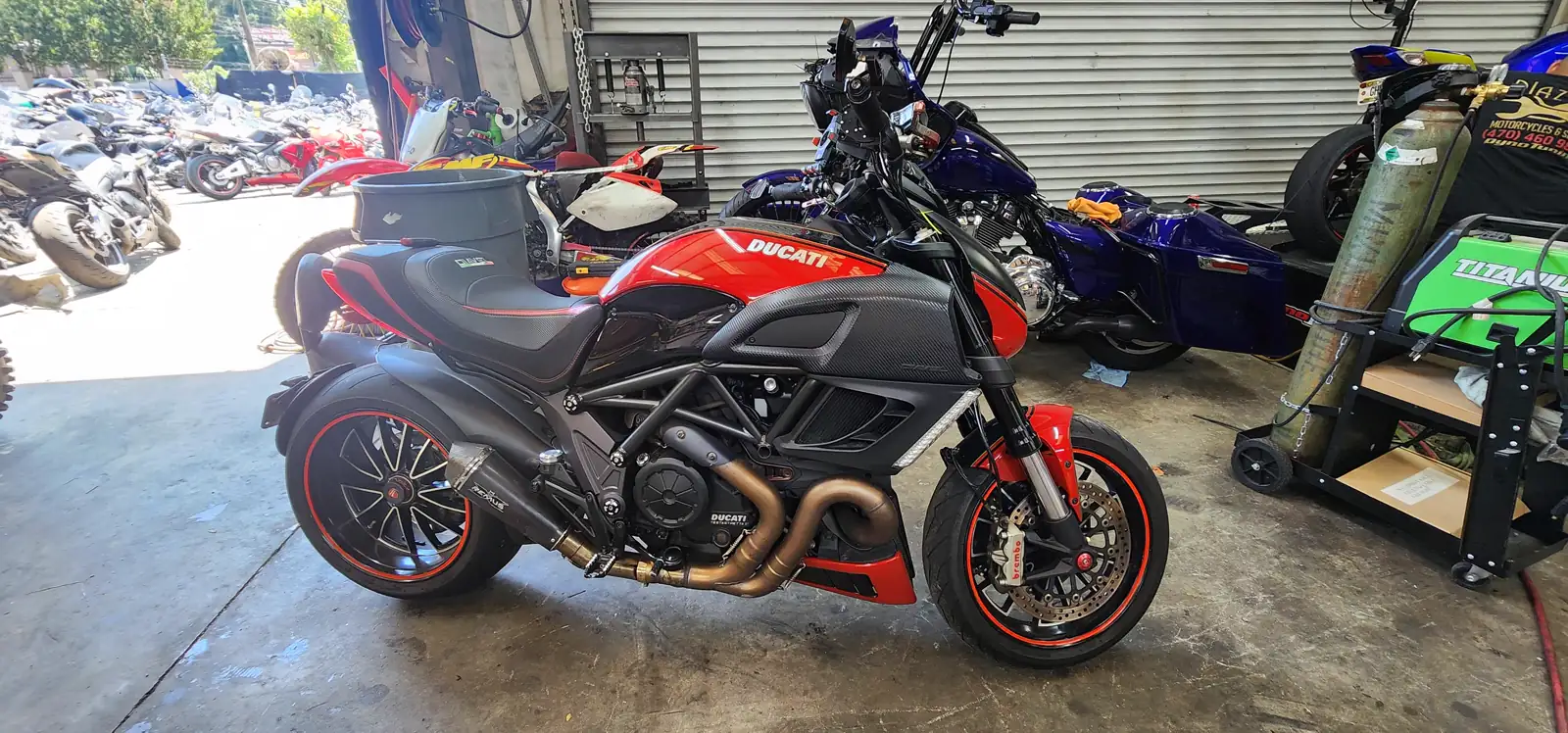
Driveline clunk and chirp usually means chain and sprockets, cush drive rubbers, or a bearing. These wear as a set, so replacing one and ignoring the rest just books a second visit. Meanwhile, a soft brake lever is normally old fluid, worn pads, or air that snuck in.
Running hot with a lazy feel points at cooling, a clogged radiator face, or a fan circuit. Because riding here is recreational and destination-driven, bikes see long highway pulls and then slow crawls, and that combination exposes cooling problems fast. A steady warning light is the bike asking for a scan, while a stumble only under load is usually fuel delivery, a sensor, or a tired filter.
SIMPLE RULE
Symptoms that change with speed are usually driveline or tires. If it changes with heat, look at cooling or electrical. And anything that shows up after weeks parked is usually fuel or battery.
Here's what a good shop checks that a rushed one skips
A rushed shop fixes the complaint. A good shop fixes the complaint and then asks why the complaint happened. Those are not the same job, and the difference is where riders get burned. For example, anyone can swap a chain. But if nobody checks the cush drive, the wheel bearings and the sprocket carrier, that fresh chain wears fast and you’re back in a few months wondering what went wrong.
So here’s the short list of things we don’t skip. We check the tires and dates, because rubber ages even when it’s parked in a spotless garage. Also, we look at brake pad thickness on both ends, the fluid color, the chain slack at the tightest point, the fork tubes, the coolant, the air filter and the battery under load. Then we road test it, since half of what a bike is trying to say only shows up moving.
That’s also why we’re upfront about what we found versus what we recommend. Those are two separate lists. You get to decide what happens now and what waits, and we’d rather you understand the difference than nod along. If you’re weighing shops in the area, we wrote about the tradeoffs between them so you can compare on something better than a phone call.
What actually happens at the shop, start to finish
People imagine a mystery box. Really, it’s a sequence, and it’s the same sequence whether your bike is a Gold Wing or a KTM Adventure.
- You tell us the story. When it started, what it does, what you were doing when it did it. This part matters more than people expect.
- We look and listen with the bike cold, because some noises only exist before things warm up and expand.
- Then again, we road test it if it’s safe to ride, so we can feel the symptom instead of imagining it.
- We put it on the lift and get access. On some bikes that’s two bolts. On others it’s a full bodywork removal first.
- We diagnose to the actual cause, scanning codes and testing circuits or pressures where that’s the honest way to know.
- Honestly, we call you with what we found, what we recommend, and what can safely wait until later.
- We order parts, and availability drives the calendar more than anything else on this list.
- Even so, we do the work, torque to spec, and clean up the surrounding systems while we’re already in there.
- We test it again, on the road, before we say a word about it being done.
- We hand it back and tell you plainly what to watch for next season.
Parts versus labor, and why access is the quiet driver
Every repair is two things stacked together: the parts and the hands. Parts are what they are, and we don’t control what a manufacturer charges or how fast it ships. Labor, though, is where two bikes with the identical problem stop looking identical. Because the problem is rarely sitting out in the open.
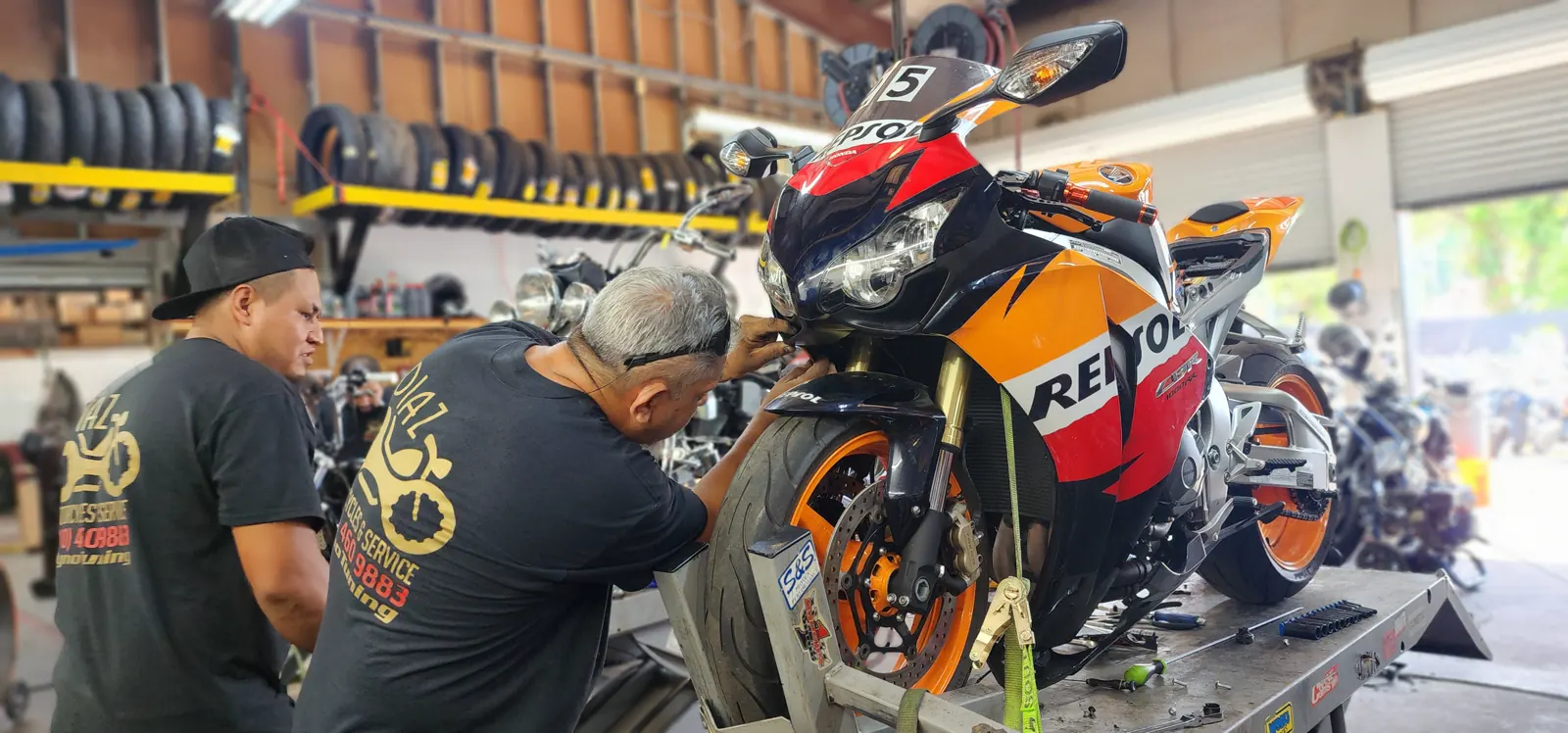
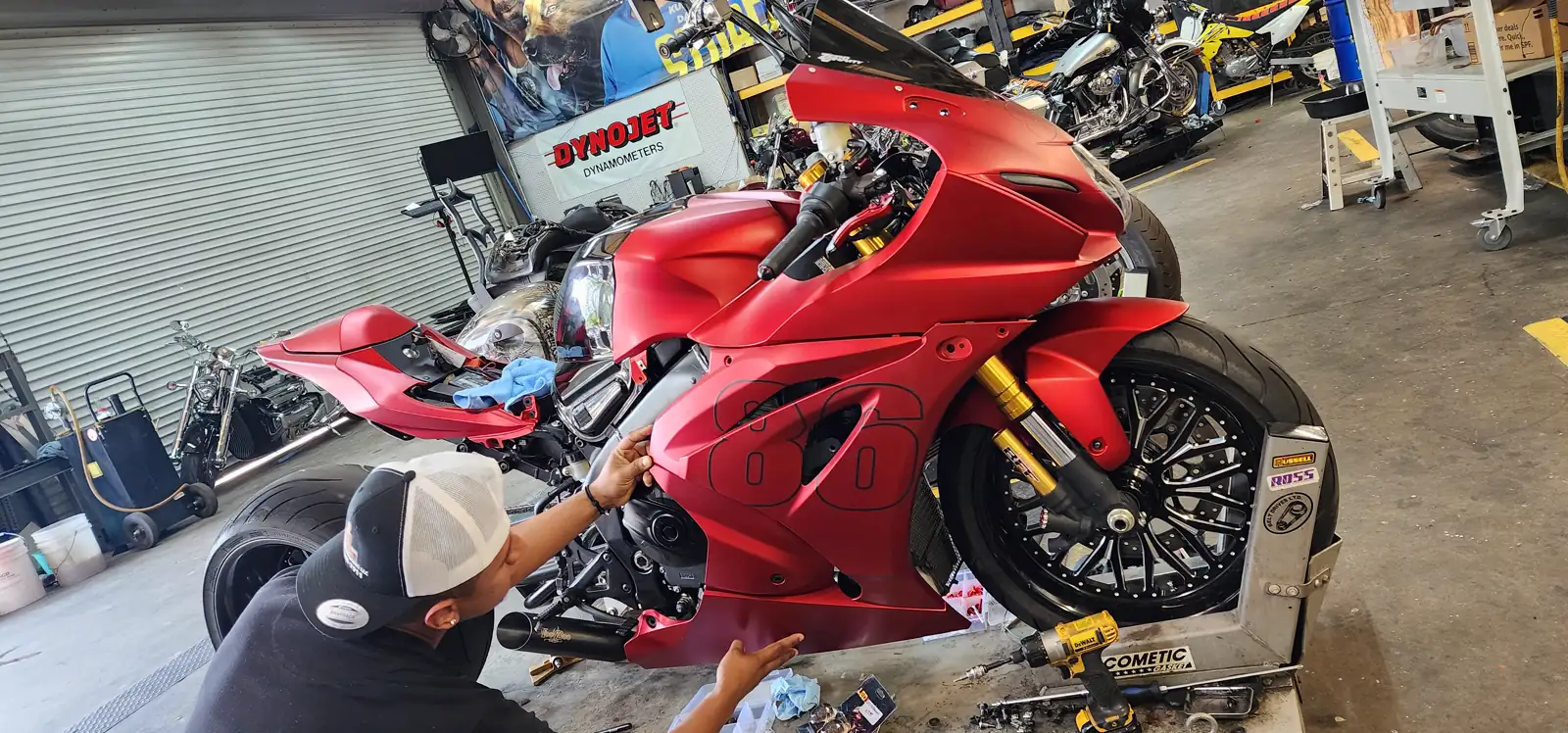
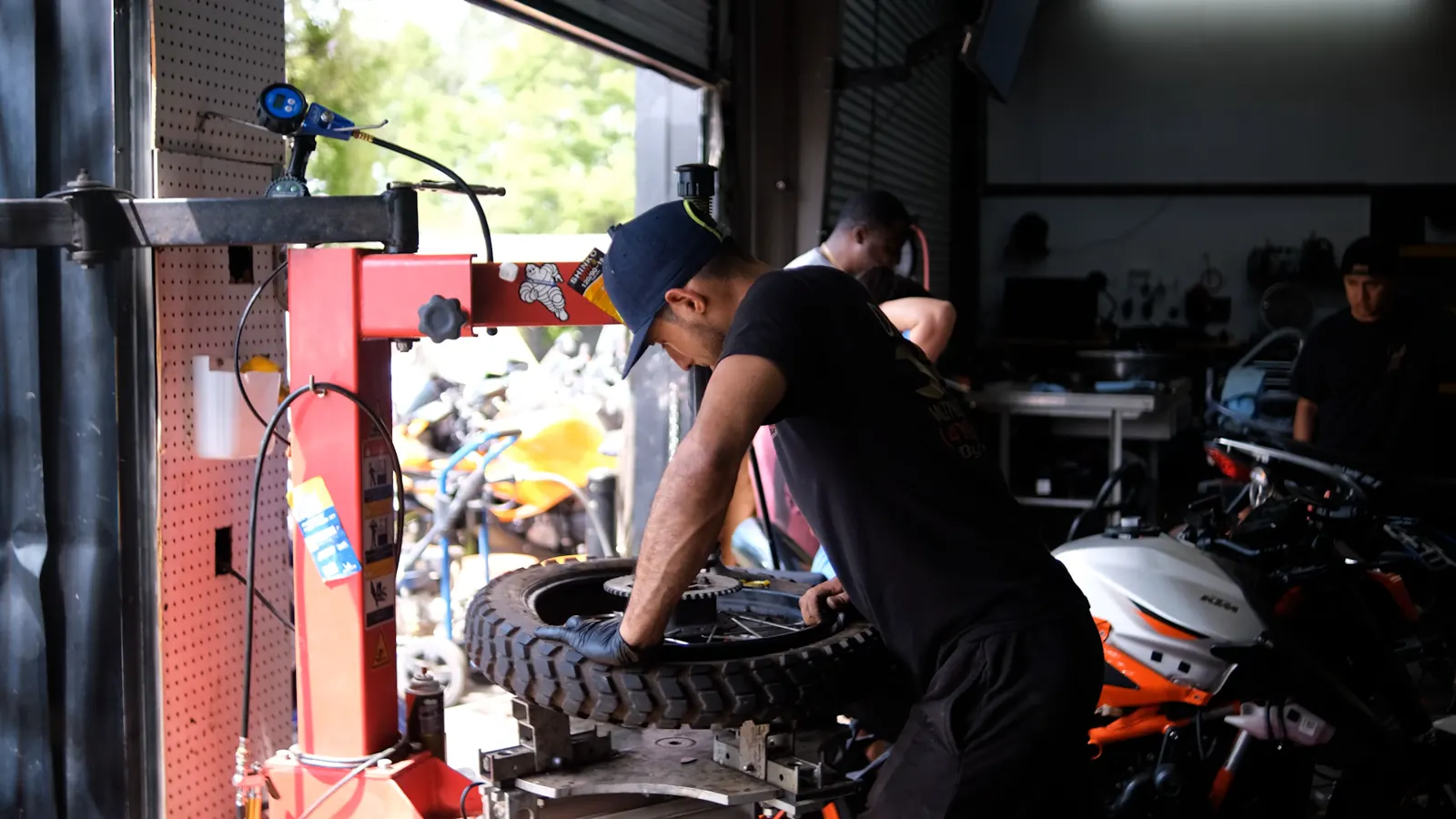
Think about a naked standard bike with a bare frame. The thing you need to reach is often right there. Now think about a full-fairing sportbike or a loaded touring bagger. Before anyone touches the part, someone removes panels, bags, trim, and sometimes the tank, and every clip gets handled so it doesn’t snap. Then it all goes back on, aligned, with nothing rattling. That’s real time, and it happens on both ends of the job.
European premium bikes over-index around here, and they often want specific tools and specific torque procedures. That’s not a knock on them at all — they’re wonderful machines, and they reward being done right. It just means the same repair on a Multistrada and a bare-bones standard are honestly different jobs. You can see the work we do in house if you want the full picture of what stays under one roof.
Parts are the easy half. Getting to the part is where the real difference lives.
How long it takes, and when to book it
Simple maintenance is usually same day or next day. Diagnosis plus repair depends on parts, and parts depend on how common your bike is. A current-model Japanese sportbike is easy. Meanwhile, a 1990s bike with a discontinued part number can mean a real hunt, which is exactly the kind of work that has no local home around here.
Timing matters seasonally too. February through April is the spring wake-up, when everyone remembers their battery, their stale fuel, their tires, their brake fluid, their chain and their fork seals all in the same week. Since RideNow Canton and Mountain Motorsports get slammed in that window, so does everyone else. That’s why we tell friends to handle known items in January if they can. Of course, if you’re already in April, we’d still rather see it now than in June.
Why Woodstock bikes wear the way they do
Woodstock is the most motorcycle-serious town we serve, and it’s the closest one to real riding. I-575 is the on-ramp to the north Georgia mountains, and GA 515, the Appalachian Highway, carries riders north beyond Canton into the good stuff. An hour to an hour and a half gets you to roads like GA 52 past Fort Mountain State Park, where the Cohutta Overlook opens up a mountain horizon and the curves stay mellow enough to actually enjoy.
That riding profile creates a very specific wear pattern. Georgia has a universal helmet law, and lane splitting and filtering are illegal, so nobody’s commuting south on I-575 for fun. Instead, bikes here sit still for stretches and then take hard mountain miles all at once. Idle weeks age fuel, batteries and tires, while concentrated mountain days hammer brakes, chains, suspension and cooling. That’s why a Woodstock bike can look barely used and still need real attention.
Roads add their own chapter. Growth means construction, so gravel and mud get tracked onto pavement along Ridgewalk, Towne Lake Parkway and the SR 92 corridor. Rural-to-suburban roads like Wiley Bridge, Trickum and Neese still carry country geometry with blind crests, off-camber curves, gravel driveways and deer. Up north, corners collect washed-in gravel, fall brings leaves and pine straw, shaded pavement stays damp, and rockfall shows up on GA 60 and SR 180. None of that is scary — it’s just information, and it explains tire, brake and suspension wear better than anything else.
Storage here is the best in our whole radius, honestly. The 1990s master-planned wave built garages as standard, and Towne Lake alone covers nearly 5,700 single-family homes, making it one of the largest planned communities in Cherokee County. Towne Lake Hills adds about 875 homes west of I-575, built between 1993 and 2002 with golf, swim and tennis. Meanwhile, the Cottages at Towne Lake, the Courtyards at Towne Lake and the Cottages of Woodstock give downsizers cottage-style, low-maintenance living. Plenty of those garages have a workbench, a trickle charger and an owner who handles basics and hires out the specialist work.
Here's how this played out for someone over by Downtown Woodstock
A friend we’ve helped lives close enough to walk into Downtown Woodstock, which is one of metro Atlanta’s most successful downtown revitalizations and a genuinely walkable dining and entertainment district. His bike had a faint chirp on deceleration. It wasn’t loud, and it didn’t ruin anything, so he rode it that way through two mountain trips.
By the time it landed on our lift, the chain had stretched past adjustment and the sprocket teeth had hooked over. As a result, a chain-and-sprocket job also became a cleanup of everything the loose chain had been slapping. He wasn’t careless at all — the bike just never got loud enough to demand attention. Still, that’s the whole lesson: small noises are cheap to answer and expensive to ignore.
The happy ending is that he rides it hard now and it’s quiet as a library. He also texts us the second something sounds new, which we love, even when the answer is that his bike is fine and he should go ride it. If you want the same breakdown for our home city, here’s how this plays out in Marietta.
Why an honest shop won't quote it sight-unseen
Real talk: anyone who pins down a motorcycle repair cost Woodstock riders should trust without seeing the bike is guessing, and a guess only goes two ways. Either it’s padded so it can’t lose, or it’s low and the conversation gets awkward later. Neither one helps you. That’s why we look first and talk second.
Three things move every job, and none of them are visible over a phone. First, the actual cause, since the same symptom has several possible sources. Second, the access, because bodywork and packaging vary wildly. Third, what we find once we’re in there, and there’s usually something, even if it’s small. So we tell you what we found, what it needs, and what can wait, then you decide.
Riders here research hard before they call, and we respect that completely. Woodstock has more motorcycle businesses than any city in our radius, but nearly all of them are narrowly scoped. Traxxion Dynamics at 261 Rope Mill Parkway is a nationally known suspension manufacturer, and that expertise raises the technical literacy of the whole local riding scene. Kotic Kustoms on Bells Ferry Road does in-city custom builds and Harley-Davidson modifications, and they’re open weekends. All good outfits. Even so, a full-service, all-brands, all-ages independent that also handles restoration, custom paint and engine tuning is a different thing entirely.
Getting the bike to us, and what happens after
From Woodstock we’re roughly 15 to 19 miles away, and figure somewhere around 25 to 35 minutes as a rough estimate based on the roads, not a stopwatch. The usual route is I-575 south to I-75 south, then east on Roswell Road to Barnes Mill Road. If you’d rather stay off the interstate, Bells Ferry Road south into north Cobb works fine too and it’s a nicer ride.
After the work is done, the goal is simple: you stop thinking about the bike. No listening for the noise. No wondering if the front end will misbehave on a damp mountain corner. Just a machine that does what you ask, every time, so you can point it up GA 515 on a Saturday and not think about anything but the road.
Because so many bikes here are 1990s and 2000s machines that quietly stopped running, we also get asked about bringing one back rather than just fixing it. That’s a different conversation with a different scope, and we broke down what that service actually involves separately. If you’re newer to riding or getting licensed, Georgia Class M licensing lays out the state’s requirements, and IIHS motorcycle research is a solid place to read up on gear and safety data.
THE TAKEAWAY
You can’t control parts prices, but you absolutely control timing. Answer small noises early, book before the spring rush, and most jobs stay small.
Questions Woodstock riders ask us
What's actually included when you say you'll repair something?
It includes the diagnosis, the access work to reach the part, the repair itself, and a road test afterward. We also check the systems right next to whatever we fixed, since they usually wear together. Then we tell you what we found and what we recommend as two separate lists, so you decide what happens now.
How long will my bike be at the shop?
Basic maintenance is often same day or next day. Bigger repairs depend mostly on parts availability, so a common current-model bike moves fast while an older or discontinued part can take longer. We’ll give you a realistic timeline once we’ve seen it, and we’ll update you if anything changes.
Why is labor sometimes a bigger part of the job than the parts?
Because getting to the part takes real time on many bikes. A full-fairing sportbike or a loaded touring bagger needs panels, bags and trim removed first, and then it all goes back on properly. On a bare naked bike, that same repair might be nearly out in the open. Same problem, very different amount of hands-on work.
Does the type of bike change the work?
Yes, quite a bit. Sport-touring and adventure bikes, premium touring baggers, modern sportbikes and European brands all package things differently, and some want specific tools or torque procedures. We work on all brands and all ages, so the bike type changes the approach rather than whether we can help.
What happens if you find something else while you're in there?
We stop and call you before doing anything extra. You’ll hear what we found, whether it’s safety-related or just wear, and whether it can safely wait. Nothing gets added without your okay, because surprises belong in birthday parties and not in repair orders.
Can you give me a number over the phone?
We can talk through what’s likely and what drives the work, but a firm answer needs eyes on the bike. The same symptom can have several causes, and access varies a lot between models. Once we’ve looked, you’ll get a clear picture with no guessing on either side.
We take care of riders all over the north metro, starting with Woodstock and Towne Lake and reaching up through Holly Springs, Canton and Ball Ground in Cherokee County. Heading south and west, we work with folks in Acworth, Kennesaw, Cartersville and of course Marietta, where the shop sits. On the east side we see plenty of bikes from East Cobb, Roswell, Alpharetta and Milton too. Whether you come down I-575 to I-75 or take the surface route along Bells Ferry Road, it’s an easy trip, and a lot of riders make a pleasant morning out of it.
BRING IT IN BEFORE IT GETS LOUDER
If your bike is making a noise you’ve started ignoring, let’s take a look while it’s still a small job. Tell us what it does and when it started, and we’ll walk you through what we find in plain language before anything gets touched. Woodstock riders are an easy run down I-575, and we’d rather see you in January than in the middle of the spring rush.
470-460-9883Diaz Motorcycles and Service, LLC · 847 Barnes Mill Road, Marietta, GA 30062