Dyno Tune vs Stock Kennesaw — The Real Answer
One rider brought us a quote that didn't sit right. Here's the honest way to decide.
Plus, a rider came down from Kennesaw last spring with a folded quote riding around in his tank bag. Of course, somebody had promised him a specific power gain on a bike that was, in his own words, running fine. Then again, he didn’t know what he was buying. Even so, he just knew the promise felt a little too clean. Meanwhile, that’s the honest starting place for most people weighing a dyno tune vs stock Kennesaw riders talk about all summer, and it deserves a straight answer instead of a sales pitch.
In fact, that said, Nobody had asked him what he’d changed on the bike, or how he rides, or what the engine does in the midrange where he spends his time. A quote written before anyone looks at your bike is a guess wearing a nice shirt. We’d rather start with a question.
So here’s ours. For example, Do you want more power, or do you want your bike to stop doing that one annoying thing it does? Those are two different jobs. After that, the answer decides everything that follows, and it’s usually the second one.
First, what "stock" actually means
Stock isn’t an insult. What’s more, it’s a compromise, and a pretty impressive one. So and Better yet, your bike left the factory with a single fuel map that had to work in desert heat and northern cold, at sea level and up in the mountains, on whatever fuel the corner station happens to be pumping, while passing emissions rules in a dozen countries at once.
Still, that map is safe, legal, and deliberately conservative. Plus, it was written for every bike of your model on earth. Of course, it was not written for yours, or your exhaust, or the Georgia summer you’re riding in right now.
For plenty of riders, that compromise is completely fine. A stock bike ridden stock does exactly what the brochure said it would. Friends we’ve helped over in Summerbrooke commute the same untouched bike year after year and never need more than fluids, tires, and a chain that gets some love. That’s a win. Keep it that way.
Why a bike runs lean or rich, in plain words
An engine wants a certain balance of air and fuel. Too little fuel for the air coming in, and it’s running lean. Too much fuel, and it’s running rich. That’s the whole vocabulary. Everything else is detail.
Lean tends to run hot. It pops on decel, feels snatchy when you crack the throttle open, and cooks your right leg in traffic. Rich feels soft and lazy, smells strong at a light, and gums things up over time. Neither is a disaster. Both are annoying every ride.
Factory bikes usually run lean in specific spots on purpose, because that’s how they clear emissions testing. You feel those spots as a flat patch at a certain rpm, or a surge when you’re holding steady throttle down a long straight. Then riders change things. A slip-on here, a freer-flowing filter there, a sprocket swap for better roll-on.
More air goes in, but the computer has no idea. Your ECU isn’t psychic. It doesn’t know you spent Saturday in the garage with a socket set and a browser tab open, and it keeps feeding fuel like the old pipe is still bolted on.
What a dyno actually measures
A dyno is a heavy roller that your rear wheel spins. Sensors read how hard the wheel pushes that roller and how fast it’s turning, and quick math turns that into torque and horsepower across your rev range. Meanwhile a probe in your exhaust reads the real air-fuel mix at every point in the sweep.
The peak number at the top of the chart is what people brag about. The shape of the line underneath it is what you actually feel. A dip at a certain rpm is that flat spot you’ve been living with. A jagged air-fuel trace is the surge on the highway. We read the whole picture, not one bragging figure, and that’s the part a quote over the phone can never give you.
How we diagnose before we touch anything
Nothing gets changed until we know what the bike is doing today. That baseline is the whole point, and it’s also the part that protects you from paying for a fix you don’t need.
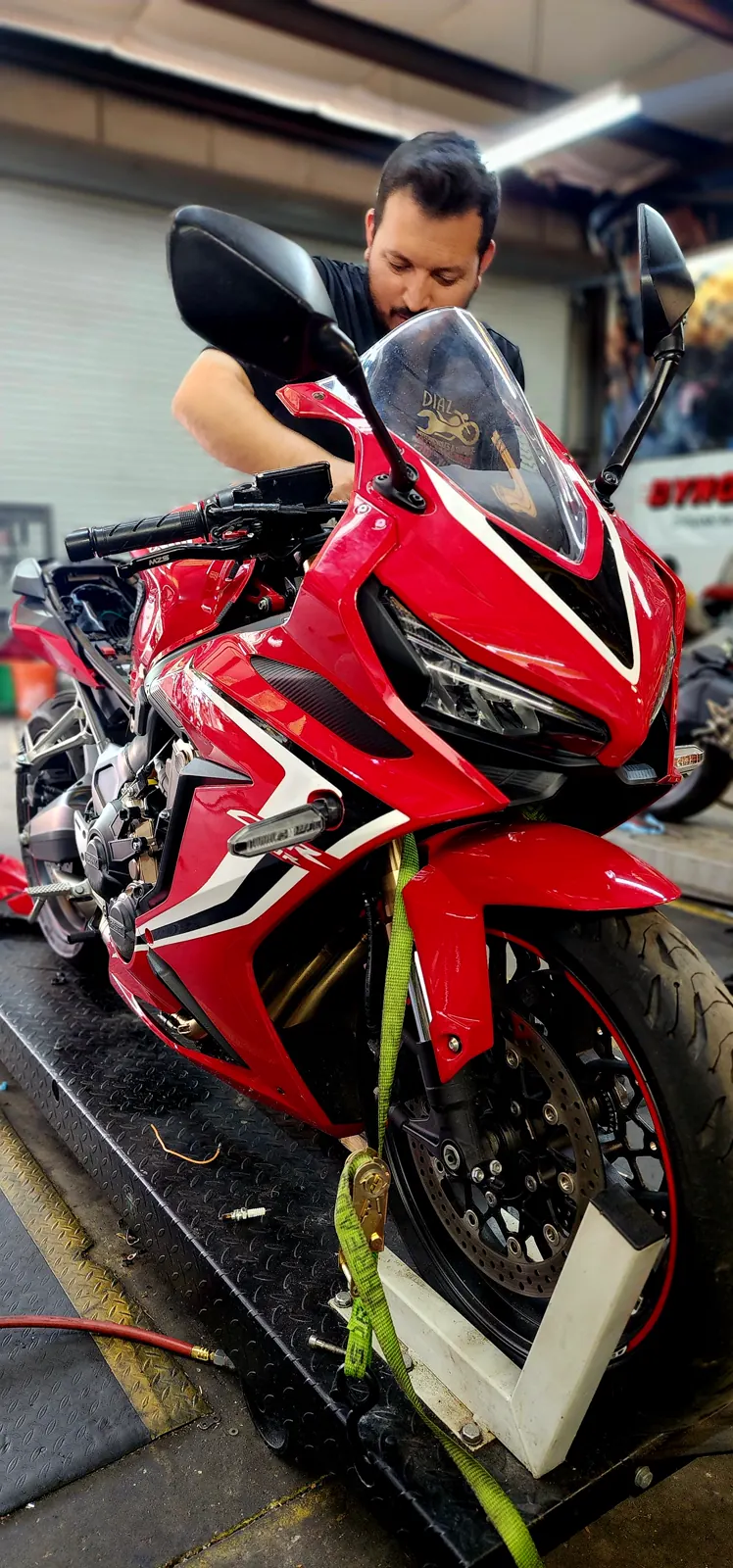
- We strap the bike down and run baseline pulls, so there’s a real before picture with your name on it.
- Still, we log the air-fuel mix through the entire rev range, not just at redline.
- We look at what’s already bolted on — intake, exhaust, gearing, anything the last owner did.
- We ask how you ride and where the bike annoys you, because your seat is a better sensor than you think.
- Then we tell you honestly whether a tune is the answer or whether something else is.
Some days the honest answer is that your bike doesn’t need tuning at all. It needs a valve check that’s overdue, or an air filter that ate half of March, or a chain adjusted so it isn’t tight as a bowstring. Pollen season here runs from late February into May, and it packs filters and radiator fins full of yellow. A choked filter can fake a fueling problem convincingly.
A tune fixes fueling. It doesn't fix maintenance you've been putting off.
There's a version of this that's cheap and a version that isn't
This is where most riders get confused, and it’s not their fault, because both things get called the same word. One is a canned map. The other is a custom tune. They are not close cousins.
A canned map is a file written for a bike like yours, usually with a common exhaust and filter combination. It gets loaded in, and it often does help. It’s quick, it’s inexpensive, and for a lightly modified bike it can be a genuinely smart choice. But it’s an average of many bikes, and your bike is not an average. It has its own compression, its own wear, and its own hardware.
A custom tune is written while your bike is on the rollers. We change a value, run it again, measure again, and repeat until the air-fuel line is where it should be everywhere you ride, not just at wide-open throttle. That repetition is the labor, and it’s worth understanding what that service actually involves before you compare two quotes side by side.
Because of that, the two options land in very different places, and we’d rather you see how the work adds up up front than be surprised later. Transparent beats cheap every time.
What a tune actually changes in how the bike feels
Riders expect a shove in the back. What they usually notice first is much less dramatic and much more useful.
- Cleaner pickup right off idle, so pulling out of a driveway stops feeling like a coin flip
- The flat spot in the midrange smooths out and stops interrupting you
- Less popping and snapping on a closed throttle coming down a hill
- Cooler running in slow traffic, which your legs notice in July
- Steady cruise without the little surge that makes your wrist tired
- Fueling that finally matches the pipe and filter you already paid for
That’s the honest list. A tune won’t rescue tired tires, a dragging brake, or suspension that gave up two owners ago. It makes the engine do what your right hand asks. Everything else is still everything else, and good rubber matters more than people admit, which is why Michelin’s motorcycle tire resources are worth a read before you chase power.
Flash the ECU, or add a Power Commander?
Both get you a corrected fuel map. They just take different roads. An ECU flash rewrites the factory brain directly, so there’s no extra box on the bike, no extra wiring, and your dash keeps working the way it always did. On many bikes it also lets us touch things a piggyback can’t reach.
A Power Commander sits between the ECU and the injectors and adjusts the signal on its way through. When a factory computer is locked down tight, that’s the practical path. It’s also easy to remove, which some riders like when a bike is still under warranty or headed for resale.
Our default lean is a flash when your bike allows it, and a piggyback when it doesn’t. That’s not a preference so much as a coin toss the manufacturer already made for us. You can see what happens in our bays for either path.
So, dyno tune vs stock? Here's our call
We promised a recommendation instead of a shrug. The dyno tune vs stock Kennesaw question really comes down to what you’ve already changed, so here it is in a table you can scan in ten seconds.
| If this is you | Our honest call |
|---|---|
| Completely stock bike, ridden stock, no complaints | Stay stock. Spend it on tires and a riding day instead. |
| Slip-on, full exhaust, freer filter, or gearing change | Tune it. You already paid for the parts; finish the job. |
| Stock bike with a flat spot, surge, or heat that bugs you daily | Tune it. This is exactly what a tune fixes. |
| Brand-new bike still inside a warranty you care about | Talk to us first. Often a piggyback or nothing at all. |
| First season riding, still building throttle control | Stay stock a while. Smoothness comes before power. |
| Bike you're selling in a month | Stay stock. The next owner should make that call. |
Notice how many rows say stay stock. That’s not modesty. Tuning a bike that doesn’t need it is how shops earn one visit and lose a customer, and we’d rather have you for the next ten years.
Something worth knowing before you book anywhere
Not everything sold as a dyno tune involves a dyno. Some of it is a file loaded in a parking lot. So ask three plain questions before you hand over keys anywhere: how many pulls does this include, do you log the air-fuel mix after the changes, and do I get my before and after sheets to keep?
A shop that tunes properly will answer all three without flinching. If you want more background before you ask, RevZilla’s Common Tread writes about this stuff for regular riders, not engineers. And the same math plays out everywhere, so it’s useful to see how this plays out in Marietta too.
Why this question hits differently in Kennesaw
Kennesaw riders get a gift most of Cobb doesn’t. I-575 splits off I-75 just south of town and runs straight toward Woodstock and Canton, which puts you on the on-ramp to north Georgia riding while everyone in south Cobb is still crawling. Lake Allatoona and Red Top Mountain sit roughly twenty minutes north, and a documented route of about fifty-three miles runs from Emerson toward Canton with sweepers, tight sections, and real elevation change.
Elevation is the part people forget. Air gets thinner as you climb, so a bike that felt acceptable on flat ground can hesitate on a hill it never met before. Those roads expose fueling problems that Barrett Parkway traffic hides, and they’re the reason so many tuning conversations start on a Monday after a good Sunday.
The rest of the week looks different. Baggers and touring bikes fill garages around Pinetree Country Club, where big lots and an eighteen-hole course make for the kind of neighborhood that stores a bike properly and rides it far. Downtown Historic Kennesaw pulls short trips instead, with Main Street’s restored storefronts, the restaurants, and the farmers market running April through September. Add quick errands over to the Kennesaw Aquatic Center and Adams Park, and you get a lot of heat-soaked, low-speed miles where a lean map is at its most obnoxious.
Service options in town are thin for how many bikes are here. Mountain Motorsports on Cobb Parkway is the city’s dealer, and it’s closed Sunday and Monday, so specialized work already tends to leave Kennesaw. We’re eleven to fourteen miles away, roughly twenty-two to thirty minutes down I-575 and I-75 to Roswell Road, or east on Barrett Parkway to Sandy Plains.
What it feels like when it's right
Here’s the outcome nobody puts on a flyer. A properly tuned bike feels ordinary in the best possible way. The throttle does what your wrist meant. The engine stops arguing at the rpm you use most. You stop planning around a flat spot without realizing you’d been planning around it for two years.
That rider with the folded quote? We ran his baseline, showed him the chart, and told him his bike was mostly fine, but his midrange was lean because of the pipe the previous owner installed. He got that fixed and nothing else. He didn’t get the big number from the quote, and he didn’t want it once he understood what he was actually feeling.
THE SHORT VERSION
Stock and untouched? Ride it and enjoy it. Modified, or living with a flat spot that bugs you every day? Tune it. Not sure which one you are? Text us and describe how it feels — that’s a free conversation, not a sales call.
That’s the whole answer. No hedging, no upsell, and no promise made before we’ve seen your bike. Bring it down, and we’ll tell you the truth either way.
Questions Kennesaw riders ask us
Does my bike change the answer?
It changes it a lot. Locked-down ECUs on some models push us toward a piggyback, while others flash cleanly. Older carbureted bikes get jetting instead of a map. Tell us the year, make, and model and we’ll tell you which path yours takes.
Is the upgrade actually worth it if my bike is stock?
Sometimes yes, sometimes no. If your stock bike has a flat spot, decel popping, or runs hot in traffic, a tune fixes the thing that annoys you daily. If it feels great already, save your money for tires and a trip up I-575.
Which one should I pick if I've only added a slip-on?
Tune it. A slip-on changes how much air moves through the engine, and the factory map doesn’t know. That’s the most common half-finished job we see, and it’s a quick one to complete.
What's the real difference between a canned map and a custom tune?
A canned map is written for a bike like yours and loaded in without measuring anything. A custom tune is written on the dyno with your bike’s own air-fuel data. The canned version is faster and cheaper; the custom version is the one that fits.
Which lasts longer, a stock map or a tune?
Both last indefinitely if nothing else changes. A tune only needs revisiting when you change hardware again, like a new exhaust or filter. Good tuning is a one-time job, not a subscription.
Will a tune hurt my engine?
A correct one usually helps, since most tunes richen the lean spots that made things run hot. The risk lives with careless tuning that chases a peak number. That’s why we log the air-fuel mix everywhere, not just at the top.
We take care of riders across Cobb County and up into the north Georgia foothills. Kennesaw is a short run down I-575 or east across Barrett Parkway, and we see plenty of bikes from Marietta and East Cobb every week. Acworth, Woodstock, and Canton riders come through on their way back from Allatoona, while Powder Springs, Hiram, and Dallas riders take the western route in. Smyrna and Mableton sit south of us on an easy morning ride, and Cartersville and Emerson round out the northwest side. Every brand goes in the same bays, so a mixed garage only needs one phone number.
TEXT US AND DESCRIBE THE FEEL
If your bike does something you can’t quite explain, that’s the perfect message to send. Tell us what you ride, what’s been changed, and where in the rev range it bugs you, and we’ll tell you straight whether a tune is the fix or whether something simpler is. Kennesaw is about a half hour away, we work on every make under one roof, and we’d rather talk you out of a job you don’t need than sell you one you won’t feel.
470-460-9883Diaz Motorcycles and Service, LLC · 847 Barnes Mill Road, Marietta, GA 30062