Motorcycle Chrome Pitting Atlanta — How to Fix It
You bought the shiniest bike you've ever owned. Here's how to keep it that way.
Meanwhile, your first cruiser is a different animal. You came off a sportbike, or maybe a naked commuter, and now there’s more chrome on the handlebars than you used to have on the whole bike. In the driveway it looks unreal. Then one morning you crouch down close and spot a cluster of little brown freckles creeping across the exhaust, and your stomach drops. Of course, those dots have a name, and if you typed motorcycle chrome pitting Atlanta into your phone this morning, you landed in exactly the right place.
In fact, here’s the good news right up front: those freckles are a problem with a fix. For example, you didn’t ruin anything, and you’re not a bad owner. Even so, Chrome is just a picky finish, and a bike this shiny comes with habits you’re still learning. So let’s walk through what you’re actually seeing, why it happens here, and what it takes to get that clean reflection back.
What you're actually seeing
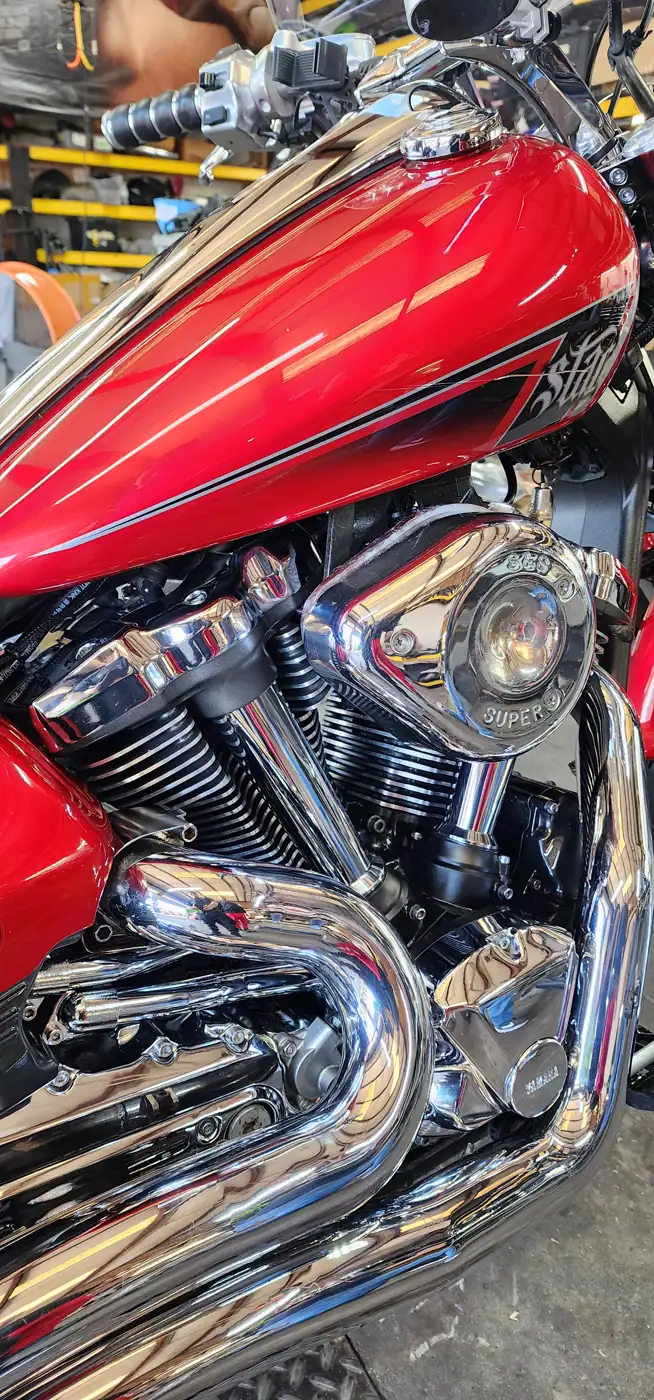
Pitting starts small. At first it looks like the chrome got dirty in one spot and won’t wipe clean. You hit it with a rag, maybe a little polish, and the dots stay put. Now run a fingernail across them. You’ll feel it — the surface catches instead of gliding. That rough patch is the tell. Healthy chrome feels like glass and throws back a clean mirror image, while pitted chrome scatters the light, so the reflection breaks up into a dull, speckled haze.
Left alone, those pinpricks grow. Each pit is a tiny hole in the chrome layer, and once moisture slips underneath, rust starts working sideways beneath the surface. The dots turn orange. Then they spread. Then the chrome around them starts to flake. Catch it early and it’s cosmetic; catch it late and you’re into real repair territory. So the fact that you noticed it now genuinely works in your favor. Most riders drive past the early stage for weeks without looking, which is why the freckle stage is such a lucky place to land.
Why Atlanta is hard on chrome
Georgia weather is the main villain here, and humidity leads the pack. Warm, wet air sits on metal all summer long and hands rust everything it needs. Then spring arrives with pollen thick enough to paint the whole city yellow — and that dust isn’t harmless. It clings to a warm tank and exhaust, holds moisture against the finish, and turns mildly acidic when it gets damp, nibbling at chrome and paint alike. Put it all together, and motorcycle chrome pitting Atlanta owners run into is, more than anything, a moisture story.
A few things drive it harder than the rest. Here’s the short list, most common first:
- Humidity and hard water. Wash the bike, let it air-dry in the sun, and mineral-heavy water leaves spots. Those spots trap moisture and kick off the pitting cycle.
- Pollen and road grime. Our record pollen loads bond to hot metal, and if they sit for weeks, they eat into the shine.
- Winter road treatment. The salt and brine that crews lay down on cold mornings is brutal on chrome, and it clings to the underside of pipes where you never think to look.
- Stone chips. A rock kicks up, dings the chrome, and exposes the raw metal underneath. Rust starts right there and works outward.
- Age and cheap re-chrome. Older plating, or a bargain re-chrome job, wears thin and lets moisture pass straight through.
Where you park matters too. Plenty of in-town riders keep a bike on a condo deck or in a detached garage built back in the 1940s, with no room to work and no outlet for a battery tender, let alone a proper wipe-down after a wet ride. Picture a bike tucked in a damp shed in Reynoldstown — the old neighborhood settled after the Civil War by railroad workers, barely two miles from Downtown. That bike sees far more standing humidity than one in a sealed, climate-controlled bay. Same machine, very different odds.
The options for fixing it
There’s a version of this that’s cheap and a version that isn’t. The cheap version is what you can try in the driveway on light, early pitting. Plus, the other version is a real repair, and it’s the honest answer once rust has taken hold. Figuring out which camp your chrome falls into is the whole game.
For fresh surface pitting, a careful hand can do a lot. You clean the area, work it with a chrome-safe polish and some fine metal work, then seal it so moisture stays out. That won’t erase deep pits, but it stops the spread and brings back most of the shine. If you’re weighing a sealant against a wax to lock things in afterward, we broke down the tradeoffs between them so you can pick the right one for how you actually ride.
Deep pitting is a different story. Once rust has undercut the chrome and it’s flaking, no polish saves it — the part has to be stripped and re-plated, or replaced. That’s more involved, and it’s not a driveway job. This is also where the gap between a wash and a real detail shows up. A wash makes a dirty bike clean; a proper detail corrects the finish and then protects it. You can see what our team handles when a bike comes in for the full treatment.
How we decide what your chrome needs
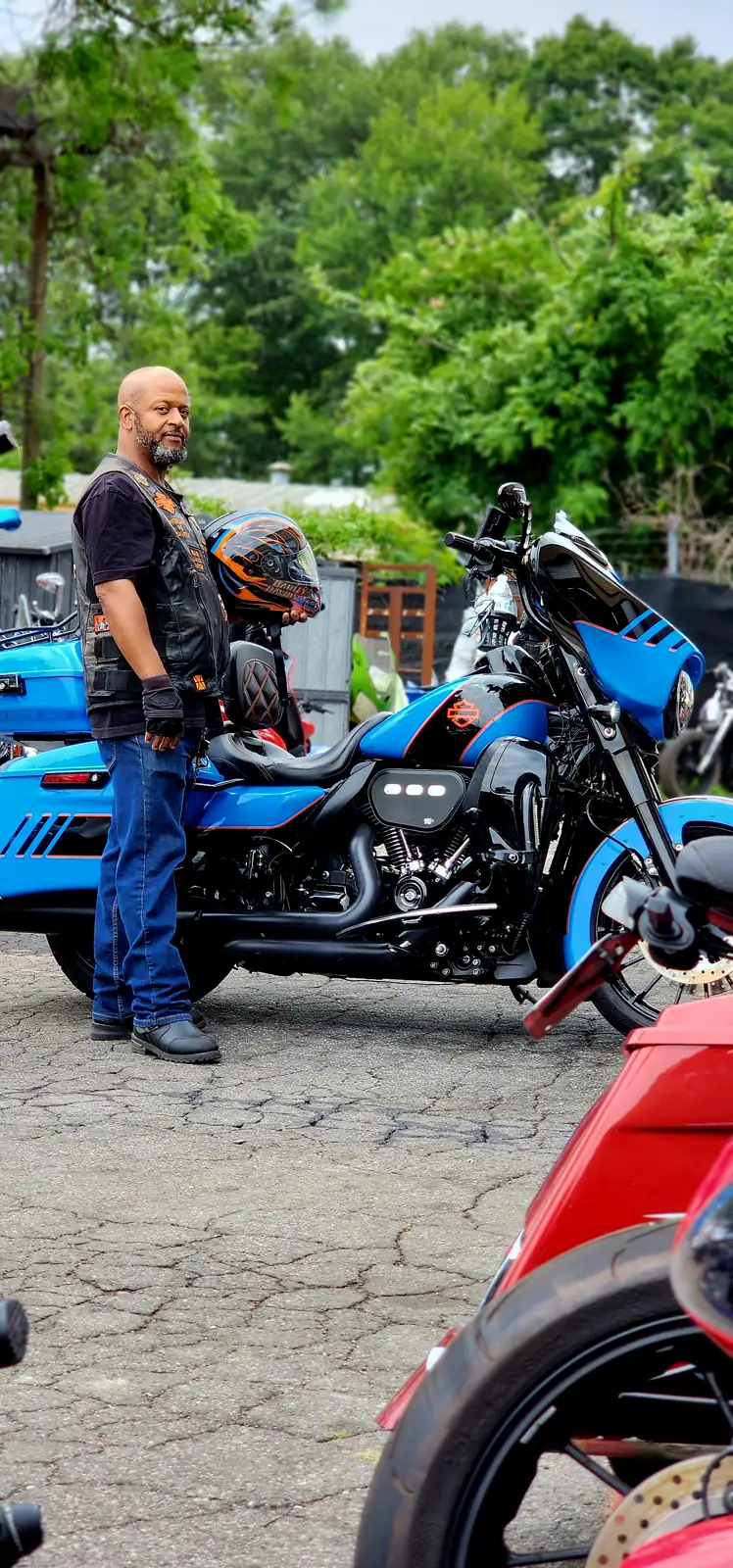
Before we touch anything, we get eyes on the metal in good light and feel every panel by hand. We’re checking how deep the pits go, whether rust has crept under the plating, and which parts are purely decorative versus which ones do a job. A pitted horn cover is one conversation. A pitted fork tube is a completely different one. Good light also shows us the difference between a stain that lifts and a pit that’s already through the plating, which the naked eye misses in a dim garage. That inspection decides everything that comes after it.
We’ll also tell you straight if it’s not worth chasing. Sometimes light pitting on a well-used bike is fine to seal and ride, and a full re-chrome would just be spending on shine you’ll never notice at arm’s length. Riders up the road deal with the same call, and we walked through how this plays out in Sandy Springs if you’d like to see the same decision made on a different bike.
While your bike is on the bench, we’ll flag anything else we spot. A pitting problem sometimes rides in next to a tuning question or a worn part, and it’s easier to sort it all in one visit than to make two trips. If you’ve ever wondered whether a dyno tune beats leaving a bike stock, we explained what that service actually involves in plain terms.
Choosing where to send it
Something worth knowing before you book anywhere: most of the metro’s service capacity sits out past the perimeter. Big chains like Mountain Motorsports run shops in Marietta, Roswell, Buford, Conyers and Lithia Springs, which is handy if you already live out that way. For a rider planted in the middle of the city, though, hauling a bike across town for a finish job is a hassle before the real work even begins.
That’s the gap we like to close. We pick up and deliver, so a bike sitting on a Midtown deck or in a Grant Park garage — the leafy old district of Victorian mansions and craftsman bungalows that shares part of its eastern edge with the Eastside BeltLine Trail and wraps around Zoo Atlanta — doesn’t have to move under its own power to get looked at. You text us, we come get it. That turns an “I can’t right now” into a simple “when.”
Is it safe to ride with pitted chrome?
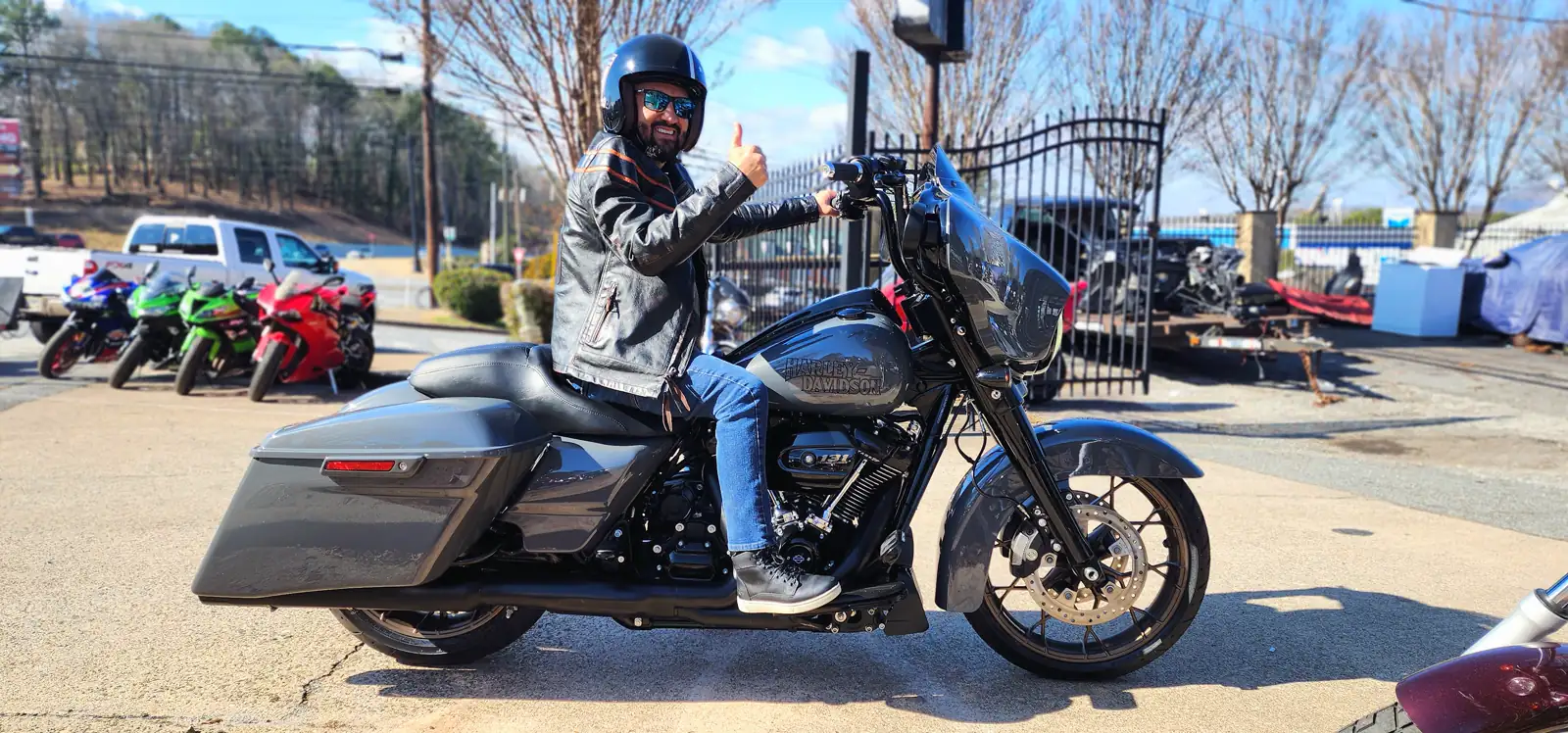
Most of the time, yes. When the pitting sits on decorative chrome — pipes, covers, mirrors, bars — it’s a looks problem, not a safety one. Ride the bike, enjoy it, and get the finish sorted whenever it’s convenient. Cosmetic rust doesn’t care one bit how the machine handles.
There’s a line, though, and it matters. Once rust reaches parts that do a job, get it checked before you ride hard. Pitted fork tubes can tear seals and start leaking. Corrosion creeping onto a brake rotor becomes a stopping-power question, not a beauty one. If you’re unsure whether a spot is cosmetic or structural, treat it as structural until someone confirms otherwise — and keep your tires in that same thought, since braking and grip work together. Michelin keeps solid plain-English guides in Michelin’s motorcycle tire resources, and road conditions across the state get tracked by Georgia DOT.
City streets add their own wear on top of all that. In-town pavement chews through fork seals and bearings faster than smooth suburban roads, and every rough patch shakes loose grime that grinds against your finish. A bike that lives on a hard urban surface simply earns its detailing sooner than one that spends its life on fresh asphalt.
What it feels like after
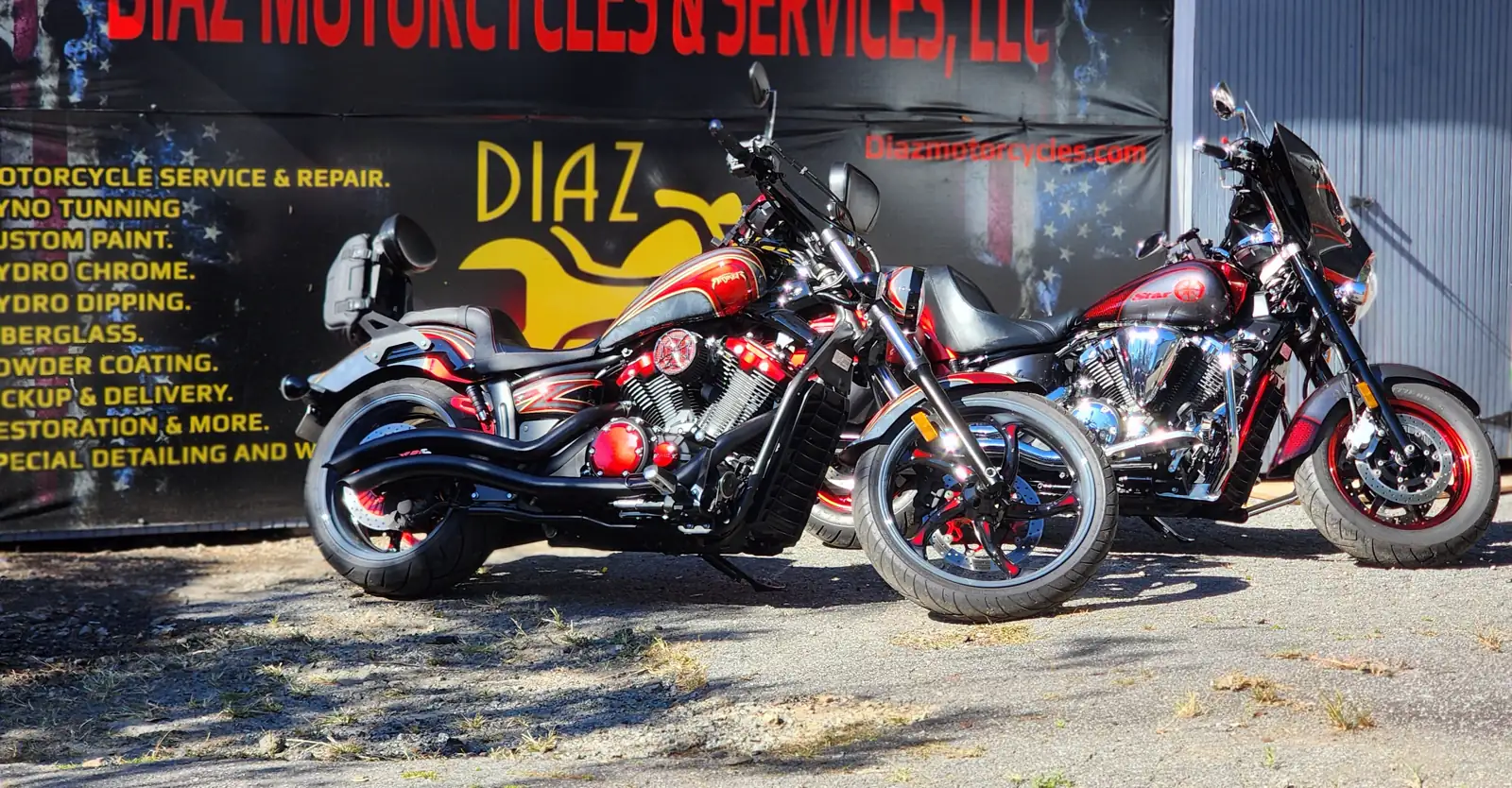
Here’s the part that makes the work worth it. When pitting is cleaned up and the chrome is sealed, the reflection snaps right back. You crouch down and see your own face in the pipe again, sharp and clear. Then you run a hand along a freshly coated tank, and it feels slick, almost wet, like water beads and rolls off before it can even settle. The whole bike reads deeper, richer, more expensive than it did a week ago. People at the pump start asking what you did to it, and the honest answer is that you just stopped a small problem from becoming a big one.
That payoff isn’t only vanity, either. A protected finish sheds pollen and water instead of holding onto it, so the next wash is easier and the pitting stays gone. A bike parked near Tuxedo Park, the Buckhead estate district around the Governor’s Mansion, tends to get shown off — and a mirror-clean cruiser sitting at a stoplight on Marietta Street reads exactly the way its owner wants it to.
Over in West Midtown, the crowd around the Westside Provisions District on Howell Mill Road runs to cafe racers and vintage builds, where a flawless finish is half the point of the bike. Roll one of those down 14th Street and every pit shows in the sun. Riders also love shooting their bikes at the Krog Street Tunnel, the graffiti-covered underpass between Cabbagetown and Inman Park, and a pitted pipe stands out in every single frame. That’s why the shine gets treated as part of the build, never an afterthought.
The outcome that matters
Chrome you keep clean pays you back. A bike with tight, unpitted finish holds its value and earns real looks at resale, while a neglected one gets marked down for exactly the rust you could have stopped early. Pride and resale ride together here. The friends we’ve helped who beat the motorcycle chrome pitting Atlanta throws at them are almost always the ones who acted at the freckle stage instead of waiting for the flaking one.
For riders coming from the farther corners of the metro, distance is usually the excuse to put it off. But that’s the part we’ve already solved. Whether you’re running the reverse commute up I-75 to East Cobb or parked deep inside the perimeter, we’ll come to the bike. You keep riding, and we handle the finish.
Catch it at the freckle stage and it's a cleanup. Wait for the flaking stage and it's a repair.
Questions Atlanta riders ask us
What causes motorcycle chrome pitting?
It almost always starts with moisture sitting on the metal. Humidity, hard-water spots left to dry in the sun, pollen that turns acidic when damp, winter road salt, and stone chips that expose bare metal are the usual suspects. Older or bargain re-chrome plating wears thin and lets moisture through, too.
How do you find the cause on my bike?
We look at the metal in good light and feel every panel by hand. That tells us how deep the pits go and whether rust has spread under the plating. We also sort decorative parts from the ones that do a job, because that changes both the fix and the urgency.
Could it be something other than pitting?
Sometimes, yes. Surface grime, water spots, and light oxidation can look similar but wipe or polish clean. Real pitting has texture you can feel with a fingernail. We confirm which one you’re dealing with before we ever recommend work, so you don’t pay for a repair you don’t need.
Is it safe to ride with pitted chrome?
Usually. If the pitting is on decorative chrome like pipes, covers, or mirrors, it’s a looks problem and the bike rides fine. Get it checked first if you see rust on fork tubes or anywhere near the brakes, since those affect how the bike handles and stops.
Can I fix chrome pitting myself?
For light, fresh surface pitting, a chrome-safe polish and a good sealant can stop the spread and restore most of the shine. Deep pitting that has undercut the chrome and started flaking needs stripping and re-plating, or a replacement part, which isn’t a driveway job.
How do I keep it from coming back?
Dry the bike after every wash instead of letting it air-dry, keep pollen and road salt off the finish, and seal the chrome so moisture can’t reach the metal. Storing the bike somewhere dry helps most of all. A sealed finish also makes each future wash quicker.
We keep riders shining across the whole metro. From Buckhead and Midtown down through Decatur and East Point, and out to Sandy Springs, Brookhaven, Chamblee and Tucker, we bring the same finish work to your driveway. Riders in Smyrna, Vinings, Mableton and Marietta lean on our pickup and delivery too, so distance never decides whether your chrome gets the attention it deserves.
STOP THE PITTING BEFORE IT SPREADS
Spotted brown freckles on your chrome? Text us a photo and we’ll tell you straight whether it’s a quick cleanup or a real repair. We pick up and deliver anywhere in Atlanta, so your bike gets sorted without you losing a Saturday. The sooner we catch it, the more shine we save.
470-460-9883Diaz Motorcycles and Service, LLC · 847 Barnes Mill Road, Marietta, GA 30062